

The best Amplitude alternatives for SaaS teams in 2026 are: Fairview (operating intelligence for revenue operators), Mixpanel (event-based product analytics), PostHog (open-source with autocapture + session replay), Heap (autocapture for low-engineering-overhead setups), FullStory (session replay + DX analytics), Pendo (product analytics + in-app guidance), and GA4 (free web and app analytics). Which fits your team depends on whether you need product behavior analytics or business operating intelligence.
Amplitude is one of the dominant product analytics platforms for SaaS companies. Its behavioral analytics engine — funnel analysis, retention cohorts, user journey mapping, and A/B test measurement — made it the default choice for product managers and growth teams that need to understand how users engage with their product.
But in 2026, more SaaS teams are asking: is product analytics enough? Knowing that 40% of users drop off at step three of the onboarding funnel is valuable for product teams. Knowing whether the cohort that completes onboarding generates NRR above 100% — and whether the CAC to acquire that cohort is justified by their LTV — is what operators and founders actually need to run the business.
In this guide, you will find the seven best Amplitude alternatives, segmented by who they are built for and what problem they solve.
Why Teams Look for Amplitude Alternatives
Amplitude's pricing scales with Monthly Tracked Users (MTUs). Teams with large user bases or high event volumes find costs escalating quickly above the free tier. Enterprise plans are priced via custom contract — often $50,000–$200,000+/year for larger SaaS companies.
Amplitude is built for product teams. It tracks user behavior inside the product — clicks, sessions, feature usage, conversion funnels. It does not track pipeline, NRR, subscription revenue, unit economics, or GTM performance. Revenue operators who need business intelligence rather than product intelligence hit a ceiling.
Amplitude requires deliberate event instrumentation — developers need to fire events for every user action you want to track. Non-technical teams find this creates a dependency on engineering resources for analytics setup and maintenance. Tools like Heap and PostHog address this with autocapture.
Amplitude's Notebook, Chart, and Experiment features are powerful but assume analytical sophistication. Founders and operators who need simple, decision-ready insights often find Amplitude's flexibility becomes a burden — too many options, not enough pre-built answers.
The 7 Best Amplitude Alternatives in 2026
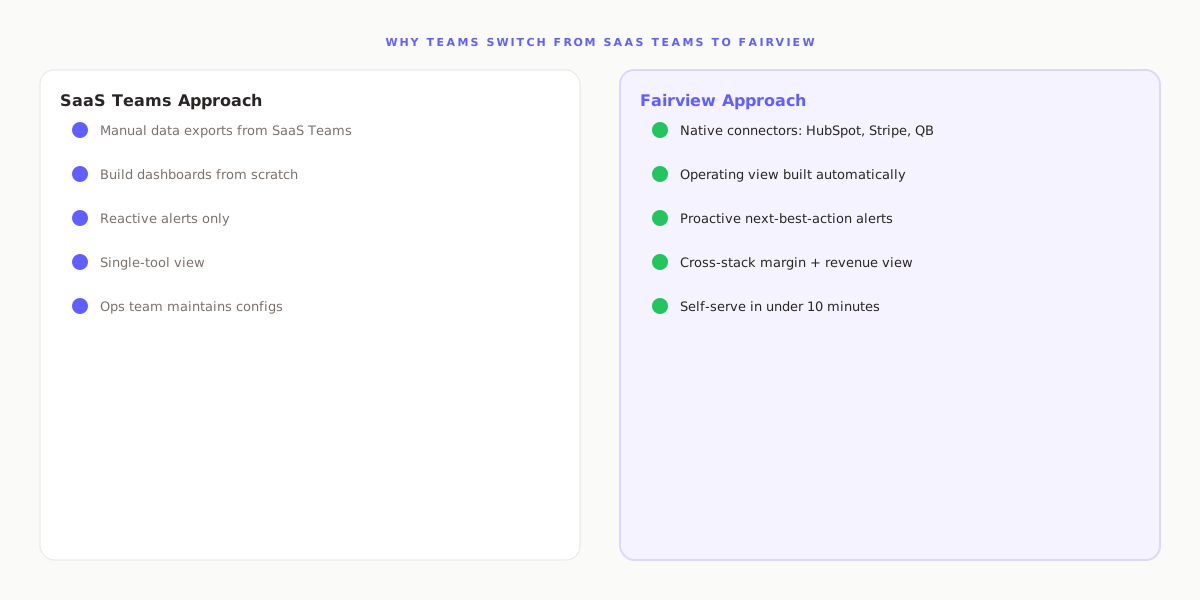
Fairview is not an Amplitude replacement in the product analytics sense — it is an adjacent tool that solves the problem that comes after product analytics: how is the business actually performing?
Where Amplitude answers "how are users engaging with the product?", Fairview answers "what is our NRR trend, where is pipeline breaking down, what is our CAC payback period, and which cohort is churning fastest?" These are operating decisions that product analytics data alone cannot drive.
For SaaS companies where the CRO, CEO, or RevOps lead is frustrated that Amplitude gives them product behavior data but not business performance data — Fairview is the operating intelligence layer that Amplitude is not designed to be. It connects Salesforce, HubSpot, Stripe, and your billing system to surface the operating intelligence that drives GTM and revenue decisions.
Best for: SaaS founders, CROs, and RevOps leads who need real-time business operating intelligence — not product usage analytics.
Mixpanel is the most direct Amplitude alternative for product analytics teams. Its event-based model, funnel analysis, retention cohorts, and A/B test measurement cover nearly identical territory to Amplitude — with a somewhat simpler data model and more predictable pricing.
The Amplitude vs. Mixpanel debate is longstanding in the SaaS analytics community. Amplitude is generally considered stronger for behavioral analysis and out-of-the-box chart quality. Mixpanel has a more intuitive event tracking model and pricing that scales more predictably for mid-market teams.
Best for: Product teams looking for a direct Amplitude alternative with similar capabilities and more predictable pricing.
Pricing: Free up to 20M events/month. Paid plans start around $20–$833/month.
PostHog is the best Amplitude alternative for engineering-led product teams that want open-source software with full data ownership. It combines product analytics (funnels, retention, user paths), session replay, feature flags, and A/B testing in a single platform — matching Amplitude's breadth while adding session replay capabilities.
PostHog's autocapture means you do not need to instrument every event manually — it captures all user interactions by default, which significantly reduces the engineering overhead compared to Amplitude. Self-hosted deployment is free with no data limits; PostHog Cloud is priced per event.
Best for: Engineering-led product teams that want open-source control, session replay, and feature flags alongside product analytics.
Pricing: Free for self-hosted. Cloud: free up to 1M events/month, then pay-per-event.
Heap's primary differentiator is autocapture: instead of requiring developers to instrument individual events, Heap captures every user interaction automatically. This means you can retroactively define events and funnels without having to re-instrument — a significant advantage for non-technical teams or product teams with limited engineering bandwidth.
The tradeoff is data volume. Autocapture generates significantly more data than deliberate event tracking, which can make Heap expensive at scale and require more work to filter signal from noise.
Best for: Product teams with limited engineering resources who want analytics without ongoing instrumentation work.
Pricing: Free tier available. Paid plans start around $3,600/year.
FullStory is a digital experience analytics platform — it captures session replays and uses them to quantify friction in user journeys. While Amplitude focuses on aggregate behavioral analytics (what percentage of users complete step X?), FullStory focuses on individual session recordings and DX signals (where are specific users frustrating?)
FullStory is most valuable for UX teams and CX teams that need to understand not just where users drop off in a funnel (Amplitude's strength) but why — by watching actual session recordings of struggling users.
Best for: UX and CX teams that need to understand why users struggle — not just where they drop off.
Pricing: Custom enterprise pricing. Free tier available for small teams.
Pendo combines product analytics with in-app messaging and user guidance — making it unique among Amplitude alternatives. While Amplitude tells you what users do, Pendo lets you act on that data without engineering work: showing in-app walkthroughs, tooltips, and announcements to specific user segments based on their behavior.
For product-led growth SaaS companies where improving onboarding completion and feature adoption is a priority, Pendo's combination of analytics + in-app action is more powerful than analytics alone.
Best for: Product-led growth SaaS companies that want to act on product analytics with in-app messaging — not just analyze behavior.
Pricing: Free tier available. Paid plans start around $7,000–$20,000+/year.
GA4 is not a direct Amplitude alternative for product analytics — it is designed for web traffic and marketing analysis, not in-product user behavior. But for teams whose primary use case is understanding website performance, acquisition channels, and basic event tracking, GA4 is free and covers a significant portion of the surface area.
GA4's event-based model and BigQuery export make it more powerful than Universal Analytics was — but it is still primarily a marketing analytics tool rather than a product analytics platform.
Best for: Teams whose primary analytics need is web traffic and marketing channel analysis — not in-product behavior.
Pricing: Free. GA4 360 (enterprise) starts around $150,000/year.
Quick Comparison: Amplitude vs Alternatives
| Tool | Primary Use Case | Autocapture | Revenue/OI | Pricing |
|---|---|---|---|---|
| Fairview | Operating intelligence | No | Yes — NRR, pipeline, unit econ | Per seat |
| Amplitude | Behavioral product analytics | No | No | Free + $49/mo+ |
| Mixpanel | Event-based product analytics | No | No | Free + $20/mo+ |
| PostHog | Open-source analytics + session replay | Yes | No | Free (self-host) / pay-per-event |
| Heap | Autocapture product analytics | Yes | No | Free + $3.6K+/yr |
| FullStory | Session replay + DX analytics | Yes | No | Custom enterprise |
| Pendo | Analytics + in-app guidance | Partial | No | Free + $7K+/yr |
| GA4 | Web and marketing analytics | Partial | No | Free |
Product Analytics vs Operating Intelligence: Choosing the Right Tool
The most important decision when evaluating Amplitude alternatives is understanding which problem you are actually solving.
Product analytics tools (Amplitude, Mixpanel, PostHog, Heap) answer: How are users engaging with the product? Where do they drop off? Which features drive retention?
Operating intelligence tools (Fairview) answer: How is the business performing? What is our NRR trend? Where is the GTM funnel breaking down? Is our CAC justified by downstream LTV?
Most SaaS companies at Series A and beyond need both. Product analytics drives the product roadmap. Operating intelligence drives the GTM and revenue strategy. These are complementary tools, not alternatives to each other.
Key Takeaways
- Amplitude alternatives divide into two categories: direct product analytics replacements (Mixpanel, PostHog, Heap) and adjacent operating intelligence tools (Fairview)
- PostHog is the best free/open-source Amplitude alternative for engineering-led teams that want full data ownership and session replay
- Heap is the best choice for teams with limited engineering bandwidth — autocapture eliminates the instrumentation overhead
- Fairview solves the adjacent problem that comes after product analytics: understanding how the business is actually performing, not just how users are engaging with the product
- Most SaaS companies at Series A and beyond need both product analytics (for product decisions) and operating intelligence (for GTM and revenue decisions)