

TL;DR
The cash conversion cycle (CCC) measures how many days it takes to convert a cash outlay into cash received from customers. The formula is DIO + DSO minus DPO. Lower is better; negative is best. For ecommerce and SaaS, zero or below is achievable. To improve CCC: reduce Days Inventory Outstanding through better forecasting and faster turnover, reduce Days Sales Outstanding through automated collections and early payment incentives, and extend Days Payable Outstanding by renegotiating supplier terms. The lever with the highest immediate impact varies by business model — this guide shows you where to start.
You have $400,000 tied up in inventory sitting in a warehouse. Your largest customer owes you $180,000 on a net-60 invoice. Your supplier expects payment in 15 days. Your cash account reads $220,000. You are technically profitable. You are also cash-constrained — unable to fund a new product launch, take a bulk purchase discount, or cover the payroll spike from seasonal hiring.
This is the cash conversion cycle problem. Revenue and profit do not pay bills. Cash does. The CCC tells you exactly how long your capital sits locked in operations before it returns as spendable cash.
Every day you shorten the CCC is a day you reduce your reliance on credit, increase your financial flexibility, and lower the working capital you need to fund the same revenue volume. This guide walks through the formula, benchmarks by industry, the difference between CCC for SaaS versus ecommerce, and eight specific strategies to improve it.
What Is the Cash Conversion Cycle?
The cash conversion cycle measures the number of days between the moment a business spends cash to acquire or produce inventory and the moment it receives cash from the customer who bought that inventory. It is a working capital efficiency metric — the shorter it is, the more efficiently your business converts investment into liquidity.
A CCC of 45 days means your business needs 45 days of cash reserves to fund operations at any given time. A CCC of 0 means cash turns over continuously with no float. A negative CCC — the optimal state — means you collect customer cash before paying your suppliers, making suppliers the de facto financiers of your operations.
Amazon has run a persistently negative CCC for years. It collects payment at checkout from consumers while paying suppliers on 30–60 day terms. The spread between those two timing windows is Amazon's structural working capital advantage. Every high-growth ecommerce operator should understand how to engineer the same dynamic at their scale.
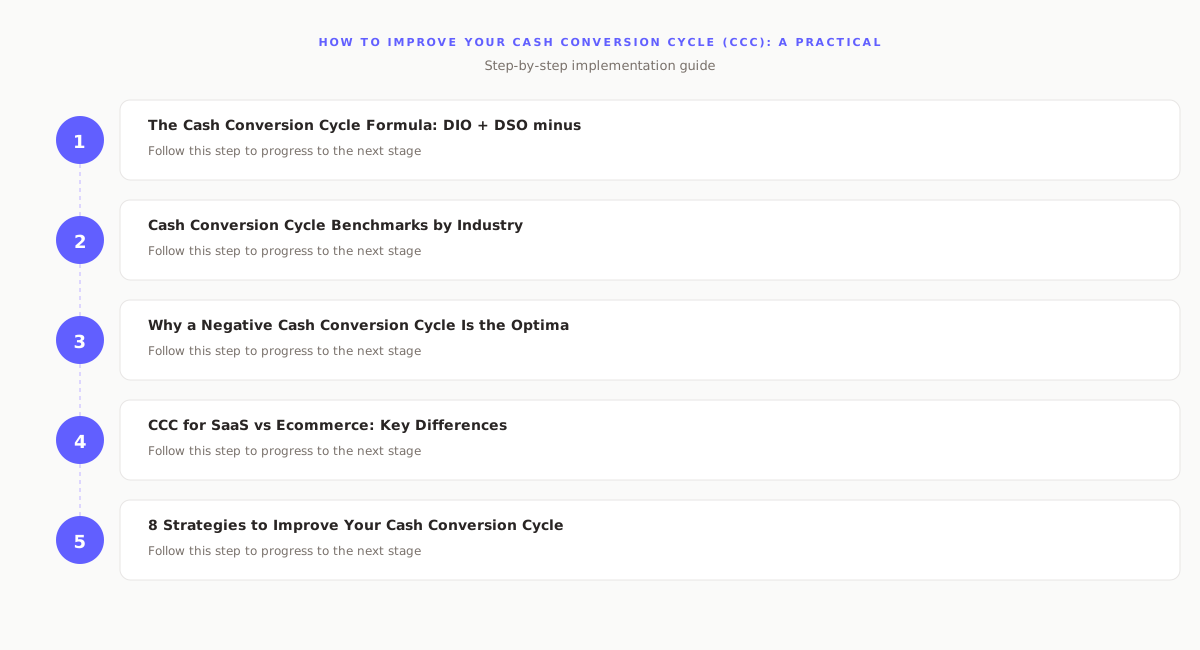
The Cash Conversion Cycle Formula: DIO + DSO minus DPO
The CCC has three components. Each represents a different stage in the cash cycle. Each can be targeted independently to improve the overall number.
Days Inventory Outstanding (DIO)
DIO measures how many days, on average, inventory sits before being sold. The formula is: (Average Inventory divided by COGS) multiplied by 365. Lower DIO means faster inventory turnover. A business with $300,000 average inventory and $2.4M annual COGS has DIO of 45.6 days.
DIO is the most variable component of CCC and the one most directly influenced by operational decisions. Demand forecasting accuracy, supplier lead times, SKU rationalization, and safety stock policies all directly affect DIO. See our guide on inventory turnover for ecommerce for the full calculation methodology and benchmarks.
Days Sales Outstanding (DSO)
DSO measures how many days, on average, it takes to collect payment after making a sale. The formula is: (Accounts Receivable divided by Revenue) multiplied by 365. A business with $120,000 in accounts receivable and $2M annual revenue has DSO of 21.9 days.
DSO is most relevant for B2B businesses that invoice on net-30 or net-60 terms. For D2C ecommerce businesses, DSO is typically near zero — consumers pay at checkout. For SaaS businesses, DSO depends on whether the billing model is prepaid annual, monthly, or invoiced.
Days Payable Outstanding (DPO)
DPO measures how many days, on average, it takes to pay suppliers after receiving goods. The formula is: (Accounts Payable divided by COGS) multiplied by 365. Higher DPO is better — it means you retain cash longer before paying it out. A business with $80,000 in accounts payable and $2.4M COGS has DPO of 12.2 days.
DPO is the only component of the CCC formula where higher is better. Extending supplier payment terms from net-15 to net-45 directly improves CCC by 30 days — without touching inventory or collections operations at all.
Cash Conversion Cycle Benchmarks by Industry
CCC benchmarks vary significantly by industry. Comparing your CCC against the right peer group is essential — a 45-day CCC is strong for manufacturing and alarming for ecommerce. The structural differences in inventory dynamics, payment patterns, and supplier relationships make cross-industry comparisons misleading.
| Industry | Typical CCC | Primary Driver |
|---|---|---|
| SaaS / Software | -30 to 0 days | No inventory; subscription cash often collected upfront |
| Ecommerce (DTC) | -10 to 20 days | Consumers pay at checkout; DPO extension is the key lever |
| Grocery / Fast Retail | 5–20 days | High inventory turnover offsets short payable windows |
| General Retail | 20–50 days | Seasonal inventory buildup creates cash troughs |
| Manufacturing | 50–90 days | Long production cycles inflate DIO substantially |
| Distribution / Wholesale | 60–90 days | Large inventory buffers plus B2B invoice terms |
| Construction / Services | 80–120+ days | Long project timelines; milestone billing delays collections |
The right target is not a universal number — it is the best CCC achievable within the structural constraints of your business model. An ecommerce brand targeting sub-zero CCC is realistic. A contract manufacturer targeting the same is likely not. Set your benchmark against the best performers in your specific category.
Why a Negative Cash Conversion Cycle Is the Optimal State
A negative CCC is not simply better than a positive one — it is structurally different. In a positive CCC business, you are a net lender to your operating cycle: you extend capital to fund inventory and receivables, then wait to get it back. In a negative CCC business, your suppliers and customers fund your operations instead of you.
Dell built its entire business model around negative CCC in the 1990s. By selling direct to consumers and assembling to order, Dell collected payment before ordering components. Customers funded Dell's supply chain. Dell operated with significant negative working capital while growing revenue at 40%+ per year — without proportional capital raises.
Amazon operates the same way at scale. Walmart achieves near-zero CCC through massive supplier negotiating leverage. For growth-stage operators, the practical goal is not necessarily negative CCC — it is understanding which components are most improvable and closing the gap systematically.
CCC for SaaS vs Ecommerce: Key Differences
The CCC formula is universal, but the dominant variables differ sharply between SaaS and ecommerce. Understanding which components you are actually fighting matters before you decide where to focus improvement effort.
SaaS: DIO Is Zero, DSO Is the Key Variable
Software companies hold no physical inventory. DIO is structurally zero. The CCC for a SaaS business simplifies to: DSO minus DPO. If DSO is 18 days and DPO is 30 days, CCC is negative 12 days — structurally favorable before any optimization effort.
Annual subscriptions paid upfront push DSO toward zero. A company with 60% annual prepaid contracts and 40% monthly billing will have DSO well under 10 days. Monthly billing with net-30 invoicing pushes DSO toward 30–40 days. The billing model is the primary CCC lever for SaaS. See our guide on working capital management for SaaS for the full framework.
Ecommerce: All Three Components Require Active Management
Ecommerce companies deal with all three components at meaningful scale. DIO is driven by inventory depth, supplier lead times, and demand forecasting accuracy. DSO is typically near zero for D2C sales — consumers pay at checkout — but can be material for wholesale or marketplace channels with delayed settlements. DPO depends entirely on supplier relationships and negotiating leverage.
The fastest CCC improvement for most ecommerce operators is DPO extension: negotiating net-30 or net-45 terms with suppliers when you were previously on net-15. This directly widens the spread between when you collect (often immediate) and when you pay (now 30–45 days later). For a business doing $5M in annual COGS, moving from net-15 to net-45 frees roughly $410,000 in permanent working capital.
8 Strategies to Improve Your Cash Conversion Cycle
Improving CCC requires coordinated action across three variables. The following eight strategies address each component with specific, actionable interventions. They are ordered by typical implementation speed and impact magnitude.
Strategy 1: Negotiate Extended Supplier Payment Terms (DPO)
This is the fastest lever for most businesses. Extending DPO from 15 to 45 days improves CCC by 30 days immediately — no operational change required. Large suppliers often offer net-30 or net-45 as standard terms to established customers. Many small business operators accept default net-15 terms because they never asked for better.
The negotiation approach: reference your on-time payment history, offer volume commitments in exchange for extended terms, and request longer windows on your largest spend categories first. For inventory-heavy businesses, a 30-day DPO extension on a supplier representing 30% of COGS can free six figures in permanent working capital immediately.
Strategy 2: Automate Invoice Follow-Up to Reduce DSO
DSO creep is almost always a process failure, not a relationship failure. Invoices sit unpaid not because customers refuse to pay — they go unpaid because no one followed up systematically. Manual AR follow-up is inconsistent and delayed. Automated invoice sequences trigger reminders at day 7, day 14, and day 21 without human intervention.
Implement three-touch automated sequences: a friendly reminder before the due date, a firm reminder on the due date, and an escalation message at 7 days past due. For B2B businesses, this single change typically reduces DSO by 8–15 days within 90 days of implementation. The cost of an AR automation tool is always lower than the cost of the DSO it eliminates.
Strategy 3: Offer Early Payment Discounts for Large Accounts
The classic structure is "2/10 net 30": a 2% discount if payment arrives within 10 days, otherwise full payment due at 30 days. For customers with healthy cash flow, a 2% discount in exchange for 20-day faster payment is attractive. For the seller, accepting a 2% revenue reduction to accelerate cash by 20 days is often worthwhile — especially when working capital is constrained.
Target early payment incentives at your top 10–20 customers by outstanding receivables balance. These accounts have the most impact on aggregate DSO. Smaller accounts rarely have the treasury sophistication to optimize around early payment terms, so the effort-to-impact ratio is better concentrated on large accounts.
Strategy 4: Improve Demand Forecasting to Reduce DIO
Excess inventory is frozen cash. Every unit held beyond what demand requires is capital that could be deployed elsewhere. Most DIO inefficiency traces to poor forecasting: over-ordering in anticipation of demand that does not materialize, or ordering in large batches to reduce per-unit cost without modeling the carrying cost of the excess.
Implement rolling 90-day demand forecasts updated weekly rather than static quarterly plans. Incorporate lead time variability from your suppliers into safety stock calculations — safety stock should reflect actual lead time variance, not a fixed blanket percentage of average inventory. Our guide on ecommerce inventory management best practices covers the full forecasting framework.
Strategy 5: SKU Rationalization — Eliminate Slow Movers
Long-tail SKUs with slow velocity disproportionately inflate DIO. A SKU that turns once every 90 days contributes 90 days of dead inventory to your average. Ten slow-moving SKUs can add 15–20 days to company-wide DIO even if your best-selling products turn in under 20 days.
Run a SKU-level DIO analysis quarterly. Any SKU with DIO above 2x the category average and below threshold gross margin should be evaluated for discontinuation or clearance pricing. Liquidating slow movers at cost or below cost recovers cash immediately. Review SKU-level profitability alongside DIO to avoid eliminating high-margin slow movers that remain economically justified.
Strategy 6: Require Deposits or Upfront Payment for New Customers
For B2B businesses, new customers carry disproportionate collection risk. You have no payment history with them and extending net-30 or net-60 credit is a material gamble. Requiring a 50% deposit before project start, or a prepaid subscription for the first three months, reduces DSO to near-zero on new accounts.
Frame this as standard policy rather than a distrust signal. Once a customer demonstrates reliable payment over two or three billing cycles, standard net terms become appropriate. This approach also improves customer quality — buyers who refuse any upfront commitment are often the accounts that cause collection problems later.
Strategy 7: Implement Supply Chain Financing
Supply chain financing (reverse factoring) allows a financial intermediary to pay the supplier immediately on the buyer's behalf, while the buyer repays the intermediary on extended net terms. The supplier receives cash on day 1. The buyer retains cash until day 60 or 90. This extends your DPO structurally without damaging supplier relationships — the supplier is made whole immediately.
For businesses scaling rapidly and constrained by working capital, supply chain financing can add 30–60 days of effective DPO. The cost is the financing rate charged by the intermediary — typically lower than merchant cash advances or revolving credit lines, and directly comparable to the cost of the working capital it replaces.
Strategy 8: Tighten Credit Policy and Escalation Process
A generous credit policy is one of the most common hidden sources of DSO inflation. Extending net-60 to every customer who asks, regardless of creditworthiness, creates unnecessary cash drag. Credit policy should be calibrated to payment risk and relationship history.
For new business customers, require a credit application and trade references before extending net terms above net-30. For existing customers with slow payment history, move them to prepaid or COD until they demonstrate consistent on-time payment. Build a formal escalation process: 7 days past due triggers an automated reminder, 21 days past due triggers a collections call, and 45 days past due initiates a formal collections procedure including interest on late balances per your contract terms.
How to Monitor CCC Without a Dedicated Finance Team
Most operators calculate CCC quarterly from their accounting software. That rhythm is too slow. CCC is a leading indicator of cash stress — by the time it appears in a quarterly report, the problem has been building for weeks. Three practical monitoring approaches work for growing businesses without dedicated finance resources.
Weekly AR aging review. Every week, run an accounts receivable aging report. Any invoice past 30 days with no follow-up action is a DSO problem in progress. This takes 15 minutes and catches collection drift before it compounds into a meaningful DSO increase.
Monthly DIO calculation per product category. For ecommerce operators, calculate DIO at the product category level monthly. DIO moving up in a specific category signals either a forecasting miss or a demand problem — both of which are actionable when caught monthly rather than quarterly.
Supplier terms audit twice per year. Review every active supplier against their actual payment terms every six months. Terms agreed three years ago may not reflect current relationship leverage. Suppliers who depend significantly on your volume are often willing to extend DPO when asked directly — they require the conversation to happen.
CCC and Profit Intelligence: The Margin Connection
CCC is a working capital efficiency metric, but it connects directly to profit at the margin level. Businesses with poor CCC often compensate with expensive short-term credit: revolving credit facilities, invoice factoring at 2–4% per month, or merchant cash advances with effective rates above 40% annually. Each of these is a direct margin drag that rarely appears in gross margin analysis.
A 60-day CCC on $5M annual revenue requires roughly $820,000 in permanent working capital to fund operations. Finance that working capital at 8% annually and you carry $65,600 in interest expense per year. Improving CCC to 20 days reduces the working capital requirement to $273,000 and the financing cost to $21,800. That $43,800 difference flows directly to net margin.
This is why CCC belongs in profit intelligence reporting alongside contribution margin, gross margin by channel, and profit leak detection. The fastest path to margin improvement is often not a pricing change or a cost reduction — it is a working capital efficiency improvement that reduces financing drag. For a complete framework, see our guide on profit intelligence for operators.
Common CCC Mistakes to Stop Making
- Calculating CCC once per year. CCC is a live number. Annual snapshots are too stale to drive decisions. Calculate it monthly at minimum — weekly for fast-moving ecommerce businesses.
- Treating all customer segments the same on credit terms. Extending net-60 to SMB customers creates DSO risk that enterprise customers with strong credit never pose. Segment your credit policy by customer type and payment history.
- Optimizing DIO without accounting for stockout risk. Cutting inventory to zero is not the goal. The goal is minimum inventory consistent with target service levels. Model stockout cost before cutting safety stock aggressively.
- Ignoring the working capital impact of growth. Growing revenue 50% with a 60-day CCC means 50% more working capital tied up in operations. Fast growth amplifies CCC inefficiency. Address CCC before scaling, not after the cash crunch arrives.
- Extending DPO unilaterally without supplier negotiation. Paying on day 60 when the agreed terms are net-30 damages supplier relationships and can disrupt supply. Negotiate extended terms formally — do not simply delay payments and hope for tolerance.
- Benchmarking against cross-industry averages. A 45-day CCC for a SaaS business is a serious problem. For a custom manufacturer, it may be industry-leading. Use your specific sector as the reference group.
Key Takeaways
- CCC = DIO + DSO minus DPO. Lower is better. Negative CCC means suppliers are funding your operations instead of you.
- The fastest lever is usually DPO extension. Negotiating longer supplier terms requires no operational change and improves CCC immediately.
- SaaS CCC is driven by DSO. DIO is zero for software. Annual prepaid contracts push CCC negative with no other changes required.
- Ecommerce CCC requires managing all three components. D2C payment eliminates DSO, but DIO and DPO both require active management and supplier negotiation.
- Negative CCC is achievable for most ecommerce and SaaS businesses. It requires structural alignment: collecting before paying, minimizing inventory float, and negotiating supplier terms with leverage.
- Poor CCC creates direct margin drag. Every day of excess CCC increases working capital requirements and financing cost — both compress net margin without ever showing in gross margin analysis.
- Monitor monthly, not annually. CCC tracked quarterly is a lagging indicator. Monthly tracking makes it actionable before cash stress arrives.