

TL;DR
- A founder-operator is a hybrid role that combines visionary founding with hands-on operational execution. The person who starts the company also runs it day-to-day.
- The role differs from a pure founder (vision-only), a hired operator (execution-only), and a COO (hired executive who takes over ops so the founder can focus externally).
- Six core responsibilities span vision, product, sales, operations, hiring, and finance. The defining trait is the ability to move between all six in the same day.
- The title matters when five signals appear: founder time on ops exceeds 60 percent, problems repeat weekly, growth outpaces systems, forecast variance exceeds 15 percent, and the team exceeds 15 people without clear ownership.
- Fairview is built for founder-operators who need one connected operating view across CRM, finance, and ad platforms — so Monday reviews do not require four hours of manual data assembly.
A founder-operator is the person who starts a company and continues to run it hands-on, combining visionary direction with day-to-day execution. Most early-stage companies have one whether they use the title or not. The founder writes the pitch deck, closes the first 10 customers, hires the first employees, manages the bank account, and fixes the production bug at midnight. The question is not whether the role exists. The question is whether the person in it knows what they are doing, whether the company needs to formalize the role, and when it is time to split the founder and operator functions into two people.
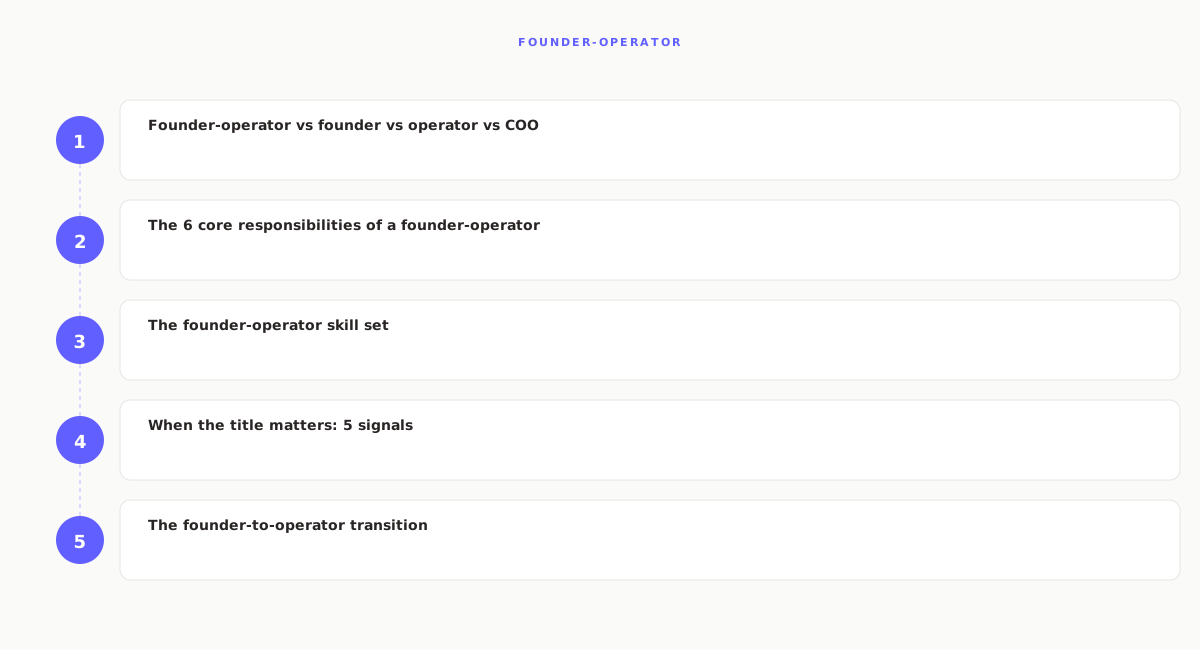
This article defines the founder-operator role precisely. It covers how the role differs from a pure founder, a hired operator, and a COO. It lists the six core responsibilities, the skill set required, the five signals that tell you the title matters, and the transition from founder-operator to a founder-plus-COO structure. It is written for the person currently doing the job, the investor evaluating a team, and the founder wondering whether to hire their first operator.
If you have read our guide to what a COO does at a startup, this article is the prequel. That guide covers the hired operator. This one covers the founder who is still the operator.
What is a founder-operator?
Definition
Founder-operator: a hybrid leadership role that combines the visionary, creative mindset of a founder with the execution-focused, systems-oriented approach of an operator. The founder-operator builds from zero while simultaneously creating the infrastructure for scale. The role shifts daily between 30,000-foot strategy and street-level execution.
The term "founder-operator" is not a formal title on most org charts. It is a description of a person who holds two roles at once: the founder who owns the vision, and the operator who owns the execution. In a 5-person company, this is the default. In a 50-person company, it is a choice. In a 200-person company, it is usually a problem.
The founder-operator model has become more common as capital efficiency has replaced growth-at-all-costs as the dominant startup narrative. According to RTP Global's 2025 report on operator-led startups, operator-led companies in India raised $101 million in 2024, a 243 percent increase from 2023. These companies reached seed funding 12 months faster than the market average and achieved Series A valuations 1.77 times higher than non-operator-led peers. The mechanism is not mysterious. Operators know how to do more with less.
The founder-operator operates at two levels simultaneously. The strategic level is what shows up in investor updates: the market thesis, the product roadmap, the hiring plan, the capital strategy. The operational level is what happens on Tuesday: the sales call, the customer support ticket, the payroll run, the ad spend adjustment, the bug triage. A founder-operator who loses touch with the operational level becomes a pure founder. A founder-operator who loses touch with the strategic level becomes a hired manager. The job is holding both.
The core insight is simple: in the earliest stages, the person with the vision and the person with the execution capability are the same person. Separating them too early creates overhead. Keeping them together too long creates a bottleneck. The art is knowing when the balance has shifted.
Founder-operator vs founder vs operator vs COO
Before defining responsibilities, it helps to clear the distinctions. These four roles are often conflated. Each one has a different scope, a different authority base, and a different ideal profile.
| Role | Primary focus | Authority source | Typical stage |
|---|---|---|---|
| Pure founder | Vision, fundraising, product strategy, external relationships | Ownership, founder status | Any stage, but most common pre-product-market fit |
| Founder-operator | Vision + execution simultaneously | Ownership + demonstrated execution | 0 to 50 people, pre-Series A to Series B |
| Hired operator | Execution, systems, process, team management | Delegated authority from founder | 15 to 100 people, Series A onward |
| COO | Full operational ownership so founder can focus externally | Executive title, reports to CEO | 50 to 500+ people, Series B onward |
The pure founder is the visionary who defines the market opportunity and raises capital but delegates execution to a team. This model works when the founder has a genuine strategic advantage (deep technical insight, unique network, or rare product intuition) and when the team is strong enough to execute without daily founder involvement. It fails when the founder delegates execution without building the systems that make delegation possible.
The founder-operator is the person who does both. They write the strategy deck and run the weekly operating review. They pitch investors and close the enterprise deal that lands the quarter. They define the culture and handle the HR complaint. The advantage is speed: no handoff delay between vision and execution. The risk is burnout and strategic drift, because operational urgency always crowds out strategic thinking.
The hired operator is an early employee (often employee 5 to 15) who takes over specific operational functions so the founder can focus. This person might start as a generalist "do everything" hire and evolve into a Head of Operations. They have execution authority but not founder authority. They can optimize systems but cannot reset strategy. The best hired operators eventually become COOs. The worst become bottlenecks because the founder never fully delegates.
The COO is a senior executive hired to own operations end-to-end. They manage the leadership team, run the operating cadence, and own the P&L so the CEO can focus on strategy, fundraising, and board management. The COO has executive authority and a seat at the leadership table. They report to the CEO but operate with significant autonomy. According to Wellfound's startup COO guide, 46 percent of surveyed CEOs plan to hire a COO in the next 12 months, and over 74,000 open COO roles exist in the United States. The role is not niche. It is standard.
The transition from founder-operator to founder-plus-COO is one of the most difficult handoffs in a company's early life. The founder has to let go of operational control while maintaining strategic direction. The COO has to earn authority without the founder's implicit credibility. Most companies botch this transition at least once.
The 6 core responsibilities of a founder-operator
Every founder-operator handles six core areas. The specific mix shifts by stage and by the founder's background, but the six areas are constant. Weakness in any one creates a hole that eventually becomes a crisis.
1. Vision and strategy
The founder-operator defines what the company is building and why it matters. This includes the market thesis, the competitive positioning, the product roadmap, and the capital strategy. The difference from a pure founder is that the founder-operator also defines the milestones that make the vision actionable. Not just "we will be the leading platform for X" but "we need 50 paying customers by Q3, and here is the weekly cadence that gets us there."
The test of good vision work is whether a new hire can explain the company's strategy in one sentence after their first week. If the founder-operator is the only person who can articulate the vision, the vision is not clear enough to scale.
2. Product development
The founder-operator leads the product from idea to launch to iteration. In technical companies, this often means writing code or at least reviewing pull requests. In non-technical companies, it means defining requirements, testing prototypes, and making the final call on feature priority. The founder-operator does not need to be the best engineer or designer on the team. They need to be the person who knows the customer well enough to resolve a product disagreement in under 10 minutes.
3. Sales and go-to-market execution
The founder-operator makes the first sales calls, writes the first pitch deck, and defines the initial pricing. They know the customer objections because they have heard them. They know the close rate because they have tracked it. They know which channel works because they have tested three. This direct sales involvement is not optional in the earliest stages. It is how the founder-operator learns what the product actually does for customers, which is often different from what the product was designed to do.
4. Operations and systems
The founder-operator builds the internal processes that make the company repeatable. This includes the CRM setup, the financial reporting cadence, the hiring process, the customer onboarding flow, and the weekly operating review. The goal is not perfection. The goal is a system that works without the founder-operator's direct involvement for one week. Then two weeks. Then a month. Each increment of delegation is a test of whether the systems are real.
5. Hiring and culture
The founder-operator recruits the first 10 to 20 employees and establishes the cultural norms that persist as the team grows. This includes the values (written or implicit), the communication style, the decision-making speed, and the tolerance for ambiguity. Culture is not a poster on the wall. It is the answer to "how do we act when nobody is watching?" The founder-operator sets that answer through their own behavior more than through any document.
6. Finance and capital
The founder-operator manages cash flow, extends runway, and handles investor relations. In the earliest stages, this means knowing the bank balance and the burn rate by heart. As the company grows, it means building a financial model, negotiating term sheets, and making the capital allocation decisions that determine whether the company reaches its next milestone with resources intact. According to Carta's Solo Founders Report 2025, the average founder salary in 2024 was $142,000, up from $121,000 in 2023. Capital discipline matters more when capital is expensive.
Key insight
The founder-operator who excels in all six areas is rare. Most are strong in two or three and competent in the rest. The danger is not weakness in one area. The danger is weakness in one area that the founder-operator does not acknowledge, which creates a blind spot that compounds until it becomes a crisis.
The founder-operator skill set
The founder-operator does not need to be the best in the world at any one function. They need a generalist skillset with depth in at least two areas, plus five meta-capabilities that make the generalist approach work.
First-principles thinking. The founder-operator reinvents approaches rather than applying playbooks. A playbook from a Series C company will not work at a pre-seed company. A playbook from a SaaS company will not work at a D2C company. The founder-operator diagnoses the specific situation and builds a solution for it.
High agency and bias toward action. The founder-operator does not wait for permission or perfect information. They diagnose problems and create solutions. When the website is down, they fix it or find someone who can. When a customer churns, they call them. When a hire is not working, they address it directly. Low-agency founders become bottlenecks because every decision routes through them.
Comfort with ambiguity. The founder-operator thrives in unstructured environments. There is no org chart. There is no process for this. There is no precedent. The founder-operator makes a decision, documents it, and moves on. The alternative is paralysis, which is fatal at the earliest stages.
Systems thinking. The founder-operator builds processes that outlast the person who built them. A process that only works when the founder-operator is present is not a process. It is a dependency. The test is whether the company can operate for a week without the founder-operator answering questions.
Direct customer empathy. The founder-operator maintains proximity to the customer even as the team grows. They read support tickets. They join sales calls. They talk to churned customers. This proximity is what prevents strategic drift. The moment the founder-operator loses touch with the customer is the moment the product roadmap starts solving problems that do not exist.
When the title matters: 5 signals
The founder-operator role is implicit in most early-stage companies. The title becomes explicit when the company grows to a point where the founder can no longer hold both roles effectively. Here are the five signals we see most consistently.
- The founder spends more than 60 percent of their time on operational tasks. When the founder's calendar is dominated by payroll, vendor negotiations, and internal process questions, strategic work gets pushed to evenings and weekends. This is unsustainable. The founder is becoming a manager, not a leader.
- The same problems resurface weekly. A customer complaint that keeps happening. A reporting error that keeps appearing. A team conflict that keeps recurring. These are symptoms of missing systems. The founder-operator is too busy fighting fires to build the fire prevention infrastructure.
- Growth increases stress faster than revenue. The company is adding customers but the founder is working harder per customer than before. This is the classic execution crisis: growth without systems creates more work, not more leverage.
- Forecast variance exceeds 15 percent consistently. The founder-operator who is stretched too thin loses the ability to track numbers closely. Pipeline estimates become guesses. Revenue forecasts become wishes. Cash flow projections become fiction. For operators who need to improve forecast discipline, see our guide to forecast accuracy metrics.
- The team exceeds 15 people without clear operational ownership. At 15 people, informal communication breaks down. Decisions need documented rationale. Processes need written standards. Handoffs need defined owners. Without a person explicitly responsible for operational infrastructure, the company drifts into reactive mode.
Three or more of these signals at once is the threshold. One signal is manageable. Two signals is a warning. Three signals means the founder-operator model is creating more drag than lift. The next move is either to hire a dedicated operator or to formalize the founder-operator role with explicit boundaries that protect strategic time.
For a deeper treatment of the operating cadence that keeps a growing team aligned, see our guide to operating cadence.
The founder-to-operator transition
The transition from founder-operator to a founder-plus-operator structure is not a single event. It is a phased handoff that takes 6 to 12 months if done well, and 18 to 24 months if done poorly. The phases are:
Phase 1: Identify the exit criteria. The founder defines what "good" looks like for each operational area before handing it off. Not "handle it" but "reduce customer response time to under 4 hours, maintain NPS above 40, and keep monthly churn under 2 percent." Specific criteria make delegation possible. Vague criteria create micromanagement.
Phase 2: Hire or promote the operator. The operator can be an internal promotion (a high-performing early employee who has grown with the company) or an external hire (a seasoned operator with relevant experience). Internal promotions preserve cultural continuity but may lack the systems experience needed at scale. External hires bring systems experience but need time to earn the team's trust.
Phase 3: Parallel run. The founder and the operator run the operational function together for 30 to 60 days. The founder observes, coaches, and intervenes only when the operator's decision would create material risk. The operator makes decisions, documents rationale, and asks questions. This phase is uncomfortable for both parties. It is also essential.
Phase 4: Full handoff with checkpoints. The operator owns the function. The founder receives weekly summaries, not real-time updates. The founder intervenes only on exceptions that cross a pre-defined threshold. The operator escalates only when the decision has strategic implications that the founder needs to own.
Phase 5: Founder recalibration. The founder uses the freed time for strategic work, not more operational work. This is where most transitions fail. The founder delegates operations and then fills the new time with more operational tasks because that is what feels productive. The test is whether the founder's calendar in month six looks materially different from month one.
The most common failure mode is the founder who delegates partially. They hire a COO but continue to review every expense report. They promote a Head of Operations but override every hiring decision. This creates the worst of both worlds: the company pays for an operator and keeps the founder as a bottleneck. The founder is exhausted. The operator is frustrated. The team is confused about who is actually in charge.
How Fairview supports founder-operators
Fairview is built for the founder-operator who needs one connected operating view without the overhead of a full data team. Once HubSpot or Salesforce, Stripe, QuickBooks or Xero, and your ad platforms are connected, Fairview computes the metrics that matter in one view.
- Operating Dashboard. One screen with margin by channel, pipeline health, forecast confidence, and anomaly alerts. Replaces 4 to 6 hours of weekly manual reporting.
- Pipeline Health Monitor. Connects to CRM and reads deal stage, close date, and last activity. Flags deals that are stalling or have slipped close dates. Surfaces the top 5 at-risk deals each week.
- Forecast Confidence Engine. Generates a weekly revenue forecast based on pipeline stage, historical close rates, and deal velocity. Assigns a confidence score and shows the optimistic versus conservative range.
- Next-Best Action Engine. Detects anomalies in connected data and generates specific, named recommendations with estimated dollar impact. Not just reports — next steps.
When a number drifts past the threshold the founder-operator sets, Fairview writes a named next-best action into the weekly operating report. The same rhythm that keeps the forecast honest also surfaces margin and retention drift earlier than a stitched-together spreadsheet would catch.
Key takeaways
- A founder-operator combines visionary founding with hands-on execution. The role is the default in early-stage companies and a choice in growing ones.
- The role differs from a pure founder (vision-only), a hired operator (execution delegated), and a COO (senior executive who takes over ops end-to-end). Each has a different authority base and ideal stage.
- Six core responsibilities span vision, product, sales, operations, hiring, and finance. The defining trait is the ability to move between all six in the same day.
- Five signals indicate the founder-operator model is creating drag: founder time on ops exceeds 60 percent, problems repeat weekly, growth outpaces systems, forecast variance exceeds 15 percent, and the team exceeds 15 people without clear operational ownership.
- The transition from founder-operator to founder-plus-COO is a 6-to-12-month phased handoff. The most common failure mode is partial delegation, where the founder hires an operator but continues to act as the bottleneck.
Conclusion
The founder-operator is not a title. It is a phase. Every company has one in the beginning. The question is whether the person in the role knows what they are doing, whether the company formalizes the role before it becomes a bottleneck, and whether the transition to a dedicated operator is handled with the same discipline that the founder-operator applied to building the company in the first place.
The version of the question worth asking is not "what is a founder-operator" in the abstract. It is: what percentage of your time is spent on operational tasks versus strategic tasks, which of the five signals are showing up in your company right now, and what is your specific plan for the transition when the founder-operator phase ends?