

TL;DR
Burn multiple = Net Burn ÷ Net New ARR. It measures how much capital you spend to generate each dollar of new ARR. In 2026, benchmarks are: Seed (<2.0x acceptable), Series A (<1.5x good, <1.0x excellent), Series B (<1.0x expected), Series C+ (<0.75x expected). Anything above 3.0x is a VC red flag at any stage. Popularized by David Sacks of Craft Ventures, it is now a standard diligence metric alongside CAC payback and Rule of 40.
When SaaS markets tightened in 2022, a simple metric moved from VC back-of-napkin math to a standard diligence requirement: the burn multiple. It answers the question investors care about most when capital is scarce: how efficiently are you converting investment dollars into revenue growth?
If your burn multiple is 1.5x, you are spending $1.50 to add $1.00 of annual recurring revenue. If it is 4.0x, you are spending $4.00. Those two numbers tell very different stories about whether your growth is sustainable — and whether your business deserves more capital to grow.
This guide covers the burn multiple formula, 2026 benchmarks by funding stage, worked examples, and the most common ways SaaS founders misread or misimprove this metric.
What Is the Burn Multiple?
The burn multiple was popularized by David Sacks, General Partner at Craft Ventures, in 2020. Sacks described it as a direct measure of capital efficiency: for every dollar of new ARR you add, how many dollars of cash did you have to burn?
Where each component means:
- Net Burn: Cash consumed in the period — total operating expenses minus total revenue collected. This is your actual cash out the door, not GAAP expenses.
- Net New ARR: New ARR added in the same period — new customer ARR plus expansion ARR minus churned ARR. This is contracted, recurring revenue — not one-time deals or professional services.
The period is typically monthly or quarterly. Most investors look at trailing 6-month or trailing 12-month figures for a smoothed view of the trend — not just the most recent month, which can be distorted by timing of large deals or one-time expenses.
Worked Example: Calculating Your Burn Multiple
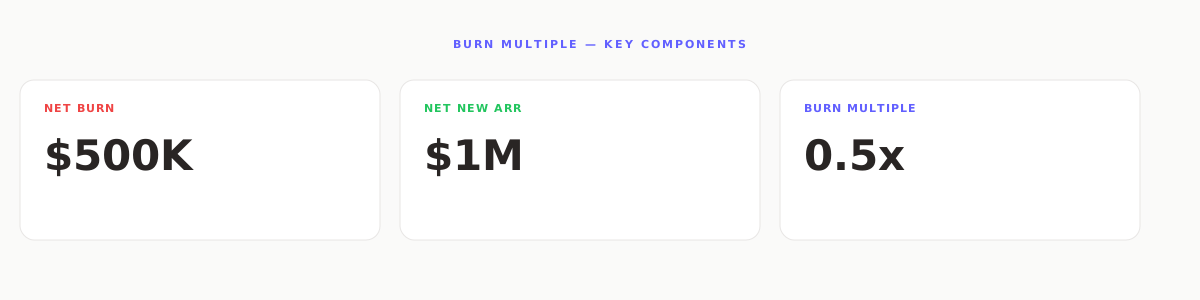
Example: Series A SaaS Company — Q2 2026
A burn multiple of 2.16x at Series A is above the "good" threshold — not a crisis, but an indicator that the company should focus on either growing ARR faster or reducing burn before the next raise.
Burn Multiple Benchmarks by Funding Stage (2026)
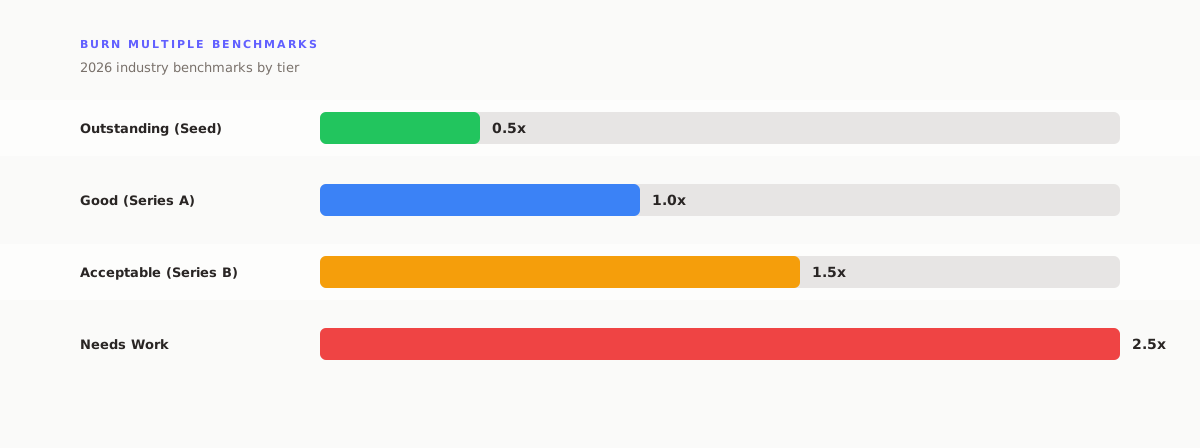
Benchmarks have tightened significantly since 2021. Investors in 2026 expect more capital efficiency than they did during the zero-interest-rate era. Here are current expectations:
| Stage | Excellent | Good | Acceptable | Red Flag |
|---|---|---|---|---|
| Pre-Seed / Seed | < 1.0x | < 1.5x | < 2.0x | > 3.0x |
| Series A | < 0.75x | < 1.0x | < 1.5x | > 2.5x |
| Series B | < 0.5x | < 0.75x | < 1.0x | > 2.0x |
| Series C+ | < 0.25x | < 0.5x | < 0.75x | > 1.5x |
Context matters alongside the benchmark. A company with 150% NRR growing fast in a large market gets more forgiveness on burn multiple than a slower-growing company with moderate expansion revenue. But the benchmark table above reflects what most institutional SaaS investors want to see before writing a check.
Watch for this: Some founders confuse "burn rate" (raw cash consumption) with "burn multiple" (efficiency-adjusted). A company burning $2M/month and adding $3M of new ARR has a burn multiple of 0.67x — excellent. A company burning $500K/month and adding $100K of new ARR has a burn multiple of 5.0x — dangerous. Raw burn rate alone tells you nothing about efficiency.
Why Burn Multiple Replaced "Growth at All Costs"
Before 2022, the prevailing SaaS growth philosophy was straightforward: grow ARR as fast as possible, worry about efficiency later. VCs rewarded revenue growth multiples without scrutinizing how much capital each dollar of growth required.
The environment shift was abrupt. When interest rates rose and public SaaS multiples compressed, the implicit assumption that "you can always raise more" stopped being true. Companies that had been burning 5x to 10x their new ARR suddenly found that capital was unavailable — or priced at terms that wiped out founders.
The burn multiple became the standard efficiency metric because it directly connects the two variables that matter: cash out and ARR growth in. It is harder to game than gross margin, less lagging than NDR, and more directly connected to fundraising sustainability than revenue growth rate alone.
How Burn Multiple Relates to Other SaaS Metrics
Burn multiple does not exist in isolation. Here is how it connects to the other efficiency metrics VCs track in 2026:
Burn Multiple vs. Rule of 40
The Rule of 40 combines revenue growth rate and profit margin (typically FCF margin) into a single score. A company with 60% growth and -20% FCF margin scores 40. The Rule of 40 is a high-level health check. Burn multiple is more granular — it measures efficiency specifically on the sales growth you are generating, not on overall profitability.
A company can pass Rule of 40 while having a poor burn multiple if they have strong existing ARR margins and poor new ARR efficiency. Investors look at both.
Burn Multiple vs. CAC Payback Period
CAC payback measures how long it takes to recover the cost of acquiring a customer. Burn multiple measures how efficiently capital converts to new ARR across the whole company. They are related but different: a team could have an excellent CAC payback period for new customers while having a poor burn multiple because of excessive infrastructure or G&A costs.
Burn Multiple vs. Magic Number
The SaaS Magic Number measures sales efficiency specifically — how much new ARR per dollar of sales and marketing spend. Burn multiple is broader: it captures all cash consumption, not just sales and marketing. Magic Number > 1.0 means your go-to-market motion is efficient; burn multiple shows whether the whole company is efficient.
5 Ways to Improve Your Burn Multiple
Most burn multiple improvement strategies fall into two categories: grow ARR faster without proportionally increasing burn, or reduce burn without proportionally reducing growth. The best outcomes come from doing both simultaneously.
Common Burn Multiple Mistakes SaaS Founders Make
Calculating burn multiple on GAAP revenue instead of cash: GAAP revenue includes deferred revenue, accruals, and non-cash items. Burn multiple should use cash-basis financials — what actually went in and out of your bank account in the period.
Including professional services ARR in net new ARR: Professional services and implementation revenue is not recurring. Net new ARR should include only contracted recurring subscription revenue. Including one-time services inflates your net new ARR and makes your burn multiple look better than it is.
Cherry-picking periods: Calculating burn multiple in your best sales month and presenting that to investors will not fool them. VCs almost always request trailing 6-month or trailing 12-month figures. Focus on improving the trailing number, not a single-quarter spike.
Ignoring the composition of your burn: A burn multiple of 1.5x looks different if 80% of your burn is in sales and marketing (scalable, could be dialed back) versus 80% in COGS and infrastructure (structural, harder to reduce). Investors ask about burn composition as part of diligence.
How Fairview Tracks Burn Multiple Automatically
Manually calculating burn multiple requires pulling cash flow data, reconciling it against ARR bookings, and building the formula in a spreadsheet — then doing it again every month. For most founders, this means they look at the metric quarterly at best.
Fairview's operating intelligence platform tracks burn multiple continuously by connecting to your financial data and CRM. You see:
- Real-time burn multiple updated as deals close and expenses land
- Trailing 3-month, 6-month, and 12-month trends in a single view
- Burn multiple by team or cost center — so you can see which functions are efficient and which are not
- Forecast scenarios showing how your burn multiple evolves under different ARR growth and hiring plans
Most founders using Fairview find that tracking burn multiple continuously — rather than once per quarter for investor prep — lets them course-correct before the metric becomes a fundraising problem.
Key Takeaways
- Burn multiple = Net Burn ÷ Net New ARR. Lower is better. Negative means cash-flow positive.
- 2026 benchmarks: Seed <2.0x, Series A <1.5x, Series B <1.0x, Series C+ <0.75x. Above 3.0x is a red flag at any stage.
- It is a trailing metric — investors want to see the trailing 6 or 12-month trend, not a single best month.
- It is an efficiency metric, not a growth metric — a company growing 200% with a 5.0x burn multiple is less attractive to most 2026-era VCs than a company growing 80% with a 0.8x burn multiple.
- Expansion ARR dramatically improves burn multiple because it costs far less to generate than new logo ARR. Investing in customer success and product-led expansion is one of the most effective burn multiple improvements available.
- Track it continuously — not just before fundraising. Companies that monitor burn multiple monthly course-correct faster than those who only calculate it quarterly for investor updates.