

The best Mosaic alternatives for SaaS companies in 2026 are: Fairview (operating intelligence for revenue operators), Cube (FP&A on top of spreadsheets), Planful (mid-market financial planning), Workday Adaptive Planning (enterprise FP&A), Causal (modern modeling for startups), and Google Sheets / Excel (pre-Series A manual modeling). The right choice depends on whether you need a full finance team tool or real-time operating intelligence for revenue operators.
Mosaic is a well-regarded financial planning and analysis (FP&A) platform for SaaS companies. Built for finance teams and CFOs, it connects to your ERP, billing system, CRM, and data warehouse to automate financial reporting, scenario modeling, and board package generation.
But Mosaic is fundamentally a planning and reporting tool — it is designed for the finance function, not for revenue operators. If you are a founder, CRO, RevOps lead, or GTM operator who needs real-time visibility into pipeline health, NRR, unit economics, and margin — not quarterly budgeting and board slides — then Mosaic may not be the right fit.
In this guide, you will find the six best Mosaic alternatives, segmented by who they are built for and what problem they actually solve.
What Mosaic Does (and Where It Fits)
Mosaic is purpose-built for SaaS finance teams. Its core capabilities include:
- Financial consolidation: Connects to QuickBooks, NetSuite, Xero, Salesforce, and Stripe to pull actuals automatically
- Scenario planning: Models "what if" scenarios for hiring plans, revenue targets, and expense budgets
- Board reporting: Generates board-ready dashboards and presentation-ready charts from live financial data
- Headcount planning: Tracks headcount costs and models hiring scenarios against budget
- SaaS metrics: Calculates ARR, MRR, gross margin, burn rate, and runway from connected data sources
Mosaic is strongest when you have a dedicated CFO or VP Finance who owns financial planning. If your finance function is handled by the founder or a fractional CFO, the implementation overhead and per-seat pricing can be difficult to justify at early stages.
Why Teams Look for Mosaic Alternatives
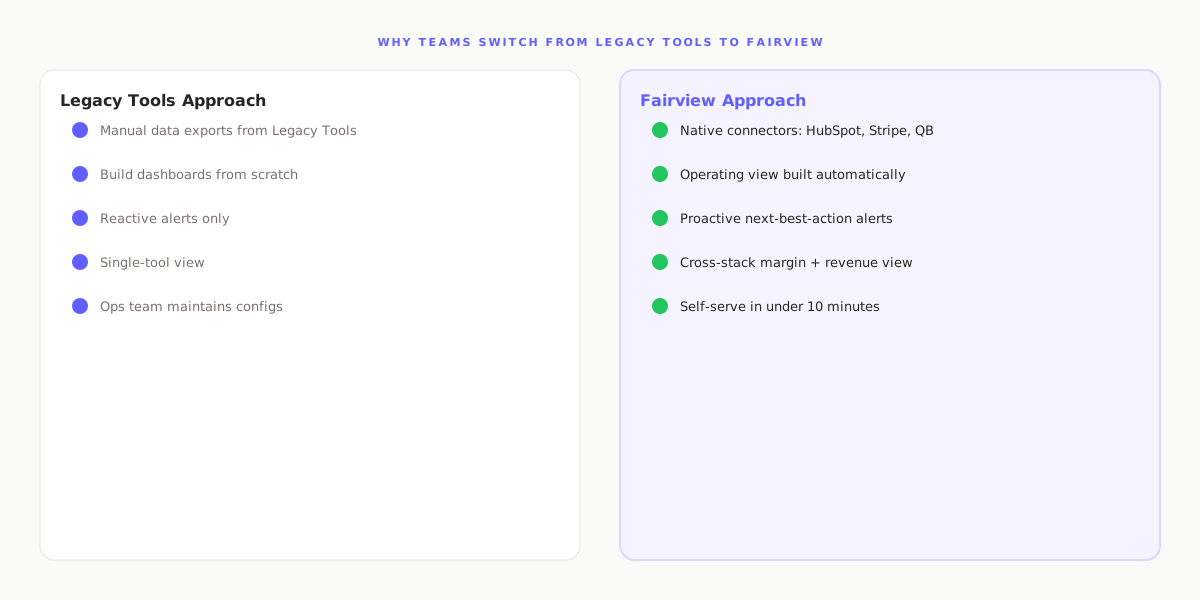
Mosaic is designed for finance professionals. Revenue operators — founders, CROs, RevOps leads — often find it difficult to extract the real-time pipeline and GTM intelligence they need from a planning-focused tool. The data is in Mosaic, but getting it out in the format operators need requires finance team involvement.
FP&A tools are built for periodic planning cycles — quarterly budgets, annual plans, board packages. Operating intelligence tools are built for real-time operational decisions. If you need to know your NRR trend this week or your pipeline coverage ratio right now, FP&A tools are the wrong abstraction.
Mosaic requires data integration work across multiple systems (ERP, CRM, billing, HRIS) before it produces meaningful output. Teams report 4–12 weeks of implementation before the platform is generating reliable reports — a significant time investment for fast-moving SaaS companies.
Mosaic's pricing is designed for Series B+ SaaS companies. Pre-Series B teams often find that the cost ($12,000–$36,000/year estimated) exceeds what can be justified for a tool that requires dedicated finance headcount to operate effectively.
The 6 Best Mosaic Alternatives in 2026
Fairview is not an FP&A tool — it is an operating intelligence platform designed for the revenue operators who run SaaS businesses day-to-day. Where Mosaic answers "what does our financial plan say?", Fairview answers "what is actually happening in the business right now and what should we do next?"
Fairview connects Salesforce, HubSpot, Stripe, and your billing system to surface real-time pipeline health, NRR waterfall, cohort retention, CAC payback period, and unit economics — without requiring a finance team to operate it. Revenue operators get the financial clarity they need to make GTM decisions, without waiting for the quarterly FP&A cycle.
For SaaS founders, CROs, and RevOps leads who are evaluating Mosaic but realize they need operational visibility rather than planning functionality, Fairview is the more appropriate tool at their stage.
Best for: SaaS founders, CROs, and RevOps leads at Series A–C who need real-time operating intelligence without a dedicated finance team.
Cube is a financial planning platform that sits on top of your existing Excel or Google Sheets models — rather than replacing them. It synchronizes financial data from your connected sources into your spreadsheets automatically, while adding version control, collaboration, and reporting features.
For finance teams that have built sophisticated models in Excel and do not want to abandon them, Cube provides the best of both worlds: the familiarity of spreadsheets with the data automation and collaboration features of a dedicated FP&A platform.
Best for: Finance teams with existing sophisticated spreadsheet models that want automation and collaboration without replacing their model infrastructure.
Pricing: Custom. Typically starts around $1,000–$2,500/month.
Planful (formerly Host Analytics) is one of the established enterprise FP&A platforms for mid-market companies. It provides financial consolidation, planning, reporting, and close management in a unified platform — covering a broader scope than Mosaic, including the financial close process alongside planning.
Planful is typically a better fit than Mosaic for companies with more complex organizational structures — multiple legal entities, subsidiaries, or international operations that require consolidation across currencies and accounting standards.
Best for: Mid-market companies ($50M–$500M revenue) with multi-entity structures that need financial consolidation alongside planning.
Pricing: Custom enterprise pricing. Typically $50,000–$200,000+/year.
Workday Adaptive Planning is the enterprise leader in financial planning software. It provides the most comprehensive planning, budgeting, forecasting, and reporting capabilities available — designed for organizations with hundreds of business units, complex approval workflows, and enterprise data governance requirements.
For organizations already on the Workday platform (Workday HCM, Workday Financial Management), Adaptive Planning integrates natively and provides a unified planning experience across finance and HR. For everyone else, the implementation complexity and cost are significant barriers.
Best for: Enterprise companies with complex organizational structures already on Workday's platform.
Pricing: Enterprise. Typically $100,000–$500,000+/year.
Causal is a modern financial modeling tool designed for startup CFOs and finance leads who want the power of a full financial model without the rigidity of traditional FP&A platforms. It uses a spreadsheet-like interface with built-in formulas for SaaS metrics, making it faster to build models than Excel but more flexible than Mosaic's structured approach.
Causal is especially popular with seed-to-Series B SaaS companies that have a part-time CFO or finance lead and need a fast, flexible modeling tool for investor reporting and internal planning — without the enterprise contract that Mosaic requires.
Best for: Seed to Series B SaaS companies with a part-time CFO who need fast, flexible financial modeling for planning and investor reporting.
Pricing: Starts around $100–$250/month for small teams.
Before Series A, the right Mosaic alternative is almost always Google Sheets or Excel. Purpose-built FP&A tools are designed to solve coordination problems — multiple people editing the same model, version control across planning cycles, consolidating data from multiple systems. These problems do not exist at pre-Series A scale.
A well-built SaaS financial model in Google Sheets — covering revenue, burn, headcount, and cohort LTV — is sufficient for most pre-Series A companies and significantly cheaper than any FP&A platform. The right time to move to a dedicated tool is when the spreadsheet starts breaking under coordination overhead, not before.
Best for: Pre-Series A SaaS companies that do not yet have the coordination problems that FP&A tools are designed to solve.
Pricing: Free (Google Sheets) to $12.50/user/month (Microsoft 365).
Quick Comparison: Mosaic vs Alternatives
| Tool | Primary User | Use Case | Price Range | Best Stage |
|---|---|---|---|---|
| Fairview | Revenue operators | Real-time operating intelligence | Per seat | Series A–C |
| Mosaic | CFO / Finance team | FP&A planning and reporting | $12K–$36K+/yr | Series B+ |
| Cube | Finance team | FP&A on spreadsheets | $1K–$2.5K/mo | Series A–B |
| Planful | Finance team | Multi-entity consolidation + planning | $50K–$200K+/yr | Mid-market |
| Workday Adaptive | Finance team | Enterprise FP&A | $100K–$500K+/yr | Enterprise |
| Causal | CFO / founder | Flexible financial modeling | $100–$250/mo | Seed–Series B |
| Google Sheets | Founder / CFO | Manual financial modeling | Free | Pre-Series A |
How to Choose: FP&A Tool vs Operating Intelligence
The most important question when evaluating Mosaic alternatives is: what problem are you actually trying to solve?
FP&A tools (Mosaic, Cube, Planful, Workday Adaptive, Causal) are built for the planning and reporting cycle. They answer questions like: What is our budget vs. actuals? What does our annual plan say? What scenarios should we model for the board?
Operating intelligence tools (Fairview) are built for the operational decision-making cycle. They answer questions like: What is our NRR trend this week? Where is pipeline coverage breaking down? What is our CAC payback period by segment? Which cohort is churning fastest?
These are different problems — and they require different tools. Many SaaS companies need both: Mosaic or Causal for the finance team's planning function, and Fairview for the revenue operator's operational function.
Key Takeaways
- Mosaic is an FP&A tool for finance teams — it is not the right tool for revenue operators who need real-time operating intelligence
- Fairview is the best Mosaic alternative for founders, CROs, and RevOps leads who need pipeline health, NRR, and unit economics without a finance team
- Cube is the best Mosaic alternative for finance teams with existing spreadsheet model investments they want to preserve
- Causal is the best choice for seed-to-Series B companies that need flexible financial modeling at lower cost
- Pre-Series A companies are almost always better served by Google Sheets than any dedicated FP&A platform