
Key takeaways
- What revenue operations actually is (in plain English)
- RevOps vs. sales ops, marketing ops, and the COO
- Who actually owns RevOps inside the company
TL;DR
- Revenue operations is the function that aligns sales, marketing, and customer success on one set of data, one forecast, and one accountable owner for the revenue number.
- Ownership shifts as a company grows: founder under $1M ARR, head of ops or VP sales between $1–5M, a dedicated RevOps lead from $2–5M onward, a CRO with a VP of RevOps once the engine clears $20M.
- The honest readiness test is operational, not size-based: you need RevOps when leadership gets three different revenue answers from three different people, not when you cross an arbitrary headcount line.
- Five signals say it's time. Three counter-signals say it's premature. Both lists matter — most "do we need RevOps" articles only ship the first one.
- Fairview is the operating intelligence layer underneath a RevOps team — one connected view across CRM, billing, accounting, and ad platforms so the seven KPIs a CRO asks about every Monday don't have to be rebuilt by hand.
If your Monday morning starts with three people pulling three different revenue numbers from three different tools — and the CEO has stopped asking because the answer keeps changing — the problem usually isn't the tools. It's that nobody owns the revenue number end-to-end. This guide covers what revenue operations actually is, who owns it inside companies that have it working, and the readiness signals that tell you it's time to formalize the function (and the counter-signals that tell you it's still premature).
Most operators we've worked with arrive at the same crossroads. The company is past the founder-runs-it-all stage. Sales has a leader. Marketing has a leader. Customer success exists. Each function reports clean numbers in isolation, and each function's numbers don't add up to a coherent picture of the business. The handoffs leak revenue and leadership doesn't trust the forecast.
RevOps is the answer most growth-stage B2B companies converge on. But "you need RevOps" gets thrown around so loosely that it's stopped meaning anything. This article fixes that by treating the question as a three-part decision: what RevOps is, who owns it (and how that ownership shifts by stage), and when you actually need it.
What revenue operations actually is (in plain English)
Definition
Revenue operations (RevOps): the operating function that aligns sales, marketing, and customer success on one shared data layer, one forecast, one set of metrics, and one accountable owner for the revenue number. Its job is to close the handoff gaps between go-to-market teams that quietly cost growing companies revenue, margin, and forecast credibility.
Strip away the consulting language and RevOps is doing one thing: making sure the three customer-facing teams in a B2B company — the people who attract demand, the people who close it, and the people who keep it — operate from the same playbook and the same numbers. When that's true, leadership gets one revenue answer instead of three. When it isn't, the company has expensive duplication and expensive blind spots.
It helps to read the function at two levels. The strategic view is the one that gets pitched in board meetings: one owner, one number, one forecast, one set of metrics that link marketing investment to closed revenue to retention. The operational view is what the RevOps person actually does on a Tuesday: pipeline hygiene, forecast modeling, attribution rules, territory and quota design, the tooling stack, and the weekly operating cadence that turns all of it into a rhythm rather than a fire drill. A complete RevOps function delivers both.
Gartner predicted that 75% of the highest-growth companies in the world would deploy a revenue operations model by 2025. That prediction tracked: by 2024, RevOps had moved from a coastal SaaS curiosity into a mainstream go-to-market function for B2B companies past Series A. Most companies didn't restructure because RevOps sounded fashionable. They restructured because the alternative — three separate ops functions reporting to three separate VPs with three separate priorities — had stopped scaling.
For a deeper definitional walkthrough including team structure and the maturity model most companies follow, the Fairview team also publishes a longer explainer on what RevOps is and how to build one. This article stays at the decision-framework layer.
RevOps vs. sales ops, marketing ops, and the COO
The most common mistake we see is calling sales ops "RevOps" because the title sounds more current. They aren't the same function. The difference is scope, reporting line, and what the role is held accountable for.
| Function | Serves | Reports to | Held accountable for |
|---|---|---|---|
| Sales ops | Sales team only | VP of Sales | Quota, pipeline, forecast accuracy for sales |
| Marketing ops | Marketing team only | CMO / VP Marketing | Attribution, MAP, lead scoring, MQL flow |
| CS ops | Customer success only | VP Customer Success | Health scoring, renewals, NRR |
| RevOps | Sales + marketing + CS (whole engine) | CRO, CFO, or CEO | One revenue number, end-to-end |
| COO | Whole company | CEO | Cross-functional execution; revenue is one of several lines |
Key insight
Sales ops optimizes a team. RevOps optimizes the revenue system that team is part of. The COO sits one level above and owns execution across the whole company, of which revenue is one workstream.
The COO overlap is worth pausing on, because in our engagements it's where ownership questions get muddiest. A COO usually owns the revenue line in companies under roughly $5M ARR, then hands it down to a dedicated RevOps lead or CRO once the company can support a specialist. In companies that never hire a CRO — common in founder-led B2B companies that grow past $30M with the founder still in the seller seat — RevOps continues reporting to the COO indefinitely. Both work. What doesn't work is having a COO and a CRO and a VP of Sales all unclear on which one owns the forecast.
If you want a deeper look at the sales-ops-vs-RevOps distinction specifically, we cover the differences in detail in our RevOps vs. sales ops post.
Who actually owns RevOps inside the company
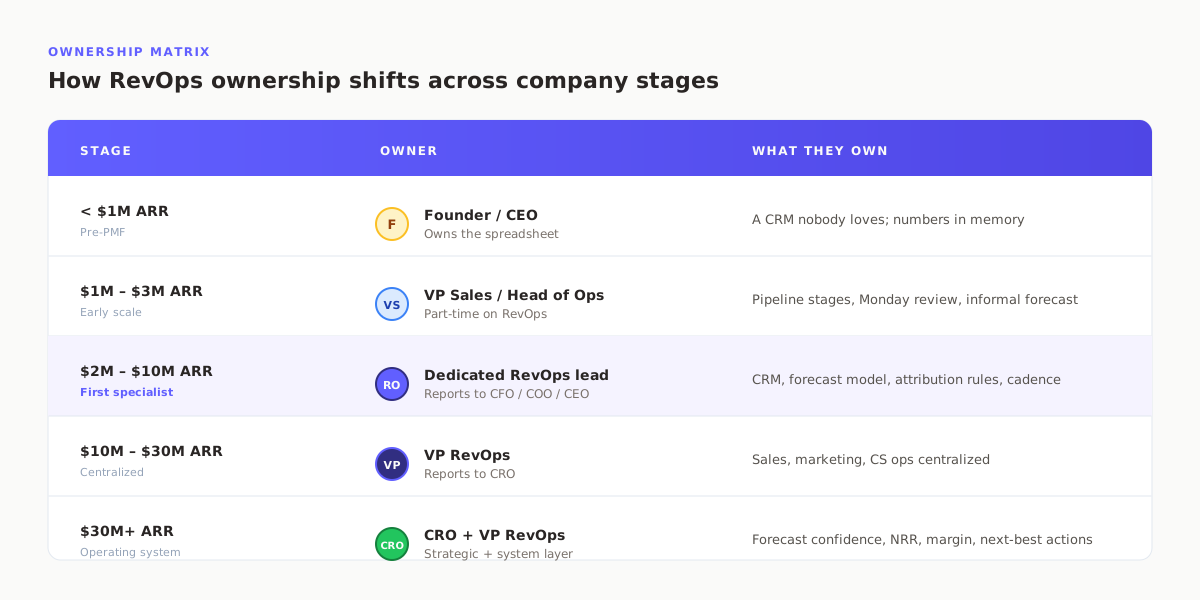
"Who owns RevOps" is the question most posts dodge. The honest answer: it depends on stage, and the wrong owner is more common than no owner. Here is the pattern we see across B2B companies between $1M and $50M ARR.
| Stage | Default owner | What they actually do |
|---|---|---|
| Pre-product-market-fit / under $1M ARR | Founder or CEO | Owns the spreadsheet. There is no system, just memory and a CRM nobody loves. |
| $1M–$3M ARR | VP of Sales (part-time) or Head of Ops | Defines pipeline stages, runs the Monday review, owns the forecast informally. |
| $2M–$10M ARR | Dedicated RevOps lead reporting to CFO, COO, or CEO | First specialist hire. Cleans the CRM, builds the forecast model, picks the tools, writes the operating cadence. |
| $10M–$30M ARR | VP RevOps reporting to CRO | Owns sales, marketing, and CS ops centrally. Three to five direct reports. Runs the full operating system. |
| $30M+ ARR | CRO + VP RevOps | CRO owns the revenue number to the board; VP RevOps owns the system that produces it. |
Two patterns repeat in this matrix worth flagging. First, the reporting line for the dedicated RevOps lead between $2M and $10M is genuinely flexible. CFO works when finance is the strongest operating function in the company. COO works when there's no CRO and execution discipline lives there. CEO works in flat early-stage orgs. We've seen all three succeed and all three fail. The reporting line matters less than whether the role has clear authority to set process across sales, marketing, and CS.
Second, the most common ownership failure isn't the wrong owner — it's shared ownership. RevOps fails predictably when the VP of Sales claims to "co-own" RevOps with the CMO and there's no senior arbiter. In our experience, RevOps decisions need a single authoritative owner who can resolve a disagreement between two function heads in under an hour. If that authority isn't clear before the function is staffed, the function won't work — and replacing the person won't fix it.
A practical decision rule: ask who, today, is accountable to the board for the next twelve months of revenue. That person owns RevOps until you formally hand it down. If the answer is "the CEO and the VP of Sales" or "the founder and the CRO", the company has an ownership problem RevOps can't solve until it's resolved upstream.
For the specific decision of when and how to hire the dedicated lead, we cover the full hiring playbook in our guide to hiring a RevOps manager, including the JD, the interview loop, and the salary band.
What a RevOps owner actually does on a Monday morning
The job title is abstract. The actual job is concrete. Here is the weekly cadence we see at companies where RevOps is working — the operating rhythm that justifies the headcount line.
- Monday — revenue review. One meeting, one dashboard, one set of numbers. Pipeline coverage, week-over-week movement, forecast call vs. last week, top three deals at risk, top three deals likely to pull in. The CEO sees the same numbers as the AE. No parallel spreadsheets.
- Tuesday — deal desk. Pricing exceptions, security reviews, multi-product packaging, anything non-standard. RevOps runs it as a single queue rather than the sales team escalating to finance, legal, and security separately.
- Wednesday — marketing-sales handoff review. Where did MQLs come from, which converted, which didn't, why. Attribution rules get tightened here, not in retroactive QBR slides.
- Thursday — pipeline grooming. Stale deals get re-aged or closed-lost. Stage-skipping gets corrected. The data the forecast runs on gets cleaned before the next Monday.
- Friday — operating report. A short written note to the leadership team: what moved, what's at risk, what's the call for next week. Replaces three separate weekly emails from sales, marketing, and CS.
Underneath that cadence sits the tooling stack — CRM, marketing automation, the data warehouse, the forecasting tool, the BI layer — and the seven deliverables we cover in detail in the longer RevOps explainer: pipeline hygiene, forecasting, attribution, quota and territory design, the revenue tech stack, unified reporting, and the operating rhythm itself. If any one of those seven lives in a different function (or worse, lives nowhere), the engine has a gap and the forecast will be off.
In our engagements, the test of whether RevOps is real isn't the org chart. It's whether the Monday meeting can run without the CEO. When it can, the function is doing its job. When the CEO has to mediate every disputed number, the function exists in name only.
Five signals it's time to formalize RevOps
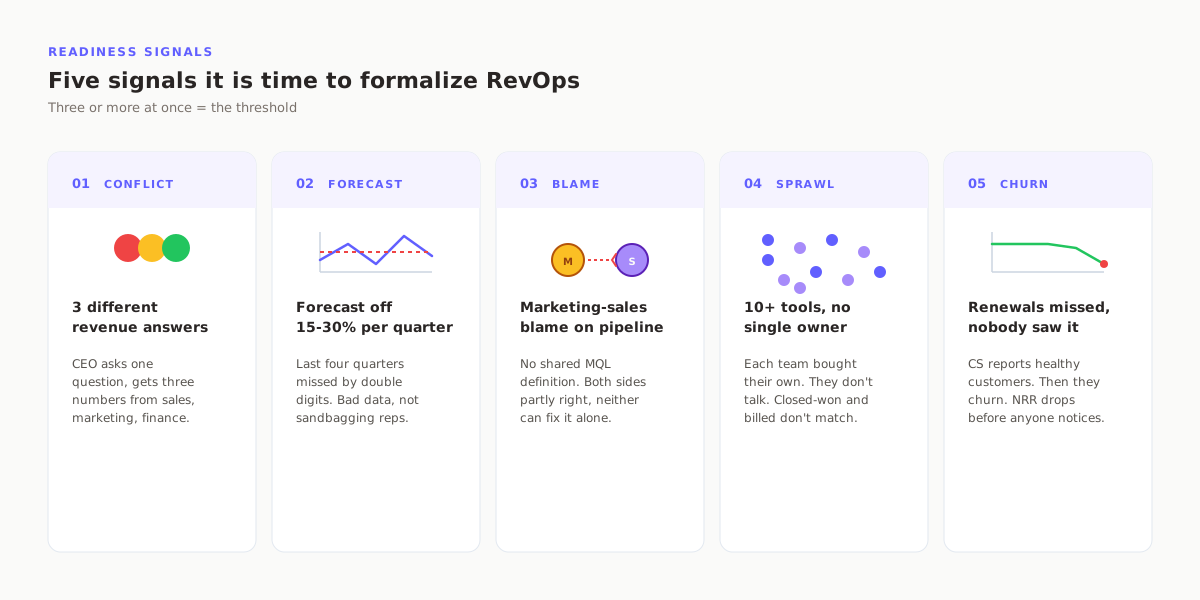
ARR thresholds are the headline answer most articles give for "when do you need RevOps". The thresholds are useful as a rough guide, but they aren't the trigger. The trigger is operational pain. Here are the five signals we see most consistently in companies that are ready, regardless of stage.
- Three people give three different revenue answers. The CEO asks "what's our committed pipeline this quarter?" and gets one number from sales, a different number from marketing, and a third from finance. None of them are wrong — they're just running different definitions. This is the single most reliable signal we see, and it usually shows up between $2M and $5M ARR.
- Forecast accuracy is consistently off by more than 15%. Most operators we work with see quarterly forecast-to-actual variance in the 15–30% range when there's no formal RevOps function. That much variance makes the forecast useless for hiring and capital decisions. If your last four quarters all missed by double digits in either direction, the diagnosis is rarely "the reps are sandbagging" — it's that the forecast model is consuming bad data.
- Marketing and sales are blaming each other for pipeline. Marketing says they're hitting MQL targets and sales is wasting them. Sales says the MQLs are unqualified. Both are partly right, and the only fix is a shared definition of what counts as a qualified lead, owned by someone neither team reports to. That's RevOps' job.
- The tech stack has grown to 10+ tools nobody fully understands. Every team has bought their own CRM add-on, MAP, conversation intelligence tool, BI tool, and data enrichment tool. They don't talk to each other. The data layer is now the bottleneck — Sales' "closed-won" doesn't match Finance's "billed". A RevOps owner consolidates the stack and writes the integration rules.
- Renewals are getting missed and nobody saw it coming. Customer success is reporting healthy customers right up until the day they churn. The handoff data from sales never made it to CS, and CS health scoring is based on usage data that doesn't reflect contract reality. NRR drops a few points before anyone notices. By the time it shows up in the board deck it's already cost a quarter.
Three or more of these at once is the threshold we use. One signal is usually noise; two is a watch-list; three is operational debt that's compounding faster than the team can pay it down. Stage 2 Capital's writeup on RevOps hiring matches this pattern: the trigger is signal-driven, not size-driven, and waiting until $10M+ ARR is a mistake the highest-growth companies don't make.
When RevOps is premature (don't hire yet)
The honest counter-section. Plenty of seed-stage and early-Series-A companies are advised to "stand up RevOps now" by people selling RevOps services. Most of them shouldn't. Here are three signals that you're not ready, and the alternative for each.
1. You haven't found product-market fit yet. If your sales motion is still being figured out — different reps closing different ICPs at different price points — there's no system to systematize. Hiring a RevOps person to "get our processes in place" before the motion is repeatable is a way to lock in the wrong process. The alternative: keep the founder or VP of Sales running the Monday review, with a single shared CRM and a single shared deal log. Don't formalize anything else yet.
2. Your ARR is under $1M and your team is under 10 people. A dedicated RevOps hire at this stage is usually a six-figure cost against a revenue line that doesn't yet support specialist headcount. The work the role would do — pipeline hygiene, forecast modeling, deal review — is small enough that the founder and VP of Sales together can absorb it in a couple of hours per week. The alternative: a fractional RevOps consultant for two days a month to set up the foundation, then re-evaluate at $2M ARR.
3. You don't have customer success or marketing yet. "RevOps" by definition spans the three GTM functions. If you only have sales — common in technical-founder PLG companies and early outbound-only motions — there's nothing to align across. What you have is sales ops, and sales ops should report to the VP of Sales. The alternative: hire sales ops first, label it as such, and let it grow into RevOps when the other functions are staffed and the cross-team handoffs start mattering.
The pattern across all three: the work isn't yet there to justify the title. Naming it RevOps prematurely buys you a more impressive org chart and a slower decision-making process. In our experience, founders who delay the formal hire by six to twelve months past the "we should have RevOps" feeling tend to get a better hire when they do — because the work has clarified itself in the interim.
Where RevOps fits across company stages
Pulling the ownership matrix and the readiness signals into one stage-by-stage view. This is the picture most operators are looking for when they search "what is revenue operations" — they're really asking "where am I in the curve, and what's the next move?"
| Stage | Who owns RevOps | What's in place | Hire next |
|---|---|---|---|
| Under $2M ARR | Founder + VP Sales | Shared CRM, weekly Monday review, one forecast number | Fractional RevOps consultant (2 days/month) |
| $2M–$10M ARR | First dedicated RevOps lead → CFO / COO / CEO | Cleaned CRM, defined pipeline stages, forecast model, attribution rules | Sales ops or marketing ops specialist (depending on which is bottleneck) |
| $10M–$30M ARR | VP RevOps → CRO | Centralized sales/marketing/CS ops, unified reporting, weekly operating rhythm | Data analyst, systems admin, enablement partner |
| $30M+ ARR | CRO + VP RevOps | Full operating system — forecast confidence, NRR tracking, margin intelligence, next-best-action workflows | Specialist analysts by domain (forecast, deals, GTM) |
If you want a much longer-form treatment of the maturity progression itself — the four-stage model, the deliverables at each stage, and the metrics that prove each stage is working — our complete RevOps pillar guide goes deeper. This article is the on-ramp.
What good RevOps looks like (the metrics that prove it)
A working RevOps function is judged on a tight set of numbers. Not on dashboards built. Not on tools deployed. Not on processes documented. The seven KPIs every CRO and CFO returns to are these:
| KPI | What it measures | Healthy range |
|---|---|---|
| Pipeline coverage | Open pipeline ÷ quota | 3–4× |
| Forecast accuracy | Commit vs. actual | ±5% at 2 weeks out |
| Win rate | Closed-won ÷ all closed | 22–35% SMB, 15–25% enterprise |
| CAC payback | Months to recover CAC | Under 15 months (SaaS) |
| Net revenue retention | Expansion − churn | Above 110% top-quartile |
| Gross revenue retention | 1 − logo/dollar churn | Above 90% |
The Scale Venture Partners public SaaS benchmark tracks most of these across listed SaaS companies each quarter and is the closest thing the industry has to a baseline. For a deeper treatment of the metric definitions, formulas, and how to track them in a single weekly view, see our RevOps KPIs post.
A practical test: a working RevOps function reports all seven of these numbers in one place, on the same cadence, with the same definitions, every Monday. If you're rebuilding the dashboard each week or stitching reports across five tools, the function isn't yet what it's claimed to be — even if the title is on someone's email signature.
How Fairview powers a RevOps team automatically
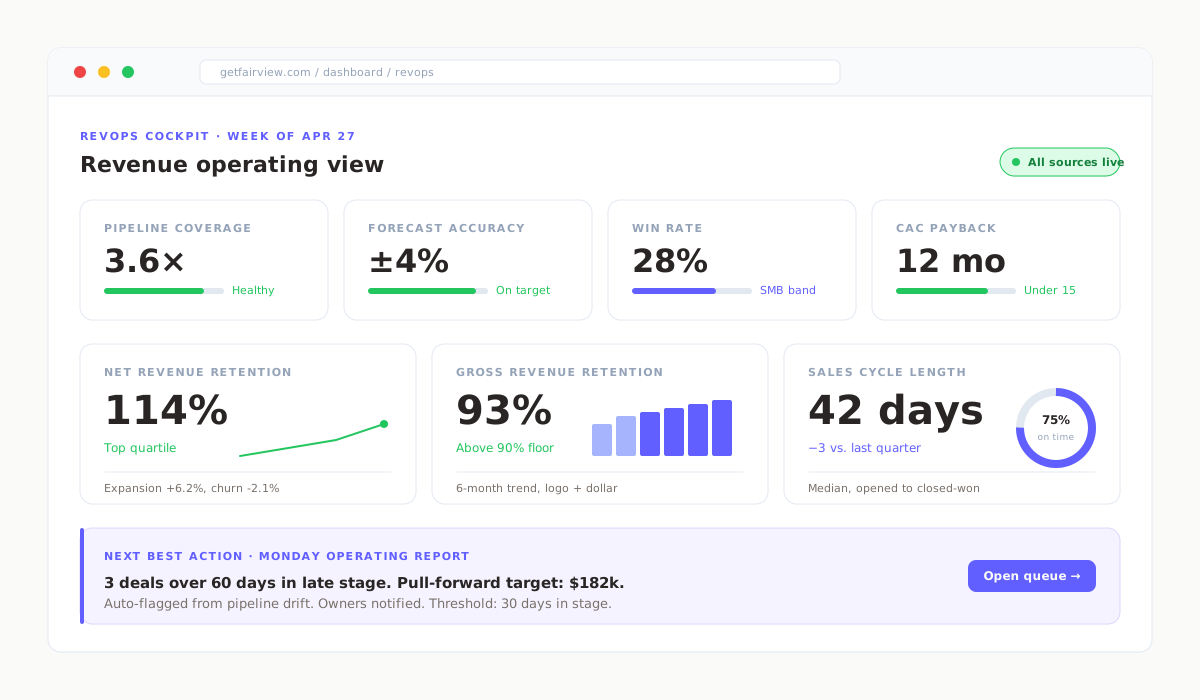
Fairview is the operating intelligence layer underneath a working RevOps team. Once HubSpot or Salesforce, Stripe, QuickBooks or Xero, and your ad platforms are connected, Fairview computes pipeline coverage, forecast confidence, NRR, CAC payback, and the rest of the seven KPIs in one connected view — the same numbers a CRO or CFO asks about every Monday, without a RevOps analyst rebuilding the dashboard each week.
When a number drifts past the threshold a RevOps lead sets, Fairview writes a named next-best action into the weekly operating report with an estimated dollar impact. The same rhythm that keeps the forecast honest also surfaces margin and retention drift earlier than a stitched-together BI stack would catch.
7
Core RevOps KPIs in one view
Weekly
Operating rhythm baked in
10 min
Setup to first dashboard
See pricing and tiers or the product overview for what a RevOps cockpit looks like in practice.
Key takeaways
- Revenue operations aligns sales, marketing, and customer success on one data layer, one forecast, and one accountable owner. It is broader than sales ops and reports higher.
- Ownership shifts by stage: founder under $1M, VP Sales or Head of Ops between $1–3M, dedicated RevOps lead from $2–5M, VP RevOps under a CRO from $10M+.
- The trigger to formalize is operational, not size-based. Three or more of the five readiness signals — conflicting revenue answers, double-digit forecast variance, marketing-sales blame, tool sprawl, missed renewals — is the threshold.
- Three counter-signals say it's premature: pre-PMF, sub-$1M ARR with under 10 people, no CS or marketing function yet.
- The function is judged on seven KPIs reported weekly in one place. If you're rebuilding the dashboard each Monday, RevOps isn't yet doing its job.
Conclusion
RevOps isn't a title or a tool. It's the operating function that makes a B2B company's revenue number defensible — one data layer, one forecast, one accountable owner. The version of the question worth asking isn't "what is revenue operations" in the abstract. It's: who owns the revenue number in your company today, what would have to be true for that ownership to scale past $10M, and which of the five readiness signals are showing up on your Monday review right now?
If those answers are clear, you have RevOps even if nobody's title says so. If they aren't, the next move is fixing the ownership question first and the tooling question second — in that order.
See it in your data
Try Fairview free for 14 days.
First data source live in 10 minutes. No credit card. Cancel any time.