Revenue · Cluster 2 Spoke

What Is RevOps? Definition, Roles, and How to Build It

A plain-English guide to Revenue Operations: what it is, how it differs from Sales Ops, the roles you actually need, and the four-stage model for building one.

SGBy Siddharth Gangal · Founder, Fairview · Updated April 12, 2026 · 11 min read

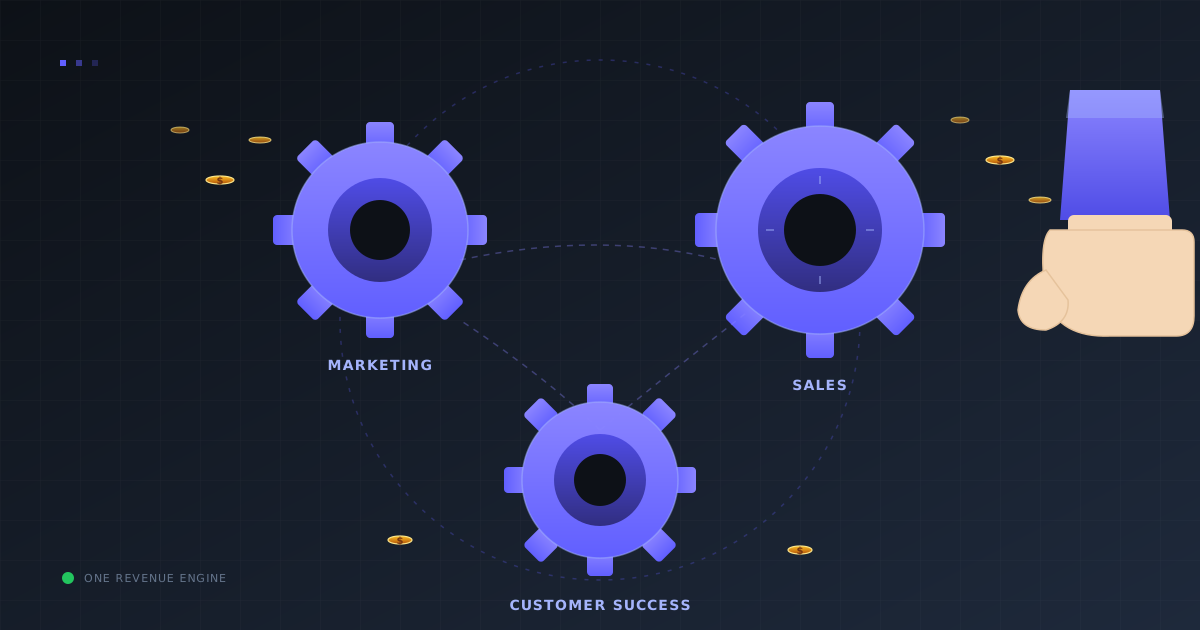
RevOps hero: three interlocking gears labeled Marketing, Sales, and Customer Success meshed into one revenue engine

TL;DR

  • Revenue Operations (RevOps) unifies Sales, Marketing, and Customer Success into one revenue engine with shared data, shared metrics, and one accountable owner for the revenue number.
  • It is not Sales Ops with a new name. Sales Ops serves one team; RevOps serves all three go-to-market functions and reports into the CRO or CFO.
  • A working RevOps team owns seven things: pipeline hygiene, forecasting, attribution, quota/territory, tooling, reporting, and the weekly operating rhythm.
  • Most companies hire their first RevOps leader between $2M and $5M ARR, then build through four maturity stages: Ad hoc, Defined, Measured, Integrated.
  • Fairview provides the operating intelligence layer a RevOps team sits on top of — one unified view across HubSpot, Stripe, QuickBooks, and ad platforms.

RevOps, short for Revenue Operations, is the function that unifies Sales, Marketing, and Customer Success under one operating system — one set of numbers, one forecast, one accountable owner for the revenue line. Its job is to eliminate the handoff gaps that cost growing companies revenue.

Most B2B companies start with three separate go-to-market teams, each with its own tools, reports, and forecast. That works under $2M ARR. Past that, the gaps between them quietly cost real money — leads that marketing closed but sales never worked, renewals that nobody owned, forecasts that three teams all dispute.

RevOps is the operating function that closes those gaps. This guide covers the definition, the team structure, how it differs from Sales Ops, the KPIs RevOps actually owns, a four-stage maturity model, and how to build one from scratch.

What is RevOps?

Definition

Revenue Operations (RevOps): the end-to-end function that aligns Sales, Marketing, and Customer Success on one set of data, one forecast, and one accountable owner for the revenue number. It owns the systems, the reporting, and the operating rhythm that connect the three teams.

The term gained traction after 2017 as SaaS companies realized their fastest-growing peers had reorganized around a single CRO rather than three separate VPs. A Gartner forecast predicted that 75% of the highest-growth companies would deploy a RevOps model by 2025. The pattern held: by 2024, LinkedIn’s job listings showed RevOps as one of the fastest-growing operations roles in B2B.

Read the function at two levels: the strategic view (one owner, one number, one forecast) and the operational view (pipeline hygiene, territory design, attribution, tooling, weekly reporting). A complete RevOps team delivers both.

RevOps vs Sales Ops vs Marketing Ops

RevOps is often confused with Sales Ops. The difference is scope — RevOps covers the whole revenue engine, Sales Ops covers one team.

FunctionServesReports to
Sales OpsSales team onlyVP of Sales
Marketing OpsMarketing team onlyVP of Marketing / CMO
CS OpsCustomer Success onlyVP of Customer Success
RevOpsSales + Marketing + CS (whole engine)CRO, CFO, or CEO

Key insight

Sales Ops optimizes a team. RevOps optimizes the revenue system that team is part of.

Roles on a RevOps team

RevOps team structure with CRO over RevOps Lead, and Sales Ops, Marketing Ops, and CS Ops reporting in
A mature RevOps org rolls Sales, Marketing, and CS Ops under one leader reporting to the CRO.

A typical RevOps team scales in this order:

1. RevOps Lead / VP

Owns the revenue operating system end-to-end: the forecast model, the tech stack, the weekly operating rhythm, and cross-functional SLAs. Reports to the CRO, CFO, or CEO depending on org design. First hire usually lands between $2M and $5M ARR.

2. Sales Ops

Pipeline hygiene, quota and territory design, CRM administration, forecast accuracy, commission calculations. The deepest bench inside RevOps at most B2B companies.

3. Marketing Ops

Attribution, campaign reporting, lead scoring, MAP administration (HubSpot, Marketo), and the handoff rules between marketing-qualified and sales-accepted leads. Often hired at the same stage as Sales Ops or shortly after.

4. Customer Success Ops

Health scoring, renewal forecasting, churn analysis, expansion tracking. Typically the last hire, but the one that completes the loop — without CS Ops, RevOps cannot report net revenue retention accurately.

5. RevOps Analyst / Systems

Horizontal roles that sit under the RevOps Lead: data analyst for reporting, systems admin for integrations, enablement partner for rollout. Added once the function crosses roughly five headcount.

What RevOps actually owns

A working RevOps team owns seven deliverables. If any of these lives in a different team, the revenue engine has a gap:

  1. Pipeline hygiene and stage definitions. Every deal in the CRM follows one set of stage rules. Stale deals are flagged weekly.
  2. Forecasting. One model, one cadence, one commit number that Sales, Finance, and the board all see.
  3. Attribution. A single, documented model for how revenue credit flows from first touch to closed-won.
  4. Quota, territory, comp. Annual design plus mid-year adjustments, with clear math that reps can reproduce.
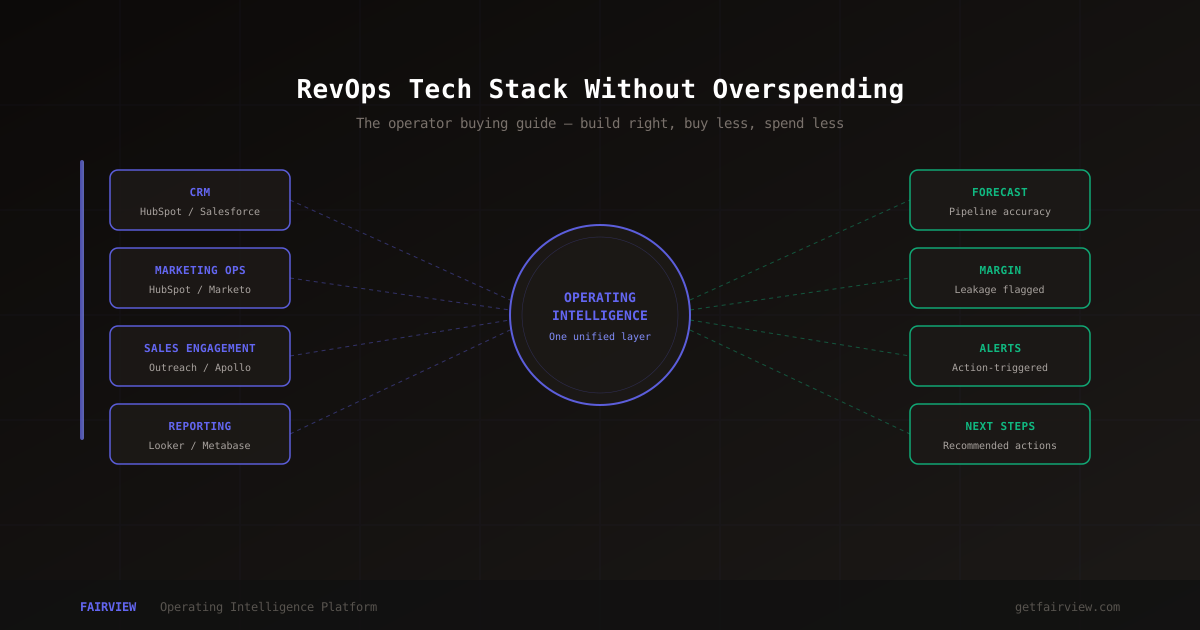
  5. Revenue tech stack. CRM, MAP, CS platform, forecasting tool, billing, data warehouse — integrated, not duct-taped.
  6. Unified reporting. One dashboard covering pipeline, forecast, NRR, CAC payback, win rate. Weekly refresh.
  7. Weekly operating rhythm. Monday revenue review, Tuesday deal desk, Thursday pipeline grooming — published and enforced.

Core RevOps KPIs

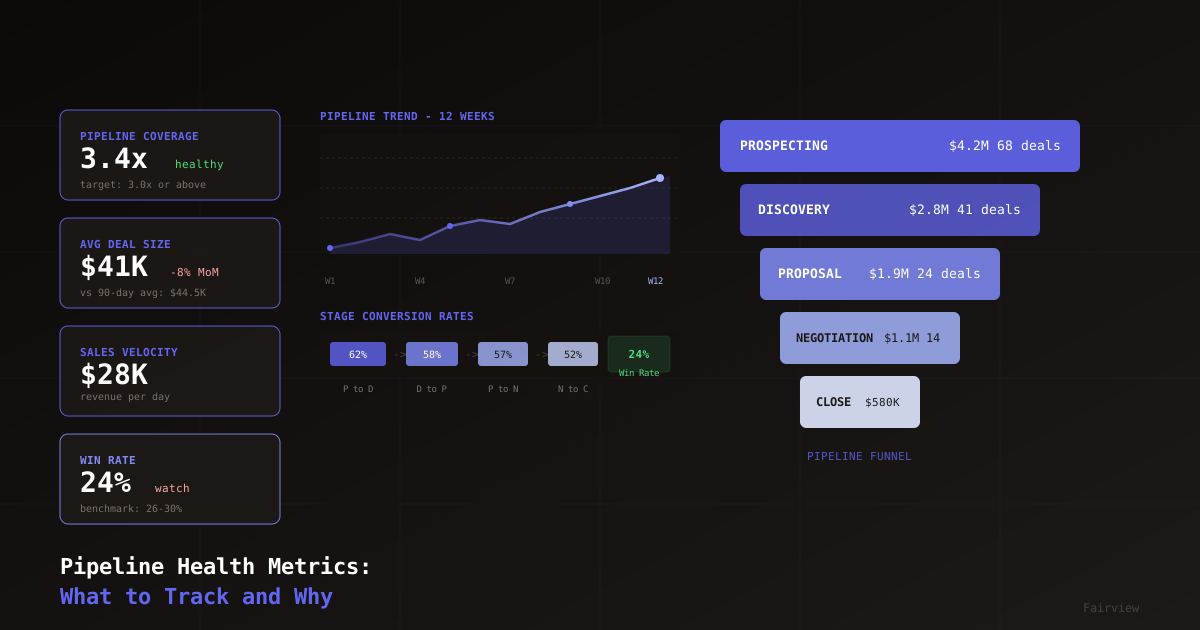
RevOps is judged on a tight set of numbers. These are the ones that show up in every board deck and every weekly review:

KPIWhat it measuresHealthy range
Pipeline coverageOpen pipeline ÷ quota3–4×
Forecast accuracyCommit vs actual±5% at 2 weeks out
Win rateClosed-won ÷ all closed22–35% SMB, 15–25% enterprise
Sales cycle lengthAvg days opened-to-wonVaries by ACV
CAC paybackMonths to recover CAC<15 months (SaaS)
Net revenue retentionExpansion − churn>110% (top-quartile SaaS)
Gross revenue retention1 − logo/dollar churn>90%

The Scale Venture Partners public SaaS benchmark tracks these across listed SaaS companies each quarter and is the closest thing to an industry baseline.

The RevOps maturity model

RevOps maturity model: four stages from ad hoc spreadsheets to an integrated revenue operating system
Most B2B companies progress through four stages as they cross $2M, $10M, and $30M ARR.

Stage 1 — Ad hoc (under $2M ARR). Three teams, three spreadsheets, three revenue numbers. The founder or a VP of Sales patches reports together each Monday.

Stage 2 — Defined ($2M–$10M ARR). A single shared CRM, agreed pipeline stages, the first dedicated RevOps hire. Handoff rules between marketing, sales, and CS get written down.

Stage 3 — Measured ($10M–$30M ARR). Unified reporting, published attribution model, weekly operating review, tooling consolidated. ARR and NRR are tracked in the same view.

Stage 4 — Integrated ($30M+ ARR). A revenue operating system. Next-best actions, forecast confidence, margin, and retention all in one place. The weekly review is driven by the system, not rebuilt from scratch.

How to build a RevOps function from scratch

Five moves, roughly in order. Most companies try to do them in parallel and end up with nothing working. Do them sequentially.

  1. Appoint an owner. Before any hire or tool, name one person (the CRO, CFO, or VP of Sales) accountable for the revenue number end-to-end. RevOps fails when nobody owns it.
  2. Unify the CRM. One CRM, one set of pipeline stages, one deal owner field that covers marketing-sourced, sales-sourced, and expansion deals. This alone kills 80% of the handoff gaps.
  3. Hire or assign a RevOps Lead. A strong operator with equal parts Sales Ops and analytics background. Usually between $2M and $5M ARR.
  4. Publish one forecast and one operating rhythm. Monday revenue review. Tuesday deal desk. One forecast number everyone sees. No parallel spreadsheets.
  5. Add the operating intelligence layer. Once the process is in place, layer in a system that unifies pipeline, forecast, margin, and retention without manual rebuilds. That is where an operating intelligence platform replaces five separate dashboards.

How Fairview powers a RevOps team automatically

Fairview RevOps cockpit with unified pipeline coverage, forecast confidence, NRR, CAC payback, and next-best actions
Fairview’s operating view gives a RevOps team one cockpit across Sales, Marketing, and CS.

Fairview is the operating intelligence layer underneath a modern RevOps team. Once HubSpot or Salesforce, Stripe, QuickBooks or Xero, and an ad platform are connected, Fairview computes pipeline coverage, forecast confidence, NRR, and CAC payback in one view — the same seven KPIs a CRO asks about every Monday.

When a number drifts past the threshold a RevOps lead sets, Fairview writes a named next-best action into the Monday operating report with an estimated dollar impact. The same rhythm that drives the profit leak detection framework applies to revenue drift as well as margin drift.

See pricing and tiers or the product overview for a closer look at what a RevOps cockpit looks like in practice.

7

Core RevOps KPIs unified

Weekly

Operating rhythm baked in

10 min

First connection to first view

Key takeaways

  • RevOps unifies Sales, Marketing, and Customer Success under one operating system and one owner.
  • It is distinct from Sales Ops — broader scope, higher reporting line, whole-engine focus.
  • A working team owns seven deliverables: pipeline, forecast, attribution, quota, tools, reporting, rhythm.
  • Companies typically progress through four maturity stages as they cross $2M, $10M, and $30M ARR.
  • Build it in order: owner, CRM, RevOps lead, operating rhythm, operating intelligence layer.

Give your RevOps team one cockpit, not five dashboards.

Connect HubSpot or Salesforce, Stripe, and QuickBooks or Xero. Fairview returns a unified RevOps view on day one. 14-day trial, no card required.

Book a demoStart free trial

Frequently asked questions

Revenue Operations (RevOps) is the function that unifies Sales, Marketing, and Customer Success under one operating system — shared data, shared metrics, shared forecasting, and one accountable owner for the revenue number. Its job is to eliminate the handoff gaps that cost growing companies revenue and margin.

A RevOps team owns the revenue operating system end-to-end: pipeline hygiene, forecasting, attribution, territory and quota design, tooling and integrations, weekly reporting, and the cross-functional rules that keep Sales, Marketing, and Customer Success aligned on one revenue number.

Sales Ops serves one team — the sales org. RevOps serves the entire revenue engine, which includes Sales, Marketing, and Customer Success. Sales Ops typically reports into a VP of Sales; RevOps reports into the Chief Revenue Officer, CFO, or CEO because its remit crosses the whole go-to-market org.

Most B2B companies hire their first dedicated RevOps person between $2M and $5M ARR, once Sales, Marketing, and Customer Success are each staffed and the handoff gaps start costing revenue. Before that, a founder or VP of Sales typically runs RevOps part-time with a shared CRM and a weekly operating review.

The core seven: pipeline coverage, forecast accuracy, win rate, sales cycle length, CAC payback, net revenue retention (NRR), and gross revenue retention (GRR). A mature RevOps team reports all of these in one weekly view rather than stitching reports together from Sales, Marketing, and Customer Success each Monday.

RevOps is the team and the operating rhythm. Operating Intelligence is the data layer that powers it — unified reporting across revenue, margin, retention, and forecast in one view. A strong RevOps team uses an operating intelligence platform instead of stitching reports across five separate tools. The team runs the rhythm; the platform keeps the numbers honest.

Tags

what is revopsrevenue operationsrevops teamrevops maturity modeloperating intelligence

Keep reading

Related posts

Ready to see your data clearly?

Stop reporting on last week.
Start acting on this week.

10 minutes to connect. No SQL. No engineering team. Your first dashboard is built automatically.

No credit card required · Cancel anytime · Setup in under 10 minutes