Key takeaways
- What is business intelligence?
- What is profit intelligence?
- The side-by-side
TL;DR
- BI answers “what happened to revenue?” Profit intelligence answers “which channels and SKUs are actually making money?”
- BI serves analysts building retrospective dashboards. Profit intelligence serves operators who need a margin decision by Monday.
- BI output is a chart. Profit intelligence output is a named action grounded in contribution margin data.
- Most growth-stage B2B and DTC companies need profit intelligence alongside BI, not instead of it.
- Fairview is profit intelligence purpose-built for the operator, not the analyst.
If you own a BI tool and still spend part of every Monday reconciling margin numbers across your ad accounts, your P&L, and your CRM, the dashboards are not the problem. The category is. Business intelligence was designed for a different question than the one you are trying to answer.
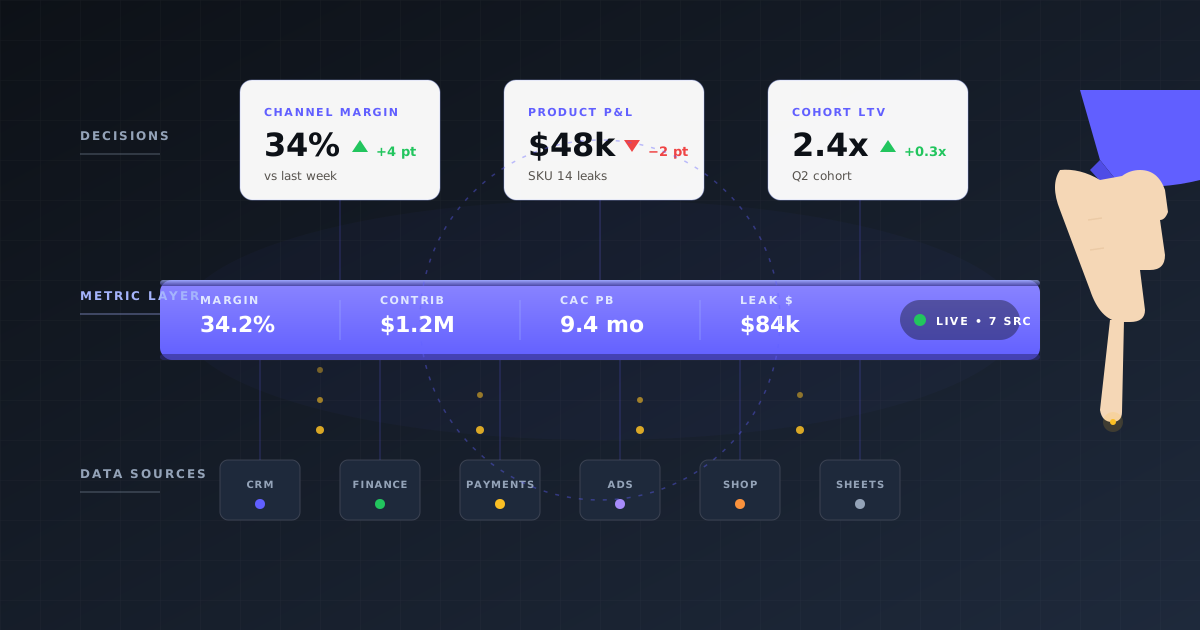
Profit intelligence is a specific discipline inside operating intelligence — the margin-side answer to the operating question your BI tool leaves open. It joins revenue, COGS, ad spend, fulfillment costs, and CRM data so you know, on a contribution-margin basis, which channels and SKUs are generating profit right now, not just which ones are generating revenue.
This post draws the line clearly: how each category is defined, what each one outputs, when to use each, and where the common misconceptions come from. It complements our posts on operating intelligence vs business intelligence and how to find profit leaks — read those alongside this one for the full picture.
What is business intelligence?
Definition
Business intelligence (BI): the category of software that turns historical data from a warehouse or database into dashboards, charts, and reports used to understand what happened. Common tools include Looker, Tableau, Power BI, and Metabase. Built for analysts; optimized for retrospective reporting across revenue, conversion, and operational metrics. (Gartner: Business Intelligence)
BI emerged in the 1990s and expanded rapidly through the 2010s as data warehousing became accessible to mid-market companies. Its architecture is SQL-driven, analyst-operated, and chart-outputting. When you need to answer “what was our revenue by region last quarter?” or “how did churn trend over the past 18 months?” — BI answers those questions with precision and authority.
That is genuinely valuable. Board decks, quarterly business reviews, compliance reporting, and ad hoc historical questions are all territory where BI performs well. The category does exactly what it was designed to do. The limitation is not quality; it is scope. BI was built for analysts preparing reports, not for operators running weekly margin reviews. When you point it at questions like “which of my paid channels is actually profitable on a net-contribution basis right now?” — it can generate a chart, but getting to the answer requires significant additional work: joining the ad platform data to your COGS, stripping out fulfillment costs, attributing return rates by SKU. Most growth-stage teams without a dedicated data engineer either skip that work entirely or do it in a spreadsheet every week.
Where BI consistently struggles: live cross-functional questions that span CRM, billing, ad spend, and fulfillment simultaneously; anything that needs to be turned into a decision on a weekly cadence; and margin-side questions that require joining cost data to revenue data in a way the original warehouse schema was never built for. These are not failures of BI. They are signals that the question requires a different category.
It is also worth acknowledging a real limitation here: most growth-stage companies have a BI tool but lack the analyst hours to maintain it properly. In our experience, the majority of Looker and Power BI instances at $5M–$20M companies have between 30 and 80 dashboards, of which perhaps a dozen are looked at regularly and fewer than five are used in actual operating decisions. The tool is not wrong — it is just pointed at reporting, not decisions.
That distinction — reporting vs decisions — is the axis the rest of this post turns on.
What is profit intelligence?
Definition
Profit intelligence: the discipline — and category of software — that joins revenue, COGS, variable costs, ad spend, fulfillment, and CRM data to produce contribution margin visibility by channel, SKU, and customer segment on a near-real-time basis. Output is not a chart — it is a named action tied to a specific margin lever. Built for COOs, RevOps leaders, and founders; optimized for weekly operating decisions, not quarterly retrospection.
Profit intelligence is a sub-category inside operating intelligence — specifically the margin-side answer to the operating question. While operating intelligence covers the full revenue stack (pipeline health, forecast confidence, CAC, retention, margin), profit intelligence focuses on the cost and margin dimension: which channels, SKUs, and customer segments are actually making money after all variable costs are accounted for, and what specifically to do this week to improve it.
The category became possible because of two shifts. First: the proliferation of native SaaS APIs that expose operating data directly — Stripe, Shopify, QuickBooks, and ad platforms all now expose transaction-level and cost-level data that can be joined without a custom ETL pipeline. Second: the ability to run decision logic on top of that joined data — to move from “gross margin is 38%” to “gross margin on Brand A via paid social is 22%, while Brand B via paid social is 4%, and the budget weighting is inverted relative to those returns.”
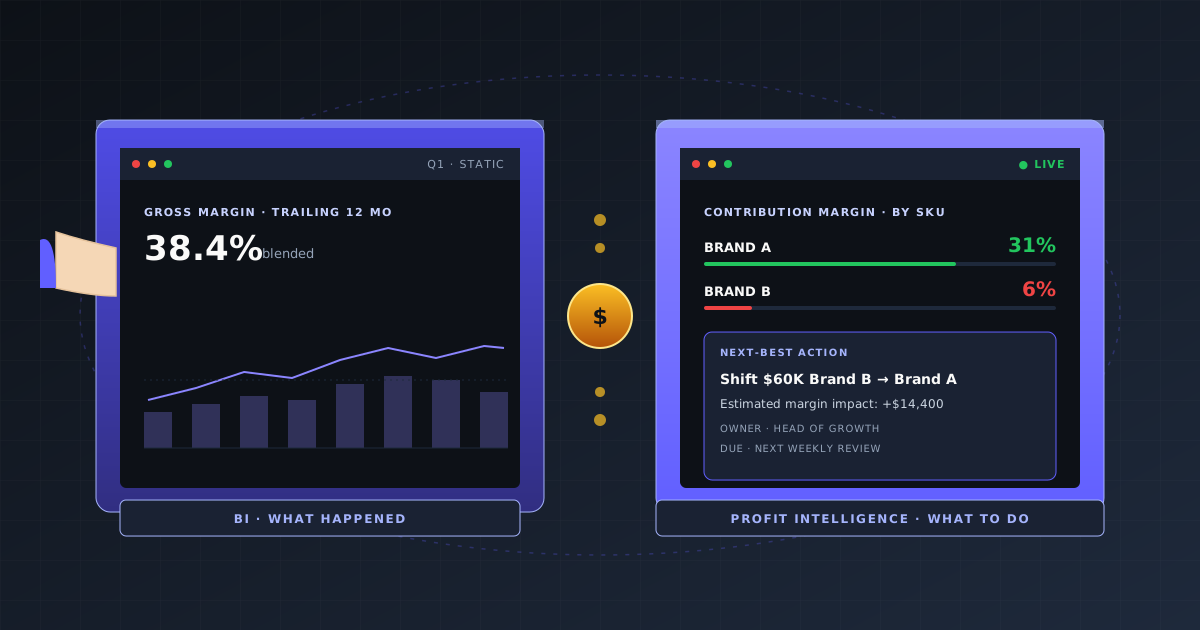
The clearest way to understand what profit intelligence means in practice: it is not a better margin dashboard. It is a different output type entirely. BI shows a margin trend over time. Profit intelligence shows the specific channel-SKU-segment combination that is compressing margin right now, and surfaces a recommended budget or inventory action with an owner and a timeframe. Operators we have worked with describe the shift as going from “we know margin is under pressure” to “we know exactly which two decisions are causing it and what to do before next week’s review.”
One important distinction: profit intelligence does not replace financial reporting. A CFO still needs the GAAP P&L. An auditor still needs the data warehouse. Profit intelligence sits between the financial close process and the operating decision — it is the layer that makes the week-to-week signal actionable without waiting for the monthly close. Think of it as the operating read of the margin, not the accounting read.
For a deeper treatment of how the discipline is defined, see our profit intelligence glossary entry.
The side-by-side
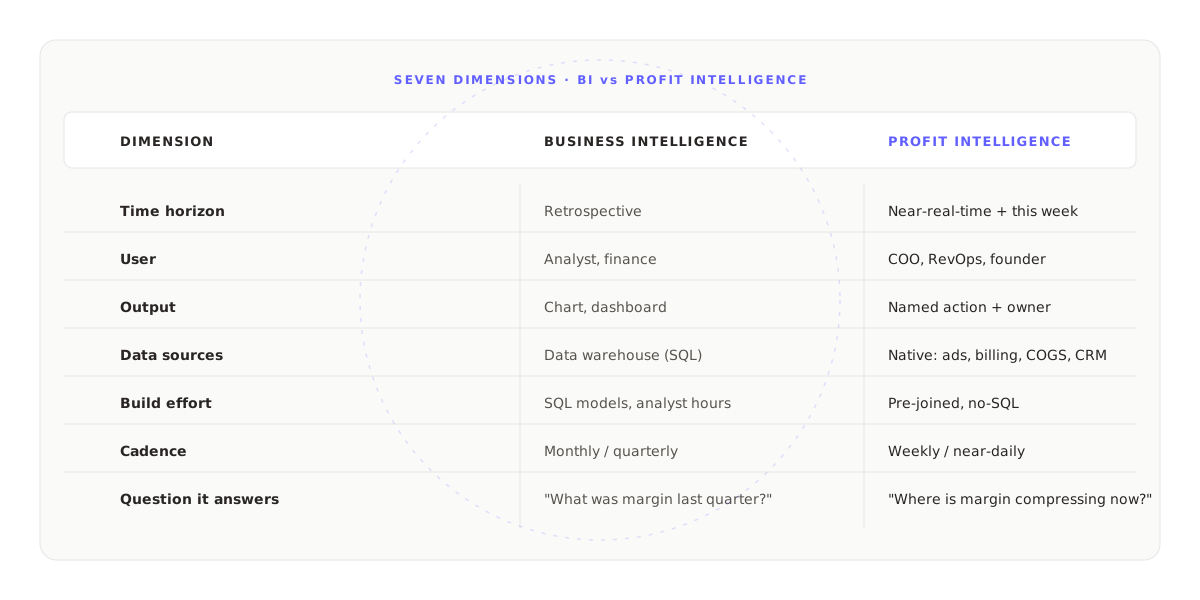
| Dimension | Business Intelligence | Profit Intelligence |
|---|---|---|
| Time horizon | Retrospective (last week/month/quarter) | Near-real-time + this week’s margin decision |
| User | Analyst, data team, finance | COO, RevOps, founder, head of growth |
| Output | Chart, dashboard, margin trend report | Named action tied to a specific margin lever |
| Primary data sources | Data warehouse (SQL layer) | Native connectors: billing, ads, COGS, CRM joined |
| Build effort | SQL models, analyst hours, custom dashboards | Pre-joined, no-SQL, out of the box |
| Cadence | Monthly / quarterly | Weekly / near-daily |
| Margin question it answers | “What was our gross margin last quarter?” | “Which channel is compressing contribution margin this week?” |
Seven dimensions, but four of them explain most of the practical difference. The first is time horizon: BI is retrospective by design, optimized for asking historical questions with precision. Profit intelligence is near-real-time, designed for the question you are asking this week, not the one you asked last quarter. That temporal difference changes everything about how the data model is built and what the output looks like.
The second is output type. A BI dashboard produces a chart or a report — accurate, filterable, useful for understanding. A profit intelligence output produces a named action: “shift $60K of Brand B budget to Brand A — estimated contribution margin impact $14,400.” These are not the same thing even when they draw on the same underlying data. One requires an operator to interpret and decide; the other does the interpretation and delivers the decision-ready recommendation.
The third is build effort. BI dashboards are analyst-built — they require SQL modeling, schema knowledge, and ongoing maintenance every time a data source or cost structure changes. Profit intelligence tools are pre-joined: the cost model, revenue attribution, and channel mapping are built into the platform, not the user’s SQL. For operators without a full-time data team, this difference is the one that determines whether the capability gets used weekly or quarterly.
The fourth is user. BI was designed for the analyst or data team building reports on behalf of leadership. Profit intelligence is designed for the operator — the COO, the RevOps lead, the founder — to use directly, without a translation step from analyst to decision-maker. That is not a small UX difference; it is a fundamental shift in who owns the margin question.
Key insight
BI makes you informed about last quarter’s margins. Profit intelligence makes you decisive about this week’s. Both matter. Neither replaces the other.
Same metric, different output
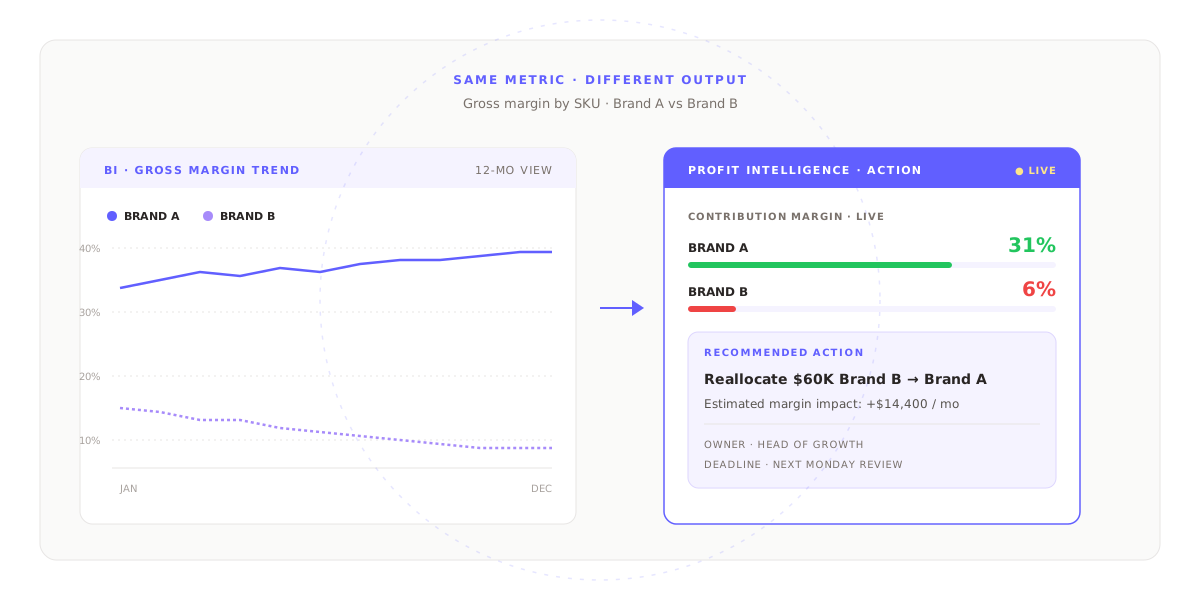
Take one specific metric — gross margin by SKU — and trace what each category does with it. This is the clearest illustration of where the categories diverge in practice.
The scenario. A DTC brand is running $400,000 per month in paid social across two product lines — Brand A (a premium SKU, $149 average order value) and Brand B (an entry-level SKU, $49 average order value). The Google Ads dashboard shows a blended ROAS of 3.1x across the account. Revenue is growing. The founder feels reasonably good about performance.
BI output. The analyst pulls gross revenue by SKU from the warehouse. It shows Brand A at $280,000 in revenue and Brand B at $120,000. A bar chart maps this by month for the trailing 12 months. There is a dashboard filter for channel. The output tells the team that Brand A generates more revenue than Brand B and that revenue has grown steadily. Leadership nods. The question “which one should we spend more on?” goes to the next meeting.
Profit intelligence output. The same data joined to COGS from QuickBooks and ad spend from Meta Ads shows: Brand A runs at 31% contribution margin after COGS ($38), paid social ad cost ($22 at 3.5x ROAS), and fulfillment ($12). Brand B runs at 6% contribution margin after COGS ($18), paid social ad cost ($31 at 1.9x ROAS — the blended 3.1x masked this), and fulfillment ($8). Blended ROAS of 3.1x looked acceptable. Blended contribution margin of 11% — with one SKU at 31% and the other at 6% — is the number that actually matters. The profit intelligence output: “Reallocate $60,000 of Brand B paid social budget to Brand A this week. Estimated contribution margin improvement: $14,400 on current volume. Owner: Head of Growth. Deadline: before next weekly review.”
Same revenue data. Same ad spend data. Same COGS in the accounting system. Two completely different outputs. The BI output is accurate and useful for the board deck. The profit intelligence output is the action that runs the business this week. Both answers have their place. Only one of them is available before Monday.
This is the most common pattern operators we work with describe: a BI stack that answers historical margin questions accurately, sitting next to a weekly manual reconciliation process in a spreadsheet that approximates the contribution-margin view. Profit intelligence eliminates the manual reconciliation step and turns the result into a named action rather than a number requiring further interpretation.
The deeper implication is attribution. ROAS and revenue-based metrics are fundamentally incomplete at the margin level because they omit variable costs that differ by SKU, by channel, and by customer segment. A 3.1x ROAS on paid social sounds healthy. A 6% contribution margin on the SKU generating most of that revenue does not. Profit intelligence makes the attribution at the margin level automatic and continuous — not a once-a-month finance close exercise. See our deeper treatment of this in contribution margin by channel and gross margin by product.
When you need BI, profit intelligence, or both
| Use case | BI | Profit Intelligence |
|---|---|---|
| Board deck, investor reporting | ✓ | — |
| Weekly contribution margin review | — | ✓ |
| Ad budget reallocation decision | — | ✓ |
| Ad hoc historical revenue question | ✓ | — |
| SKU or channel margin leak detection | — | ✓ |
| Compliance / audit reporting | ✓ | — |
| CAC payback and cohort profitability | — | ✓ |
Most growth-stage companies end up running both. BI stays with the data team and the finance function for reporting, compliance, and historical deep-dives. Profit intelligence goes in front of the operating team — the COO, the RevOps lead, the founder — for the weekly decisions that actually move margin. The failure mode on each side is symmetric: operators trying to run weekly margin reviews out of BI dashboards turn those meetings into status theater, with most of the session spent interpreting charts rather than deciding actions. Analysts trying to answer real-time margin questions out of a profit intelligence tool hit a wall because the tool is not designed for ad hoc schema exploration. Each category is built for a specific job. The decision is not which one to buy; it is which job needs doing right now.
One nuance worth naming: if you are under $2M ARR with a single product line and two channels, a well-maintained BI tool plus a weekly spreadsheet is often sufficient. Profit intelligence as a distinct category earns its place when the number of variables — channels, SKUs, customer segments, cost types — exceeds what a manual weekly process can reliably track. In engagements we have run, that threshold typically appears somewhere between $3M and $8M ARR for DTC brands and between $5M and $15M ARR for B2B SaaS, when CAC and margin by channel start diverging enough to matter week-to-week.
Common misconceptions
- “Profit intelligence is just real-time BI.” Real-time data is a necessary input but not the defining characteristic. A live Tableau dashboard pulling from a streaming data source is still BI — its output is still a chart that requires human interpretation. Profit intelligence is distinguished by its output type (named action, not chart) and its data model (COGS, ad spend, and revenue pre-joined at the contribution-margin level). Latency is a secondary detail.
- “We can build this in our BI tool if we add enough dashboards.” Technically possible; practically expensive in a different way than expected. The real cost is not the build — it is the maintenance. Every time a new ad channel is added, a SKU is repriced, or a COGS assumption changes, the dashboard logic has to be updated manually. In our experience, most growth-stage teams without a dedicated data team end up with a version that is accurate for the first 90 days and quietly stale thereafter — usually because the people who wrote the original SQL have moved on or are pulled onto other priorities.
- “If my ROAS looks healthy, my margins are fine.” This is the most common and most costly misconception in growth-stage DTC. ROAS is a ratio of revenue to ad spend. Contribution margin is revenue minus COGS, fulfillment, returns, and ad spend — all the variable costs that determine whether a sale actually generated cash. A 4x ROAS on a SKU with 18% gross margin and 12% fulfillment cost is 4x on a contribution margin that may be negative depending on return rates. ROAS and revenue-based metrics were not designed to answer the margin question. That is why a separate discipline exists.
- “Profit intelligence replaces the CFO function.” It does not. The CFO still manages GAAP reporting, financial controls, audit readiness, and capital allocation decisions that require the full accounting picture. Profit intelligence operates at the operating decision layer — the weekly read, not the accounting close. The two functions are complementary: the CFO runs the month-end close, profit intelligence runs the week-to-week margin decision. In engagements we have run, the CFO is typically among the first advocates for profit intelligence because it reduces the volume of ad hoc margin questions they get asked mid-month.
Quote-ready
BI is the analyst’s instrument. Profit intelligence is the operator’s instrument. They are not competitors. They just serve different hands at different points in the decision cycle.
How Fairview fits the profit intelligence category
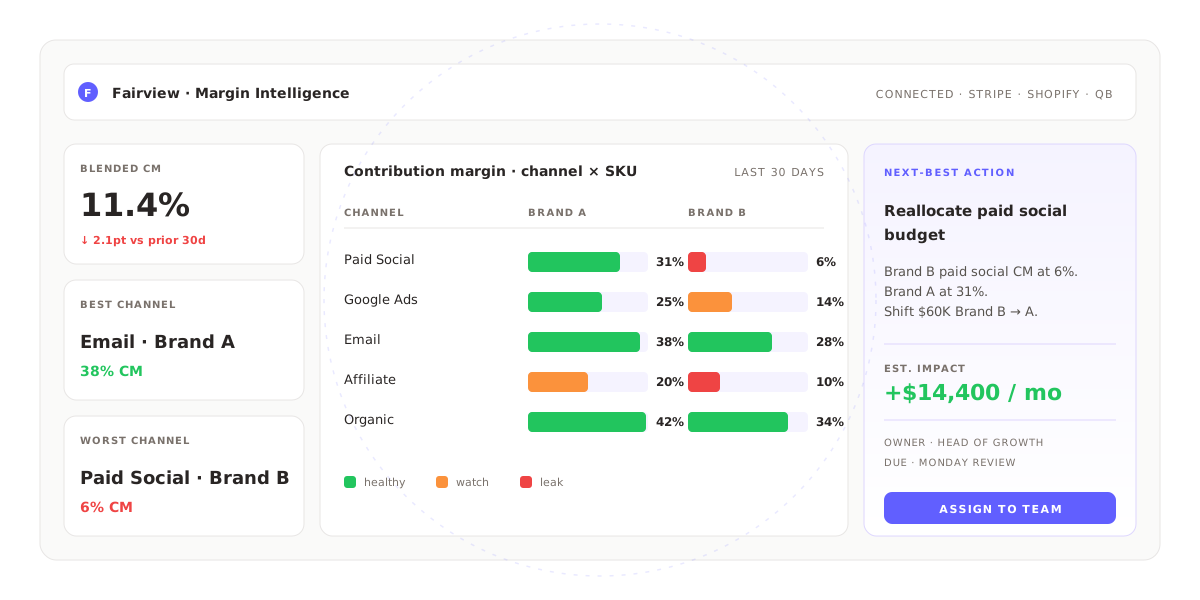
Fairview is Operating Intelligence for B2B and DTC operators, with profit intelligence at its core. It connects natively to Stripe, Shopify, QuickBooks, Xero, Google Ads, Meta Ads, HubSpot, Salesforce, Pipedrive, and HubSpot Marketing Hub — joining revenue, COGS, ad spend, and pipeline data without a data warehouse or custom SQL. The Margin Intelligence module produces contribution margin by channel and SKU on a near-real-time basis, with no analyst time required between data connection and first margin read.
To return to the earlier example: a DTC brand running $400K per month across paid social and Google Ads connects both ad platforms alongside Shopify and QuickBooks in Fairview’s Data Connection Layer. Within the first session, the Margin Intelligence view shows blended contribution margin by channel, by SKU, and by campaign. If Brand B’s paid social contribution margin is running at 6% while Brand A is at 31%, the Next-Best Action Engine surfaces that variance as a named recommendation: shift budget, with an estimated margin impact and a clear owner. The Weekly Operating Report, generated automatically every Sunday, packages the top margin signals alongside pipeline health and forecast confidence — so the Monday operating review starts with decisions, not with chart interpretation. Companies using Fairview recover an average of 23% of leaking margin in the first 90 days.
Fairview sits next to your BI tool — it does not replace it. Your Looker instance keeps running the board deck and the historical deep-dives. Fairview handles the operating read: which margins are moving, what is driving the movement, and what to do about it before the week closes. The Pipeline Health Monitor and Forecast Confidence Engine extend the same logic into the revenue side, giving the COO or RevOps lead a single operating view across margin, pipeline, and forecast in one place. See pricing for the plan that fits your stage, or read about how we approach operating intelligence vs BI more broadly.
No SQL
Pre-joined contribution margin data
23%
Avg margin recovered in first 90 days
Weekly
Operating cadence built in
Key takeaways
- BI answers “what happened to revenue and margin?” Profit intelligence answers “which channels and SKUs are compressing margin right now, and what should we do about it?”
- BI output is a chart or trend report. Profit intelligence output is a named action tied to a specific margin lever, with an owner and a deadline.
- BI serves analysts and finance; profit intelligence serves operators. Different users, different jobs, different weekly cadences.
- ROAS and revenue metrics are incomplete at the margin level. Contribution margin by channel and SKU — which profit intelligence produces — is the operating metric that determines whether growth is actually profitable.
- Most growth-stage companies need both categories. BI for reporting and historical analysis; profit intelligence for the weekly operating decision.
See it in your data
Try Fairview free for 14 days.
First data source live in 10 minutes. No credit card. Cancel any time.