Key takeaways
- Why Operating Data Leaves Margin Invisible
- What Margin Intelligence Actually Means
- Margin Intelligence vs. Gross Margin Reporting — and Three Adjacent Terms
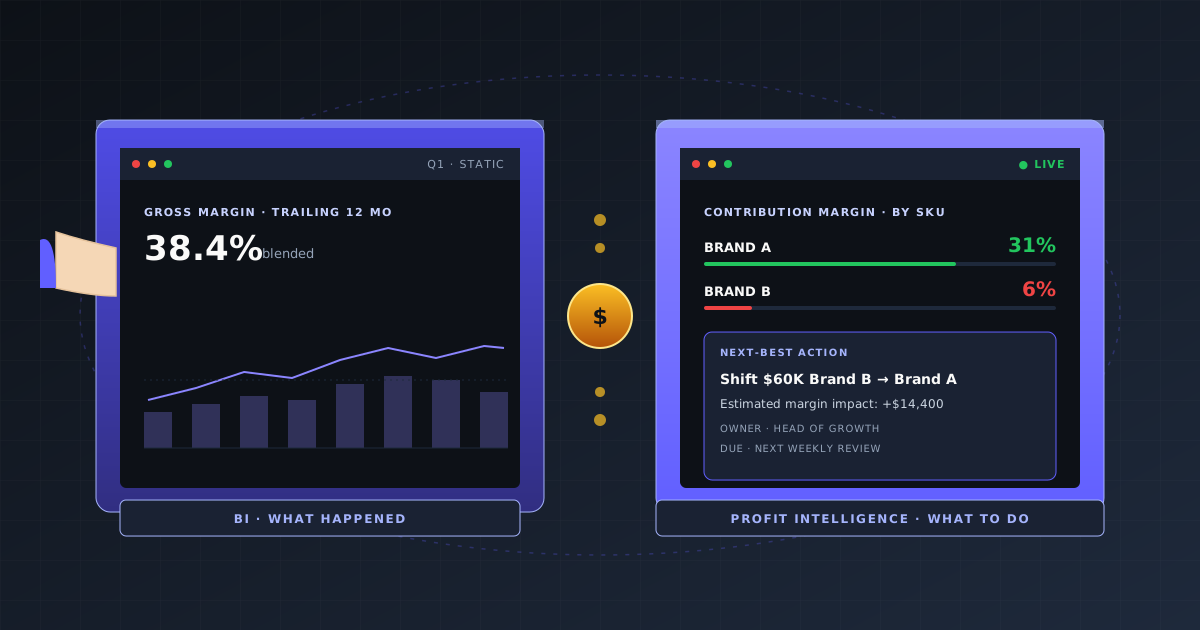
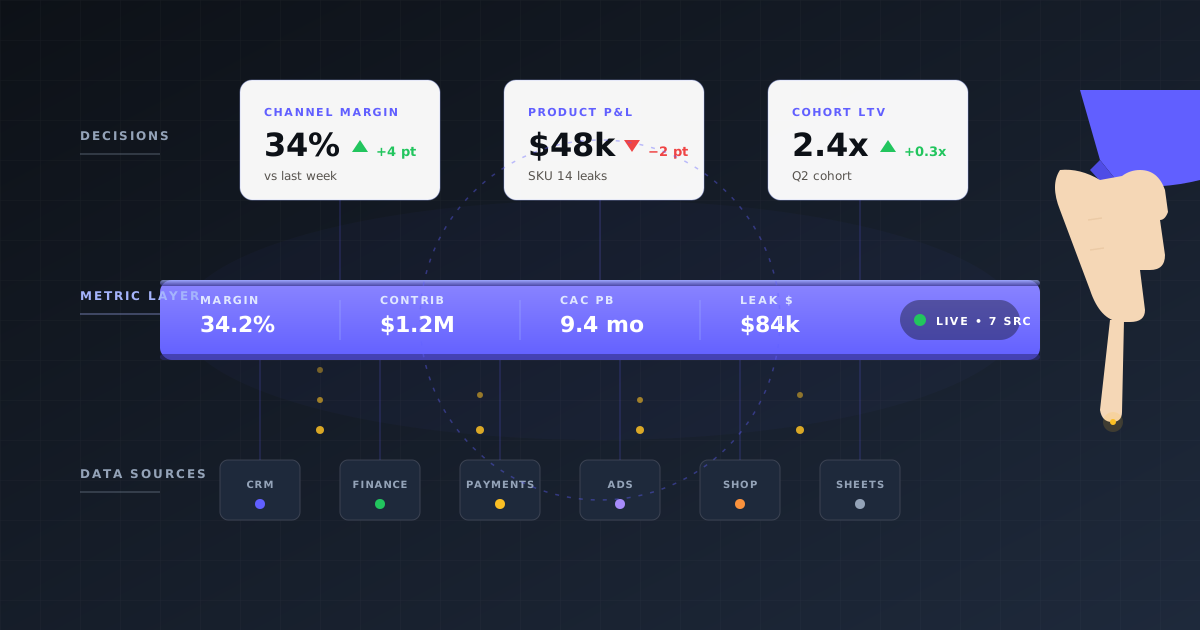
Margin intelligence is the metric layer that sits between your transactional data and your operating decisions. It converts raw revenue, cost, and channel data into a real-time view of which products, customers, and channels are actually making money — and flags where margin is leaking before it compounds into a quarterly surprise.
Most operators are not short on data. They have a CRM tracking deals, an accounting tool tracking costs, a payment processor tracking revenue, and an ad platform tracking spend. The problem is that none of those systems were designed to produce a shared picture of margin. The data exists — but it is distributed across tools that do not talk to each other.
This article defines margin intelligence as a working concept — what it actually means, what data it requires, how it differs from adjacent terms you may already use, and what the fragmentation problem looks like in practice. By the end, you will have a clear framework for assessing where your own margin visibility stands and what it would take to improve it.
Why Operating Data Leaves Margin Invisible
Consider a specific Monday morning. An operator opens three tabs: HubSpot showing $340K in pipeline, Shopify showing $82K in orders last week, and QuickBooks showing expenses from the prior month. Each number is accurate. Together, they answer almost nothing.
Which channel drove the most profitable orders last week? Which product line is eating margin through returns and fulfillment costs? Which acquisition source is producing customers who churn before recovering CAC? None of those questions can be answered from three separate tabs — not without hours of manual work pulling data into a spreadsheet and trying to join it by hand.
This is the structural problem that leaves margin invisible for most operators. It is not a data shortage. It is a data architecture gap: the systems that hold the relevant data were each built to serve their own function, and none of them produce a shared attribution layer across revenue, cost, and channel by default.
The common workaround — reconciling in spreadsheets — introduces its own set of errors. Data goes stale by the time the reconciliation is finished. Manual joins introduce mismatches. Definitions drift between what the CRM calls "closed revenue" and what the payment processor records as settled charges. By the time a margin number is assembled, it reflects last week's reality at best.
A few patterns come up repeatedly in our engagements with growth-stage operators. They tend to cluster around the same set of mistakes:
- Using gross revenue as a margin proxy. Revenue is visible in real time; cost is not. Operators often optimize for the revenue number because it is available, even though contribution margin is the decision-relevant figure. A high-revenue channel with elevated return rates and ad spend can easily run at a loss.
- Treating monthly close as the margin checkpoint. Finance teams close the books monthly. Operators make decisions weekly. The gap between those cadences means margin data arrives after the window for acting on it has passed.
- Reconciling across tools without a shared definition of revenue. CRM pipeline, Shopify orders, and Stripe settlements each count "revenue" differently — by recognition date, by order date, by settlement date. Joining them manually without a normalization step produces numbers that look wrong because they measure different things.
McKinsey has put the productivity and revenue cost of fragmented and poor-quality enterprise data at multiple trillions of dollars annually, and Gartner's research on "bad data" estimates direct losses at roughly $12.9 million per year for an average enterprise. The specific numbers vary by company size and sector, but the directional finding is consistent across operator engagements we have run: fragmented data slows decisions, and slower decisions compound margin erosion.
The contrast between a fragmented view and a unified one is not subtle once you have experienced it. With fragmented data, the Monday review answers the question "what happened last week?" — and often takes 90 minutes to get there. With a connected margin view, the same review answers "what is leaking, which channel caused it, and what should we do this week?" It is ready before the meeting starts. That difference is what the rest of this article is about.
What Margin Intelligence Actually Means
The term gets used loosely. Finance teams sometimes mean it as a synonym for margin analysis. Vendors sometimes use it to describe any dashboard that shows a profit number. Neither usage captures what the term means in an operational context.
That definition has five components worth separating out, because each one does meaningful work:
- Data collection. Margin intelligence starts by pulling raw data from the systems that hold it: payment processors for revenue, accounting tools for costs, CRM for deal and customer data, and ad platforms for spend. No single source has the full picture. The layer has to reach across all of them.
- Normalization. The raw data from different systems uses inconsistent definitions, currencies, date conventions, and entity identifiers. A Stripe payment, a QuickBooks expense line, and a HubSpot deal are not automatically joinable. Normalization creates a shared schema that makes cross-system comparison valid — rather than technically possible but semantically broken.
- Attribution logic. Margin by channel requires connecting revenue to the marketing spend that produced it. That connection is not native to any individual system. An attribution layer applies rules — last-click, first-touch, linear, or custom — to allocate ad spend to the revenue it generated, so the margin calculation is channel-specific rather than aggregate.
- Segmentation. Once data is collected, normalized, and attributed, margin intelligence slices it across the dimensions that drive operating decisions: by product line, by acquisition channel, by customer cohort, by geography, by team. The aggregate margin number is a starting point. The segmented view is where the decision-relevant signal lives.
- Action alerting. The final component — the one that distinguishes margin intelligence from margin reporting — is a signal layer that flags changes, anomalies, and declining trends before they compound. A margin intelligence layer does not wait for a quarterly review to surface a problem. It surfaces the problem as it develops, with enough specificity to act on it.
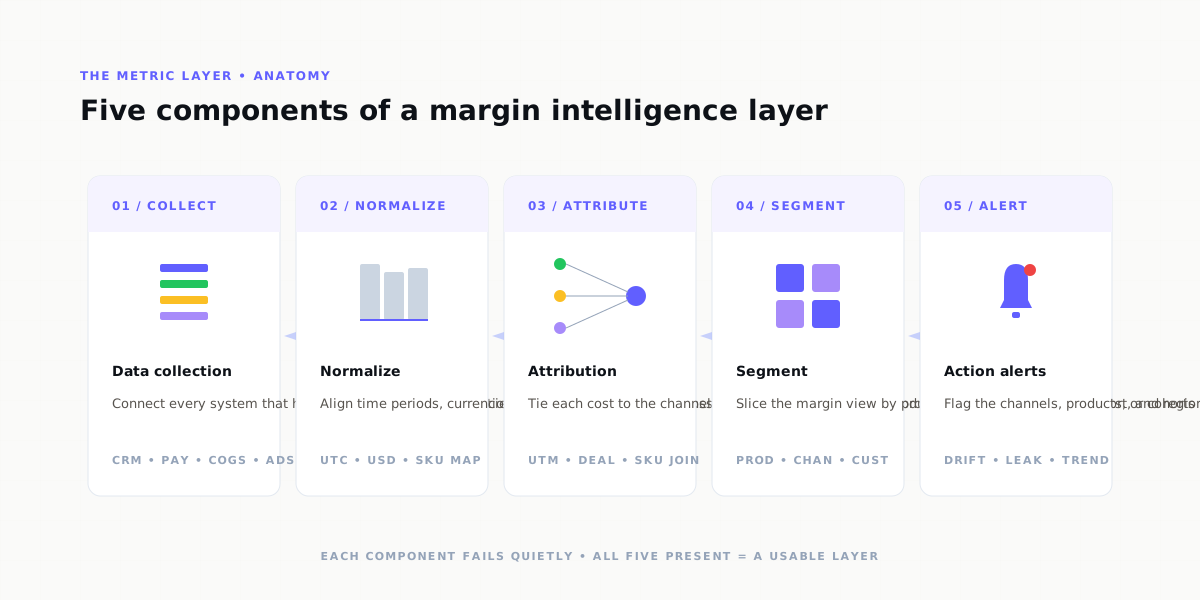
In our engagements, the companies that describe themselves as "data-driven" are often doing components 1 and 2 reasonably well. They have the data and they have some normalization, usually maintained in spreadsheets or a light BI tool. What they are typically missing is components 4 and 5: the segmentation that turns an aggregate number into a diagnostic, and the alerting that turns a diagnostic into an action.
It is worth separating margin intelligence from the adjacent concept of margin management. Margin management refers to the operational practices a business uses to control costs, optimize pricing, and improve profitability — it is about the levers. Margin intelligence is the information layer that tells you which levers to pull and when. You can have margin management practices without a reliable margin intelligence layer; the result is that you are pulling levers without clear feedback on whether they are working.
Margin Intelligence vs. Gross Margin Reporting — and Three Adjacent Terms
A COO at a DTC brand described the problem clearly in a conversation we had earlier this year. She had QuickBooks showing a 52% gross margin for the prior quarter. That number was real. But when the board asked which channel drove the most profitable customers, she could not answer — because QuickBooks does not know which channel acquired which customer, and her Shopify and Meta Ads data lived in separate systems with no shared key.
She had gross margin. She did not have margin intelligence. Those are different things, and the gap between them is where most operator confusion sits.
The table below maps out four terms that often get conflated:
| Term | What it answers | Who uses it | What it misses |
|---|---|---|---|
| Margin intelligence | Which products, channels, and customer segments are margin-positive right now — and what is changing week over week? | COOs, operators, and founders making weekly resource and channel decisions | Does not replace strategic pricing models or long-range financial planning |
| Gross margin reporting | What was the overall profit margin after direct costs for the period — total, not segmented? | Finance teams, accountants, investors reviewing period performance | Cannot tell you which channel, product, or customer drove the number or where it is deteriorating |
| Margin management | What practices, pricing rules, and cost controls are in place to protect margin over time? | Finance leadership, pricing teams, procurement | A management practice, not a data layer — tells you what you are doing, not whether it is working in near real time |
| BI dashboards / FP&A | What does the historical data show — visualized across dimensions that an analyst configured? | Analysts, finance teams, executives in larger organizations | Requires ongoing analyst maintenance; surfaces data on demand rather than flagging anomalies proactively |
The table makes the structural distinction clear. Gross margin reporting is periodic and aggregate. BI dashboards are retrospective and analyst-dependent. Margin management is operational practice, not data infrastructure. Margin intelligence is the continuous, segmented, proactive layer that none of the others provide.
A brief note on profit intelligence, a term that appears in some vendor marketing: it is not a standard term with a precise technical definition. In practice, "profit intelligence" is used interchangeably with margin intelligence by some tools and as a synonym for BI-driven profitability reporting by others. For the purposes of this article, we treat them as overlapping concepts — both concerned with profit visibility — but reserve "margin intelligence" for the specific operational layer described in the definition above.
Q: Is profit intelligence the same as margin intelligence? Not precisely. Profit intelligence tends to be used as a broader term that includes top-line revenue performance alongside margin. Margin intelligence specifically focuses on the margin dimension — how much of each revenue dollar survives after costs are applied, segmented by the dimensions that operators can act on. If a tool calls itself a "profit intelligence platform," the question to ask is whether it tracks margin by channel and product, or just aggregate profit. The distinction matters for operating decisions.
Why Operating Data Fragments — and Makes Margin Invisible
Most operators understand, in the abstract, that their data is fragmented. The more specific diagnosis — which tools hold which part of the margin picture and why joining them is structurally hard — is less often articulated. It helps to be concrete about the 4-tool pattern that produces the problem.
- CRM (HubSpot, Salesforce, Pipedrive). Holds deal and customer data: which company bought, what they paid, when they closed, which rep owned the deal, and sometimes which campaign sourced the lead. The CRM does not know the cost of acquiring that customer, the cost of delivering the product, or the margin on the transaction. It knows revenue and pipeline — full stop.
- Finance and accounting tools (QuickBooks, Xero, NetSuite). Holds expense and cost data: COGS, operating expenses, payroll, vendor payments. The accounting tool knows the cost side of the business but typically does not know which revenue transaction those costs are attributable to — especially not by channel or product line unless a finance team has built custom tagging into the chart of accounts. Month-end is the cadence; real-time is not a design goal.
- E-commerce and payment processors (Shopify, Stripe). Holds transaction-level revenue data: which product was sold, at what price, to which customer, with what discount, and what refunds were processed. Shopify knows which products moved. Stripe knows what settled. But neither connects naturally to the cost data in QuickBooks or the acquisition source data in the CRM without a shared customer identifier and attribution logic applied across all three.
- Ad platforms (Google Ads, Meta Ads). Holds spend data by campaign and ad set, and conversion data if pixel tracking is configured. The ad platform knows what you spent and how many conversions it claims — but its attribution model is not coordinated with your accounting tool, your CRM, or your payment processor. Each platform claims credit using its own rules, which produces overlapping and inconsistent attribution across channels.
A worked example makes the gap concrete. Consider a DTC brand running $50K/month in Meta Ads alongside $20K/month in Google Ads. Shopify shows $280K in monthly revenue. QuickBooks shows $140K in COGS and operating costs. At the aggregate level, that implies a roughly 50% margin — which sounds acceptable.
But drill into the channel level: if Meta Ads drove $180K of that revenue with $50K in spend and $95K in product cost, the channel contribution margin is roughly $35K on $180K — under 20%. Google Ads, meanwhile, drove $100K in revenue with $20K in spend and $45K in product cost, yielding $35K on $100K — 35%. The same aggregate margin number is hiding a 15-point difference in channel profitability. Without a margin intelligence layer connecting all four systems, the operator sees one number. With it, they see a clear signal: Meta is underperforming on margin, which ROAS alone would not show. The figures here are illustrative — drawn from a typical mid-market DTC pattern rather than a single brand — but the structural point holds across the engagements we have run.
In our engagements with 50–200 person companies, operators typically manage between 5 and 10 systems that hold margin-relevant data — CRM, accounting tool, payment processor, e-commerce platform, ad platforms, and one or two analytics tools. Industry mapping work like the chiefmartec landscape consistently shows the count climbing further at enterprise scale (over 14,000 distinct martech solutions exist as of 2024). Each additional system compounds the fragmentation. The practical ceiling is not about having too many tools — it is about not having a layer that connects them into a shared margin view.
What Data Margin Intelligence Requires
Building a margin intelligence layer — whether with a dedicated tool or a manual process — requires four categories of data. When all four are present, the layer can produce a segmented, actionable margin view. When any one is missing, the picture degrades in predictable ways.
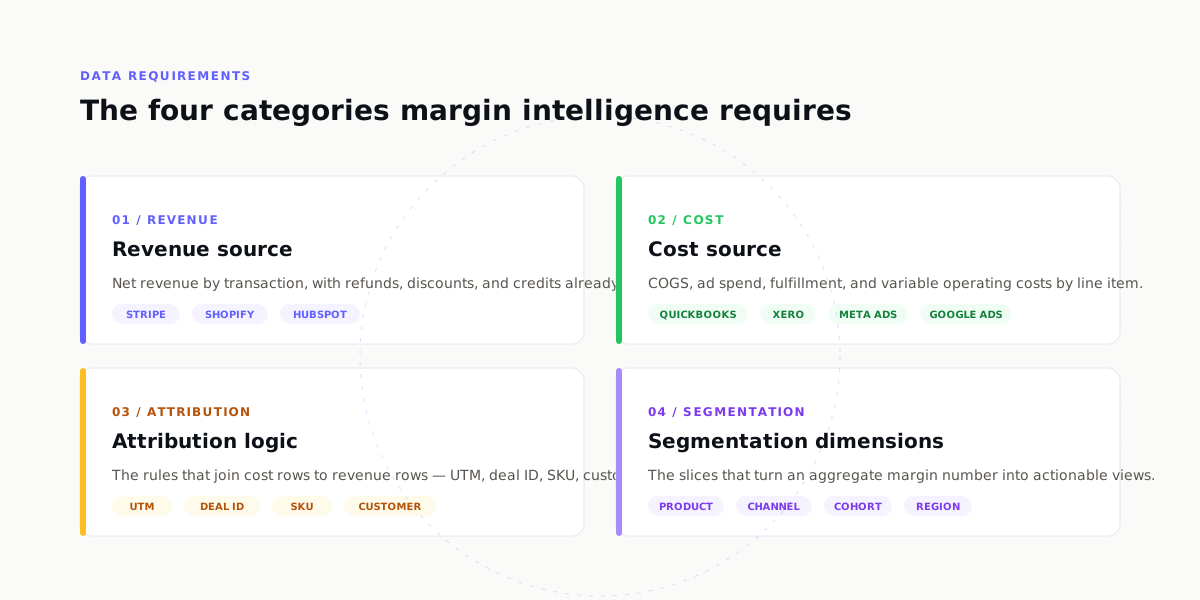
- Revenue source data. Transaction-level records of what was sold, to whom, at what price, when, and through which channel or product. This typically comes from a payment processor (Stripe) or e-commerce platform (Shopify). The critical requirement is transaction granularity — revenue aggregated by month is not sufficient for channel or product segmentation. Without revenue source data, there is no numerator for the margin calculation.
- Cost source data. Categorized expense records that break down COGS, operating expenses, and channel-specific costs (ad spend) at a level of detail that allows cost allocation by product or channel. This typically comes from an accounting tool (QuickBooks, Xero) and ad platforms (Google Ads, Meta Ads). The critical requirement is that the chart of accounts is structured with enough granularity to map costs to revenue categories — a single "expenses" line item cannot be allocated meaningfully. Without cost source data, margin calculations default to gross revenue, which is not the same thing.
- Attribution logic. A set of rules that maps revenue transactions to the marketing spend and channels that generated them. Attribution connects the revenue source to the cost source at the customer or campaign level. Without attribution logic, channel margin is not calculable — only aggregate margin is. Attribution is where most manual margin tracking breaks down, because it requires a shared customer identifier across systems and a consistent set of rules applied consistently over time.
- Segmentation dimensions. The categorical variables by which margin will be sliced: product line, SKU, acquisition channel, customer cohort, geography, team, or any other dimension that drives operating decisions. Segmentation dimensions need to be defined before data collection begins — or at least before normalization — because the way cost and revenue data are tagged at the source determines which segmentation cuts are available downstream. Adding a segmentation dimension after the fact typically requires re-processing historical data.
Several patterns emerge when one of these categories is missing or incomplete:
- Using ROAS as a margin proxy. ROAS (return on ad spend) is a ratio of channel revenue to channel ad spend — it does not account for COGS, fulfillment, or other costs. A channel with a 4x ROAS can still be margin-negative if product costs are high. Operators without a cost source connected to their margin layer often default to ROAS as a profitability signal. It is not one.
- Omitting refunds and discounts from the revenue calculation. Gross order value in Shopify includes orders that are later refunded or discounted at settlement. If refunds are not deducted from revenue before applying cost allocation, the margin calculation overstates revenue and therefore understates margin erosion. This is a consistent gap in spreadsheet-based margin tracking.
- Applying spreadsheet VLOOKUP attribution. Operators who build attribution manually in spreadsheets — joining Shopify orders to Meta Ads campaigns via a shared UTM parameter in a VLOOKUP — face two problems: the join breaks when UTM parameters are inconsistent, and the attribution model is usually last-click by default, even when a different model would be more accurate for their business. The result is an attribution layer that is fragile and often systematically wrong.
One nuance worth acknowledging: even with all four data categories in place, margin intelligence is not a perfectly precise instrument. Attribution is an approximation, not an exact measure — especially in an environment of browser privacy changes, multi-touch customer journeys, and cross-device behavior. Cost allocation involves judgment calls about which expenses to treat as variable versus fixed. The goal of a margin intelligence layer is not accounting-level precision but operating-level signal quality: directionally reliable, sufficiently granular, and updated frequently enough to act on. Operators who wait for perfect data before building a margin view tend to wait indefinitely. A reliable 80% view, updated weekly, is substantially more useful than a theoretically complete view that arrives at month-end close.
Who Owns Margin Intelligence Inside a Company
This question comes up often in our engagements, and the answer is rarely clean. Finance owns the books. Operations owns the weekly cadence. Marketing owns the channel data. RevOps, if the company has it, owns parts of the attribution logic. The result, in many growth-stage companies, is a shared non-ownership: everyone has a piece of the data, and no one is accountable for connecting it into a usable margin view.
The structural mismatch is worth naming precisely. Finance teams run month-end close on a monthly cadence, and that is the right cadence for GAAP-compliant reporting. But operators make decisions weekly. By the time finance closes the books and produces a margin view, the operating team has already made three rounds of channel allocation decisions, pricing calls, and resource assignments — without the information that view would have provided. The cadence of financial reporting was designed for a different purpose than weekly operating decisions — finance is not slow, it is aimed elsewhere.
Without explicit ownership, what tends to happen is that operators build shadow systems: a spreadsheet that one analyst maintains, a Looker dashboard that no one updated after the person who built it left, a Slack channel where the head of growth pastes weekly ROAS numbers that no one ties back to cost data. These are ownership vacuums dressed up as solutions. The information is technically available, but without integration or consistent maintenance it rarely earns enough trust to drive decisions reliably.
The alternative is a clear RACI. In our experience, the most effective model for growth-stage companies assigns operational accountability for margin intelligence to the COO or operator role, with finance as the data owner for the cost side and marketing or growth as the data owner for the attribution side. The person who runs the weekly operating review should own the margin view — because they are the one who will use it to make decisions.
The right ownership model also depends on company size. A useful decision ladder:
If you are 50–150 employees: Margin intelligence ownership sits with the COO or the operator who runs the revenue review. Finance provides cost data inputs; the COO assembles and interprets the view. A dedicated analyst is helpful but not required if you are using a purpose-built tool.
If you are 150–400 employees: Ownership typically migrates to a RevOps function or a Head of Finance who partners closely with operations. Finance maintains the cost layer; RevOps or a data lead owns the attribution logic and segmentation definitions. The COO consumes the output rather than building it.
If you are 400+ employees: Margin intelligence is likely split into sub-functions: a finance analytics team owns cost allocation; a growth analytics team owns attribution; a central data team owns the normalization layer. The COO or CFO sets the segmentation requirements; analysts maintain the view. At this scale, the tooling typically includes a data warehouse. Below this scale, it usually does not need to.
The structural insight is that ownership should follow accountability. Whoever is held responsible for channel performance and margin outcomes should also own the data layer that surfaces those outcomes. Separating accountability from information access is a reliable way to produce decisions made in the dark.
Common Mistakes Operators Make Before They Have Margin Intelligence
Most operators who lack a margin intelligence layer are not operating blindly — they have workarounds. The problem is that the workarounds introduce systematic errors that compound over time. The five patterns below come up repeatedly when operators describe how they were managing margin before a dedicated layer was in place.
- Using channel ROAS as a proxy for channel profitability. ROAS — return on ad spend — tells you the ratio of channel revenue to ad spend. It does not account for COGS, fulfillment costs, return rates, or any other cost category. A channel running at 4x ROAS can be delivering negative contribution margin if product costs are high enough. Operators who optimize toward ROAS without a cost layer connected to their attribution data are optimizing toward the wrong signal. The fix is to calculate contribution margin by channel, not ROAS — which requires connecting the accounting tool to the ad platform data.
- Treating aggregate margin as diagnostic. A 55% gross margin at the company level looks healthy until you discover that two product lines are at 72% and one is at 18%. Aggregate margin is a financial summary, not an operating signal. The action-relevant information is in the variance across dimensions. Operators who review only total margin miss the signal that lives in the segment-level spread.
- Relying on month-end data for weekly decisions. If the most current cost data available comes from last month's close, the operator is making this week's channel and budget decisions with information that is already 2–5 weeks stale. In a business with meaningful seasonality or active campaign testing, month-old cost data is not just incomplete — it is potentially misleading. The cadence of margin visibility should match the cadence of decisions.
- Omitting refunds, discounts, and fulfillment variance from the margin calculation. Gross order value in a payment processor or e-commerce platform is not the same as recognized revenue net of refunds and promotional discounts. In DTC businesses with return rates above 15%, the difference between gross and net revenue can shift a channel margin calculation by 10 points or more. Operators who build margin views from gross figures systematically overstate channel profitability.
- Attributing MQL volume to a channel without adjusting for ACV differences. This mistake is common in B2B SaaS. A channel that drives high MQL volume looks like a high-performing acquisition source — until you track the ACV of the deals those MQLs produce. A channel generating 40 MQLs at an average ACV of $8,000 is delivering less margin than a channel generating 15 MQLs at an average ACV of $28,000. Attribution that stops at lead volume — rather than connecting through to closed revenue and cohort margin — produces misallocated spend budgets. The worked example is instructive: if Channel A produces 40 MQLs at 18% close rate and $8,000 ACV, it generates $57,600 in revenue. Channel B produces 15 MQLs at 30% close rate and $28,000 ACV, generating $126,000. A lead-volume view suggests Channel A is outperforming. A margin view reverses that ranking. The numbers in this example are illustrative (chosen to make the structural point clear), but the pattern — a high-volume channel underperforming a low-volume channel on margin — shows up regularly in B2B SaaS engagements.
In our experience, most companies under 200 employees still build their margin views in spreadsheets — pulling exports from accounting, payments, and ad platforms and joining them by hand. The spreadsheet approach is not wrong as a starting point. It becomes a liability when the business grows past the point where one analyst can maintain it without errors, or when channel complexity means the joins are too numerous to reconcile reliably by hand. The transition is rarely about needing a more sophisticated tool — it is about freeing the analyst from the reconciliation work so they can focus on the decisions the data is meant to inform.
What Good Margin Intelligence Looks Like — A Weekly Operator Workflow
The difference between operating with and without margin intelligence is most visible on Monday morning. Two operators. Same role. Same type of business. One Monday each, side by side.
Monday without margin intelligence: The operator opens three tabs (CRM, Shopify, QuickBooks) and starts pulling numbers into a spreadsheet. An hour passes before the revenue figure is assembled. The cost data from QuickBooks is from last month's close, so it does not reflect this week's ad spend. ROAS numbers from Meta and Google are in separate browser tabs. The operator estimates channel profitability mentally, without connecting the cost data to the revenue data. The weekly review starts 90 minutes late, and the first question from the CEO — "which channel drove the most profitable customers this month?" — takes another 45 minutes to answer, and even then with a caveat: "this is approximate."
Monday with margin intelligence: The operator's weekly report arrived by email at 7 AM: revenue vs. forecast, margin by channel versus the prior week, the top 3 anomalies detected, and the open action items from last week. The review starts on time. The channel margin question is answered in 30 seconds, directly from the dashboard. The meeting moves to decision-making rather than data assembly.
The 7-step weekly cadence that operators with a margin intelligence layer tend to follow:
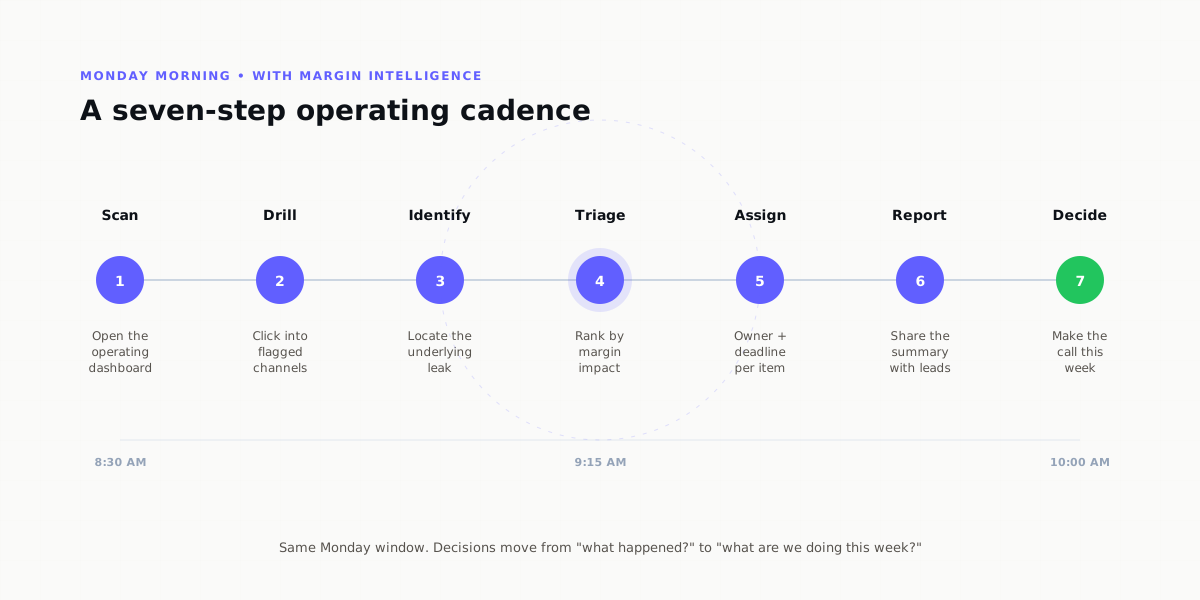
- Review the weekly operating report (Sunday night or early Monday). Read the summary of revenue vs. forecast, margin by channel vs. prior week, and the flagged anomalies. This takes 10–15 minutes and replaces the 60–90 minutes of manual data assembly that precede a meeting without a margin layer.
- Identify the largest margin variance from the prior week. Which channel, product line, or customer segment moved most? Is the variance directionally consistent with what the team expected, or is it a surprise? If it is a surprise, what is the most likely explanation before the meeting?
- Check pipeline health against the forecast. What is the current forecast confidence? Which deals are stalling? Does the pipeline composition support hitting the revenue target for the next 30 days? If not, which segment of the pipeline needs attention?
- Triage the flagged action items. A margin intelligence layer surfaces recommended actions alongside the data: a channel that dropped margin 12% week-over-week, a product line with elevated refund rates, a deal cohort with slipping close dates. The operator's job is to assign each action to a team member with a deadline, not to spend the meeting debating whether the problem is real.
- Make the week's channel and resource allocation decisions. With the margin view available, the operator can make explicit choices: reduce spend on the underperforming channel, shift budget toward the channel with the highest contribution margin, delay a campaign launch until margin stabilizes. These decisions are faster and more defensible when they are grounded in a segmented margin view rather than aggregate ROAS or intuition.
- Assign open items and close the review. The meeting ends with a short list of owners, actions, and deadlines — not a long list of questions that need follow-up analysis before decisions can be made.
- Note what to watch by next Monday. The margin layer surfaced a trend this week. What signal would confirm or disconfirm the hypothesis? Flag one or two metrics to track against next week's report. This closes the feedback loop and turns margin intelligence from a one-time view into a learning system.
In our experience, operators who run this cadence consistently find that the quality of decisions improves not because the data is better in any single week, but because the pattern recognition that accumulates across weeks is qualitatively different from what you get in monthly reviews. A margin trend that would take 8 weeks to detect in monthly data becomes visible in 2–3 weekly cycles.
| Dimension | Monday without MI | Monday with MI |
|---|---|---|
| Time to data ready | 60–90 minutes of manual pull and reconciliation | 0 minutes — report delivered by 7 AM |
| Questions the review answers | "What happened?" (with caveats about data completeness) | "What changed, why, and what do we do about it?" |
| Decisions made | Deferred pending "more complete data" or made on intuition | Made in the meeting, assigned with owners and deadlines |
| Primary friction points | Data staleness, definition mismatches across tools, manual reconciliation errors | Action triage (which flagged item is highest priority this week?) |
How Margin Intelligence Works Differently Across Business Models
The principles of margin intelligence are consistent across business models: collect revenue and cost data, normalize it, attribute it to the right channels and products, segment it by the dimensions that drive decisions, and surface anomalies before they compound. What changes, significantly, is which data inputs matter most — and which margin dimensions carry the most decision weight in each model.
SaaS companies. In a SaaS business, the central margin question is cohort-level, not product-level or order-level. Which acquisition channel produced the customers who retained longest and expanded most? The relevant margin dimension is contribution margin by cohort and by acquisition source: what did it cost to acquire this customer, what do they pay monthly, and at what point does the customer pay back CAC and begin generating net positive margin? Operators at SaaS companies without a margin intelligence layer tend to see MRR and ARR at the company level, but cannot see gross margin by acquisition cohort — which means they cannot make defensible decisions about where to allocate next quarter's growth budget. The cost inputs that matter here are: sales cost per acquisition source, customer success cost per cohort, and infrastructure cost per seat or usage tier. Revenue intelligence platforms handle pipeline and forecast; margin intelligence handles whether the pipeline that closes will produce a sustainable unit economics model.
DTC and e-commerce brands. In a direct-to-consumer business, the margin question operates at the SKU and channel level simultaneously. Which products are actually profitable after accounting for COGS, return rates, fulfillment costs, and the ad spend that drove the order? And which acquisition channels are delivering customers with positive LTV, not just high first-order ROAS? These two questions require connecting Shopify order data (revenue and SKU), QuickBooks or Xero (COGS and operating costs), and Meta and Google Ads (channel spend) into a single attribution view. DTC operators are often most exposed to the ROAS-as-margin-proxy mistake described in the previous section: a channel can look excellent on ROAS and poor on contribution margin if return rates are high and product costs are not factored in. Gross margin benchmarks for DTC businesses vary considerably by category and business model — apparel and home goods tend to run lower than health and beauty; subscription models tend to run higher than one-time purchase models. Public-company DTC data shows a median gross margin of about 57% across SEC filings, with apparel brands clustered tightly in the 53–57% range; private DTC brands typically report slightly higher numbers because they don't always fully load freight, duties, and warehousing into COGS.
B2B services and professional services. Services businesses have a margin structure that is fundamentally different from product businesses: the primary cost driver is labor, not COGS. The relevant margin question is contribution margin by engagement type, client tier, and delivery team. Which service lines are profitable after accounting for the hours delivered at the loaded labor rate? Which client segments generate the most margin per engagement dollar? Which delivery configurations (senior-heavy vs. junior-heavy teams, fixed-price vs. time-and-materials) produce better margin outcomes over a comparable set of engagements? Services operators often track utilization rates and billing rates as operating KPIs, but without connecting those metrics to cost data at the engagement level, the margin view remains aggregate. A services business that is 80% utilized but billing primarily on fixed-fee contracts at below-market rates can be operating at poor contribution margin despite strong-looking utilization numbers.
| Business model | Key margin dimension | Most common blind spot |
|---|---|---|
| B2B SaaS | Contribution margin by acquisition cohort and channel — net of CAC, support cost, and infrastructure | Attributing MQL volume without weighting by ACV; missing the channel-to-cohort margin connection |
| DTC / e-commerce | Contribution margin by SKU and by paid channel — net of COGS, fulfillment, returns, and ad spend | Using ROAS as a margin proxy; omitting return rates and fulfillment variance from the calculation |
| B2B services | Contribution margin by engagement type and client tier — net of loaded labor cost and overhead allocation | Tracking utilization without connecting it to billing rate and cost per engagement; fixed-fee underpricing |
One limitation worth acknowledging directly: while the principles described in this article apply consistently across these three models, putting them into practice is not a one-size-fits-all process. The specific data sources, normalization rules, and attribution logic a SaaS company needs are meaningfully different from what a DTC brand or a services firm needs. A margin intelligence layer built for one model does not automatically transfer to another. Operators evaluating purpose-built tools should assess whether the tool's cost allocation and attribution models are designed for their specific business structure — or whether they are built for a generic "revenue business" that may not reflect how costs actually flow in their operation.
How Fairview Makes Margin Intelligence Operational
The educational case for a margin intelligence layer (what it is, what data it requires, and how it changes operating decisions) is the majority of this article. The implementation question is separate: what does it actually take to move from fragmented data to a working margin view, in practice?
Fairview operationalizes margin intelligence through a four-step flow:
- Connect sources via the Data Connection Layer. Fairview connects to CRM (HubSpot, Salesforce, Pipedrive), finance and accounting (QuickBooks, Xero), e-commerce and payments (Shopify, Stripe), and ad platforms (Google Ads, Meta Ads, HubSpot Marketing Hub) via native OAuth or API key. The first integration is live in under 10 minutes. Each additional source adds to the margin layer without requiring engineering support or a data warehouse. The connection layer handles data refresh on a configurable cadence — daily by default.
- Normalize and unify in the Operating Dashboard. Once sources are connected, Fairview normalizes the data into a shared schema — reconciling date conventions, entity identifiers, and revenue definitions across systems. The Operating Dashboard surfaces the unified view: revenue vs. forecast, margin by channel, pipeline health, and anomaly alerts — all in one screen. This replaces the spreadsheet reconciliation step that typically consumes 60–90 minutes of an operator's Monday morning.
- Surface margin by dimension via the Margin Intelligence module. The Margin Intelligence module applies attribution logic to allocate ad spend to revenue by channel, then calculates contribution margin by channel, product line, and customer segment. The output is not a single margin number — it is a segmented view that shows which dimensions are above trend, which are deteriorating, and which are outside expected ranges. The Next-Best Action Engine flags the most significant margin movements and recommends specific responses.
- Deliver weekly via the Weekly Operating Report. Every Monday morning, Fairview generates a structured report — revenue vs. forecast, margin vs. prior week, top anomalies, and open action items — delivered to the operator's inbox before the review meeting. Operators arrive already briefed, which shifts the meeting from data assembly to decision-making.
A concrete example: an operator on the Growth plan connects QuickBooks, Stripe, and Shopify on a Tuesday morning. By that evening, Fairview has pulled transaction data from Stripe, order data from Shopify, and cost data from QuickBooks, normalized them into a shared schema, applied attribution logic to channel order data, and surfaced a channel margin view. The operator sees, for the first time in one place, that their organic channel is running at 41% contribution margin while their paid social channel — which has been the primary growth vehicle — is running at 22% after COGS and ad spend. That single view changes the budget conversation for the following week.
One limitation to acknowledge: the Margin Intelligence module requires a finance or accounting integration — QuickBooks or Xero — to calculate the cost side of the margin equation. Without it, Fairview surfaces revenue, pipeline health, and forecast confidence, but the full contribution margin view is not available. The cost side of the calculation requires a connected accounting source; there is no reliable way to estimate it from revenue data alone.
≤1 wk
to first margin-by-channel view after connecting sources
10+
live integrations across CRM, finance, e-commerce, and ad platforms
Built for ops
not finance teams — no data warehouse, no SQL, no analyst required
For operators who want to see how the margin layer works across their specific source stack, Fairview's pricing and plan structure shows which integrations and features are available at each tier.
From Fragmented Data to Decisive Operating Action
Margin intelligence is a different kind of layer than the reports operators already have — one that changes the cadence of visibility from monthly to weekly, the grain of analysis from aggregate to segmented, and the output from data presentation to decision triggering. The three shifts matter independently. Continuous visibility without segmentation still produces an aggregate number that cannot be acted on. Segmentation without a decision-triggering signal layer produces a richer report that still ends with "interesting — what do we do?" The full value of a margin intelligence layer comes from all three operating together: seeing margin in near real time, seeing it by the dimensions that drive resource allocation decisions, and receiving specific recommended actions when something changes.
Most operators already have the raw data that a margin intelligence layer needs. The revenue is in the payment processor. The costs are in the accounting tool. The channel data is in the ad platforms. What is missing is not the data — it is the layer that connects it, normalizes it, attributes it, segments it, and surfaces the signal on a cadence that matches how decisions actually get made. If you want to see what that layer looks like in practice for your business, book a walkthrough — Fairview connects your existing sources and surfaces margin by channel, product line, and customer segment without a data team or a data warehouse. Or, if you want to understand the plan structure first, see Fairview's pricing to find the tier that fits your current stack.
See it in your data
Try Fairview free for 14 days.
First data source live in 10 minutes. No credit card. Cancel any time.