These tools live in different worlds. Here is what separates a B2B revenue operating platform from a DTC ecommerce attribution tool — and who actually needs each one.
Founder, Fairview
TL;DR
Fairview and Triple Whale serve almost entirely different customer bases. Triple Whale is built for DTC ecommerce brands on Shopify — it tracks ad attribution, MER, and blended ROAS. Fairview is built for B2B SaaS and services companies — it tracks revenue, margin, and pipeline. If you run a DTC brand, Triple Whale makes sense. If you run a B2B company, Fairview is the relevant tool.
Two Tools, Two Different Business Models
The Fairview vs Triple Whale comparison comes up because both platforms market themselves around "revenue intelligence" — but the similarity ends there. They were built for fundamentally different business models, sell to different buyers, and solve problems that do not overlap in any meaningful way.
Triple Whale is a DTC ecommerce platform. It was designed for brands selling physical products online — primarily via Shopify — that run paid advertising on Meta, Google, and TikTok and need accurate attribution across those channels. The core problem Triple Whale solves is post-iOS-14 attribution collapse: Meta and Google data became unreliable, and brands lost visibility into which channels were actually driving profitable purchases.
Fairview is a B2B revenue operating intelligence platform. It was designed for companies selling software or services — typically with a CRM-driven sales process, recurring revenue, and a leadership team that needs visibility into MRR, gross margin, pipeline health, and channel ROI across a longer buying cycle.
What Triple Whale Does
Triple Whale centralizes ecommerce data across your store, ad platforms, and customer data into a single dashboard. Its core differentiator is its first-party pixel — a piece of tracking code you install on your Shopify store that captures purchase attribution data independently of Meta Pixel or Google Tag, giving you a cleaner signal even when platform-reported data is skewed by iOS privacy restrictions.
Triple Whale's Core Features
- First-party attribution pixel: Independent tracking of purchases and attribution events, reducing dependence on platform-reported data
- Blended ROAS / MER dashboard: A unified view of Marketing Efficiency Ratio (total revenue divided by total ad spend) across all channels
- Profit dashboard: Real-time gross profit tracking pulling in COGS, shipping costs, and ad spend to show contribution margin per order
- Creative analytics: Ad creative performance analysis — which images and copy are driving the best results — linked back to revenue outcomes
- Cohort LTV analysis: Customer lifetime value by acquisition cohort to understand which channels acquire customers who spend more over time
- Moby (AI assistant): A natural language query interface for asking questions about your data — "which creative had the best ROAS last week?"
- Benchmarks: Industry benchmarks against other DTC brands in Triple Whale's network, showing how your MER compares to peers
Triple Whale starts at approximately $129–$149 per month for lower GMV brands and scales upward based on your monthly Gross Merchandise Value. For high-GMV DTC brands, pricing can reach $1,000+ per month. The platform is deeply Shopify-native: most of its integrations, data models, and reporting assumptions are built around the Shopify ecosystem.
What Triple Whale Does Not Do
Triple Whale does not integrate with Salesforce or HubSpot in any meaningful B2B context. It has no concept of MRR, ARR, or subscription revenue. Its attribution model is built for e-commerce purchase events — not multi-touch B2B deal cycles that take 30 to 90 days to close. There is no pipeline health view, no gross margin by customer segment (beyond the DTC order-level margin), and no account-level revenue intelligence.
What Fairview Does
Fairview is built for revenue operators at B2B companies — typically SaaS, software, or services businesses with a CRM, a sales team, and recurring revenue. The platform unifies data from your CRM, billing system, marketing channels, and accounting into a real-time operating view.
Fairview's Core Features
- Revenue metrics: MRR, ARR, expansion, contraction, and churn — connected directly from Stripe, Chargebee, or your billing system
- Margin intelligence: Gross margin and contribution margin by customer segment, product line, or geographic region — not just revenue optics
- Pipeline health: Deal velocity, win rate by stage, pipeline coverage, and forward-looking forecast signals from your CRM
- Marketing ROI: Spend vs pipeline vs closed revenue by channel — connecting paid, organic, and outbound to actual business outcomes
- AI anomaly detection: Automatic flagging of metric anomalies — a sudden drop in win rate, an unusual spike in churn, a pipeline shortfall against target
- RevOps KPI tracking: The RevOps metrics that matter to leadership: CAC, CAC payback period, LTV, NRR, and gross margin — all in one view
Fairview vs Triple Whale: Feature Comparison
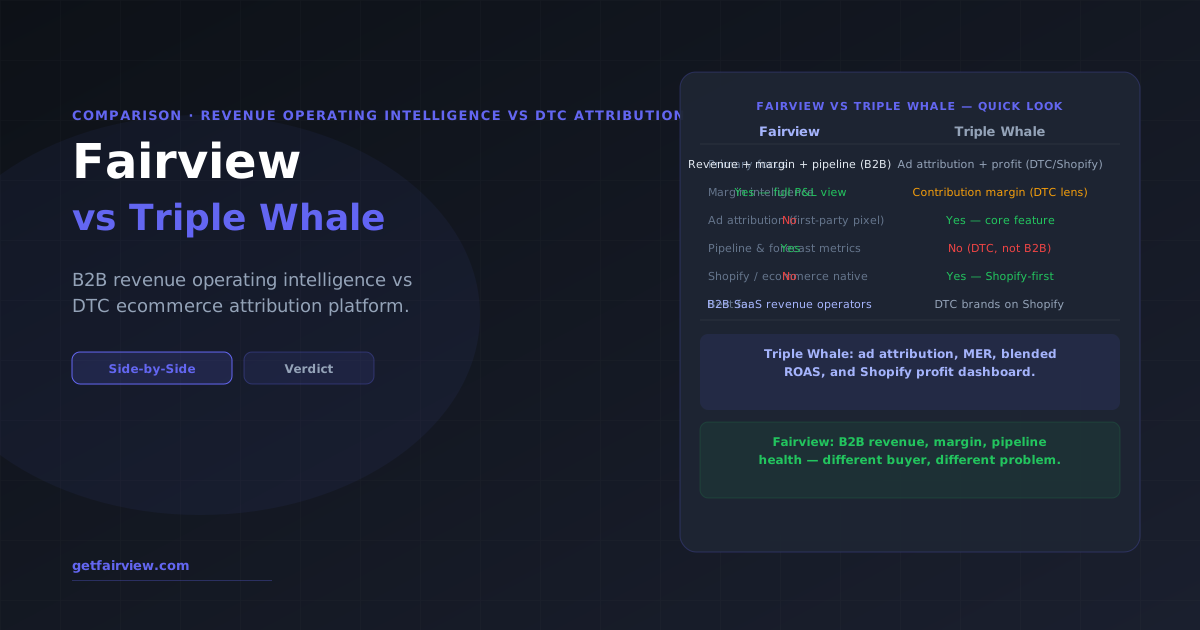
| Feature / Capability | Fairview | Triple Whale |
|---|---|---|
| Business model fit | B2B SaaS / services | DTC ecommerce (Shopify) |
| Revenue metrics (MRR, ARR, churn) | Yes — core feature | No (DTC GMV, not B2B) |
| Ad attribution (first-party pixel) | No | Yes — core feature |
| Blended ROAS / MER | No | Yes — best-in-class |
| Gross margin intelligence | Yes — by segment, product, geography | Yes — by order / channel (DTC) |
| Pipeline / CRM integration | Yes (Salesforce, HubSpot) | No |
| Shopify integration | No | Native Shopify integration |
| Creative analytics | No | Yes — ad creative ROAS |
| Customer LTV by cohort | B2B retention / NRR cohorts | DTC purchase cohort LTV |
| AI anomaly detection | Revenue metric anomalies (B2B) | Limited |
| Pricing access | Growth-stage accessible (flat) | GMV-based ($129–$2,500+/mo) |
The Audience Gap: Who Buys Each Tool
The buyer profiles for Triple Whale and Fairview are almost entirely distinct.
Who Buys Triple Whale
Triple Whale is purchased by DTC brand operators — typically a founder, Head of Growth, or Director of Paid Media at a Shopify-based product brand. The pain point is accurate attribution in a privacy-constrained advertising environment. The success metric is marketing efficiency: improving MER, lowering blended CAC, identifying high-LTV acquisition cohorts. Common Triple Whale customers are brands doing $1M–$50M in annual GMV through Shopify with significant Meta and Google ad spend.
Who Buys Fairview
Fairview is purchased by revenue operators at B2B companies — a CFO, CRO, VP of RevOps, or CEO at a SaaS or services business. The pain point is visibility across revenue, margin, and pipeline — metrics that are scattered across Salesforce, Stripe, HubSpot, and spreadsheets. The success metric is revenue health: growing MRR while protecting gross margin, shortening CAC payback, and maintaining pipeline coverage above 3x. Common Fairview customers are B2B companies doing $3M–$50M in ARR.
Why This Comparison Comes Up
The "Fairview vs Triple Whale" search exists because both platforms use the language of revenue intelligence, profit, and business performance. Both surface margin-related data. Both promise to help operators make better financial decisions. But the underlying data, business model assumptions, and use cases are almost completely separate.
If you run a DTC Shopify brand with meaningful paid social spend, Triple Whale is a strong choice for attribution clarity. If you run a B2B SaaS or services company that needs to understand revenue, margin, and pipeline health in one place, Fairview is the relevant tool. Very few companies are genuinely in both categories simultaneously — and if you are (say, a hybrid DTC + B2B business), you would likely use both tools independently.
How Fairview Handles B2B Revenue Intelligence
For B2B operators who have looked at Triple Whale and realized it is not built for their business model, Fairview provides the operating visibility that Triple Whale offers for DTC — but designed for subscription revenue, deal-cycle pipeline, and B2B margin economics.
The setup process is straightforward. Fairview connects to your existing systems — Salesforce, HubSpot, Stripe, QuickBooks, or your data warehouse — within one to two days. There is no instrumentation required, no pixel to install, no custom event tracking to set up. Fairview reads your existing data and surfaces the metrics that matter to your revenue team immediately.
The result is a real-time operating view that replaces the weekly spreadsheet pull: MRR and ARR trends, gross margin by segment, pipeline coverage and deal velocity, and marketing ROI by channel. When something breaks — a cohort starts churning faster, a pipeline stage develops a conversion problem, a marketing channel goes negative-ROI — Fairview's AI anomaly detection surfaces it before it becomes a board-level conversation.
Book a demo to see whether Fairview fits your revenue operations context.
Who are Triple Whale's competitors? +
How accurate is Triple Whale attribution? +
Does Triple Whale work for B2B SaaS companies? +
Built for B2B Revenue Operators
If you run a B2B SaaS or services company, Fairview gives you the revenue, margin, and pipeline visibility that Triple Whale gives DTC brands for ad attribution.
Book a Demo