.svg)
TL;DR
- Operating Intelligence is the category of software built for operators — COOs, founders, general managers — rather than analysts. It turns fragmented CRM, finance, e-commerce, and ad data into weekly decisions.
- It is different from BI (which is built to run queries on historical data) and from RevOps analytics (which focuses only on the revenue funnel). Operating Intelligence spans revenue, margin, pipeline, and cash in a single view.
- The four pillars: connected data, margin-level visibility, pipeline health, and next-best action.
- The category exists because operators between $2M and $100M ARR have outgrown spreadsheets but cannot justify a data team — and their BI tools answer questions they do not have time to ask.
- Fairview is an Operating Intelligence platform: it connects your stack, surfaces the weekly operating picture, and writes the named action for each anomaly.
Operating Intelligence is the category of software that turns fragmented operating data — from CRM, finance, e-commerce, and marketing — into the weekly decisions an operator actually has to make. It sits between business intelligence (which is built for analysts) and operational software (which captures the data in the first place), and it exists because operators between $2M and $100M ARR have outgrown spreadsheets and cannot justify a data team.
The category is new enough that most operators still call whatever tool they use for Monday morning reviews a "dashboard" or a "reporting layer." Neither is right. A dashboard shows metrics. Operating Intelligence shows decisions. The difference is the point of the category.
This guide defines Operating Intelligence, contrasts it against BI and RevOps analytics, lays out the four pillars the category is built on, and shows how operators use it to run a weekly rhythm. Pair it with the RevOps pillar, profit-leak detection, and sales forecasting methods.
What is Operating Intelligence?
Definition
Operating Intelligence: a category of software that unifies data from CRM, finance, e-commerce, and marketing into one operating view — then pairs that view with named actions so operators can run the business weekly without assembling reports themselves.
The shorthand: BI is built for analysts running queries. Operating Intelligence is built for operators running a business. The difference shows up immediately in how the product answers questions. A BI tool will render a beautiful chart of margin by channel when you write the SQL for it. An Operating Intelligence tool will show you that margin by channel on Monday morning and flag that paid search dropped eight points, with a named recommendation to review the creative mix.
Operating Intelligence is action-first. Every metric it surfaces is paired with a decision. Every weekly review ends with assigned follow-ups rather than more questions. The test for whether a tool qualifies as Operating Intelligence: does it tell the operator what to do next, or does it wait for them to ask?
Why Operating Intelligence exists as a category
Three things happened between 2020 and 2025 that created the gap Operating Intelligence fills.
First, the operating stack exploded. A typical B2B company today runs HubSpot or Salesforce for CRM, Stripe for billing, QuickBooks or Xero for finance, Google Ads and Meta for acquisition, and half a dozen point tools on top. Revenue lives in one system, margin lives in another, and pipeline lives in a third. No single dashboard has the whole picture.
Second, BI tools priced themselves out of reach for sub-$50M companies. Looker, Tableau, and Power BI are designed for teams with dedicated analysts. The tools are powerful but the implementation assumes someone writes the SQL, builds the model, and maintains the views. Most operators under $50M ARR do not have that person.
Third, operators got more accountable. Series A and B boards now expect weekly operating reviews with margin, pipeline health, and forecast confidence — not a Monday morning revenue number. Founder-CEOs are expected to run the company like a COO does, and COOs are expected to produce the picture without the dashboard team.
Operating Intelligence vs BI vs RevOps analytics
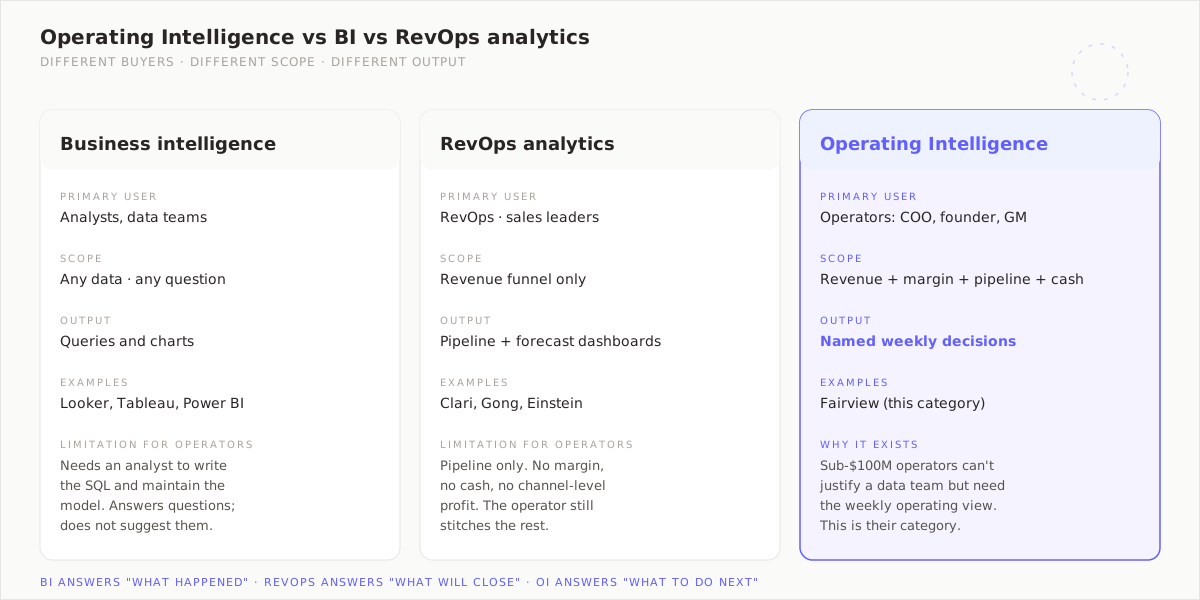
| Category | Primary user | Scope | Output |
|---|---|---|---|
| Business intelligence | Analysts, data teams | Any data, any question | Queries and charts |
| RevOps analytics | RevOps, sales leaders | Revenue funnel only | Pipeline + forecast dashboards |
| Operating Intelligence | Operators (COO, founder, GM) | Revenue + margin + pipeline + cash | Named weekly decisions |
The three categories are not competing for the same buyer. BI is a horizontal platform. RevOps analytics is a vertical slice of the revenue team's workflow. Operating Intelligence is built for the person who owns the outcome — the operator who needs one view and one action list, not five tabs and a data team.
Key insight
BI answers the question an analyst asks. Operating Intelligence answers the question an operator already has — and the one they should be asking but did not.
The four pillars of Operating Intelligence
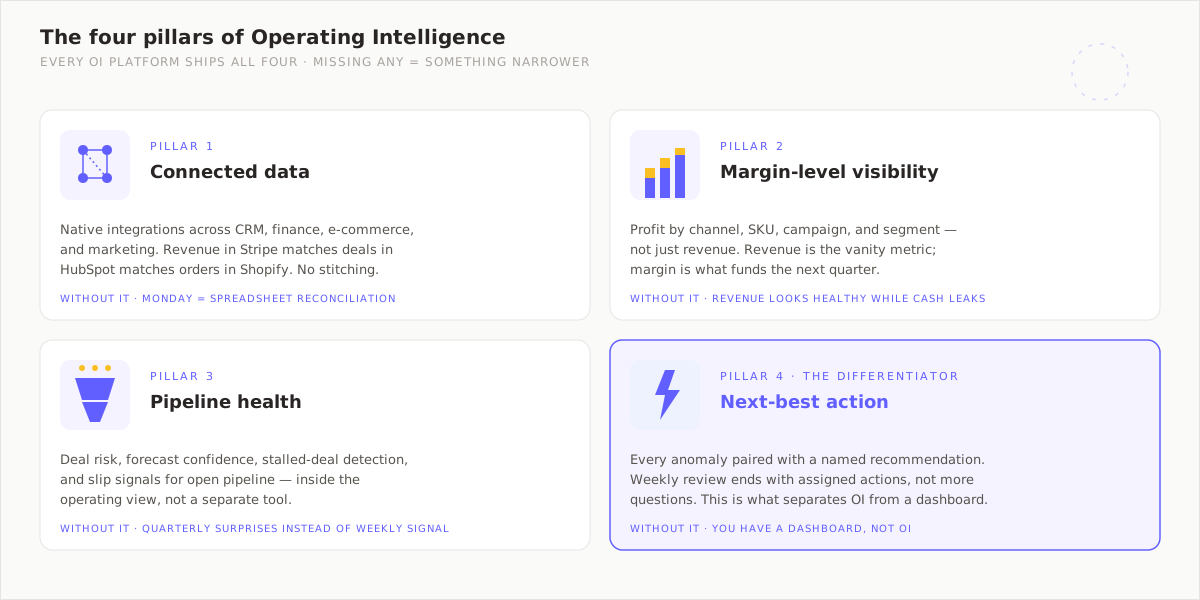
Every Operating Intelligence platform — whether it is Fairview, a carefully assembled internal stack, or something yet to be built — ships the same four capabilities. A product missing any one of them is solving a narrower problem.
- Connected data. Native integrations to CRM, finance, e-commerce, and marketing. Data normalised so revenue in Stripe matches deals in HubSpot matches orders in Shopify. Without this, operators spend Mondays reconciling instead of deciding.
- Margin-level visibility. Profit by channel, SKU, campaign, and segment — not just revenue. Revenue is the vanity metric. Margin is the metric that funds the next quarter. Operating Intelligence shows margin at the level where action happens.
- Pipeline health. Deal risk, forecast confidence, stalled-deal detection, and slip signals for open pipeline. The forecasting pillar of Operating Intelligence overlaps with RevOps analytics but sits inside the broader operating view, not a standalone tab.
- Next-best action. Every anomaly paired with a named recommendation. “Margin on paid social dropped 12%. Likely driver: AOV fell from $62 to $49 after the BFCM cohort landed. Review promo windows.” This is what separates Operating Intelligence from a dashboard.
Who uses Operating Intelligence?
The profile is consistent: someone whose job description includes the outcome, not the function. Four archetypes buy Operating Intelligence today.
- The COO of a $10–100M B2B company. Owns the weekly operating review. Needs revenue, margin, pipeline, and cash in one place. Currently spends Monday morning stitching together a Google Sheet from finance, sales, and marketing exports.
- The founder-CEO doing sales. Running the company and the pipeline. Cannot afford a RevOps hire yet. Needs the operating picture that the investors expect in the next board pack, and an answer to “how is the quarter looking?” that takes 90 seconds to produce.
- The D2C operator above $2M revenue. Needs contribution margin by channel, CAC payback by cohort, and a way to know which SKUs fund growth versus which ones drain it. Triple Whale and Northbeam solve the marketing attribution layer; Operating Intelligence adds finance, inventory, and operating cash on top.
- The general manager of a business unit. Reports a P&L but does not own the data team. Operating Intelligence is how they get a credible weekly narrative without borrowing analyst time from corporate.
The weekly rhythm Operating Intelligence enables
The real product is not the dashboard, it is the rhythm. A well-run Operating Intelligence platform collapses the weekly operating review from four hours of stitching into 45 minutes of deciding.
Quote-ready
A weekly operating review that ends with a list of questions is a reporting exercise. One that ends with a list of assigned actions is Operating Intelligence working.
- Sunday evening. The platform delivers the week's operating report to the operator's inbox: revenue vs forecast, margin vs prior period, pipeline changes, and the top three anomalies with named actions.
- Monday 9am. Operator opens the dashboard already briefed. Reviews the three anomalies, assigns the actions, and moves on.
- Mid-week. Alerts fire for pipeline deals that stall, margin swings that cross thresholds, and forecast changes driven by specific deals. No need to check in — the platform surfaces what changed.
- Friday. Action review: which Monday decisions moved the number, which did not. Loop closes, learning compounds.
What Operating Intelligence is not
Three adjacent categories get confused with Operating Intelligence. It is worth being clear about the difference.
- Not a data warehouse. Snowflake and BigQuery store data. Operating Intelligence consumes it. The warehouse is infrastructure; Operating Intelligence is the product built on top.
- Not a BI tool. Looker, Tableau, and Power BI are query platforms. Operating Intelligence ships with the queries and the actions pre-built for the operator use case. The trade is less flexibility for more speed-to-answer.
- Not a RevOps platform. Clari, Gong, and Salesforce Einstein focus on the revenue funnel. Operating Intelligence includes pipeline but also covers margin, cash, and channel-level profitability that RevOps tools deliberately exclude.
- Not an FP&A tool. Mosaic, Cube, and Abacum are built around the CFO's model. Operating Intelligence is built around the operator's week. They overlap on cash, differ everywhere else.
How Fairview delivers Operating Intelligence
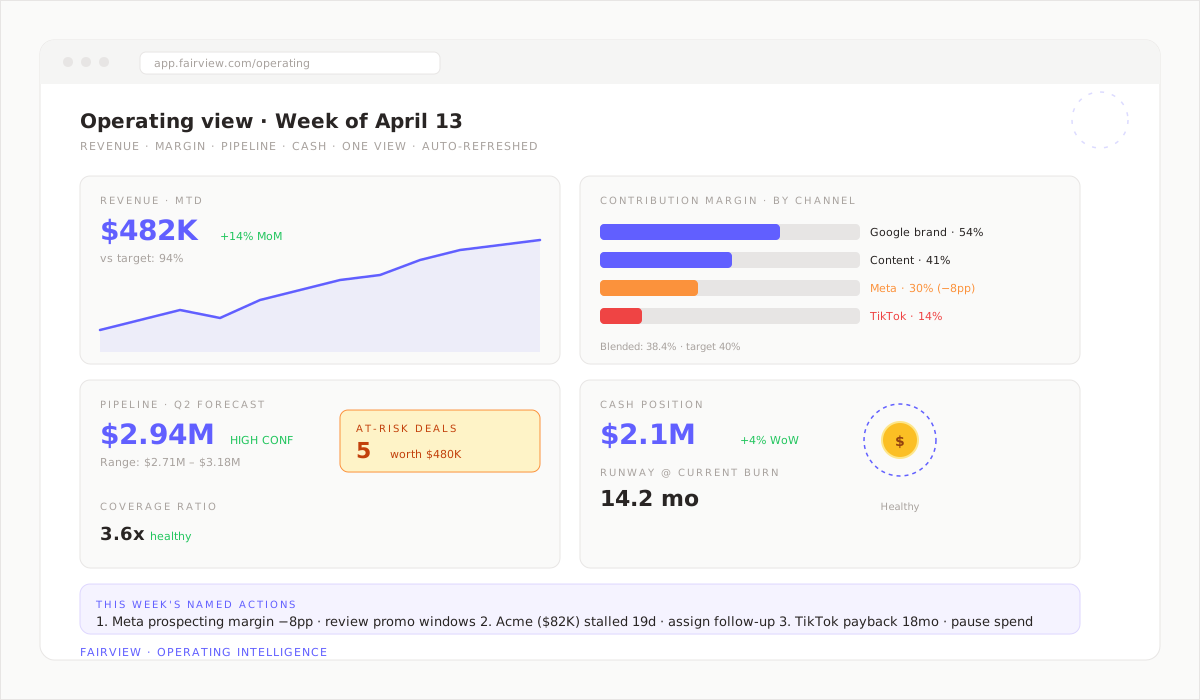
Fairview is an Operating Intelligence platform built for operators between $2M and $100M in revenue. It connects to HubSpot, Salesforce, Pipedrive, Stripe, QuickBooks, Xero, Shopify, Google Ads, Meta Ads, and HubSpot Marketing Hub via native OAuth — and turns the combined stack into a single operating view.
The Operating Dashboard aggregates margin by channel, pipeline health, forecast confidence, and anomaly alerts in real time. The Next-Best Action engine pairs every anomaly with a specific recommendation. The Weekly Operating Report lands in the operator's inbox every Monday morning, already assembled.
See pricing and tiers for the plan that fits your stack.
1 view
Revenue, margin, pipeline, cash
10 min
First integration to live dashboard
Weekly
Auto-generated operating report
Key takeaways
- Operating Intelligence is the category built for operators, not analysts.
- It spans revenue, margin, pipeline, and cash in a single view.
- Four pillars: connected data, margin visibility, pipeline health, next-best action.
- Different from BI (query tool) and RevOps (revenue funnel). Broader than both.
- Best fit: $2–100M revenue businesses with an operator owning the weekly number.
Run your business on one view, not five dashboards.
Connect HubSpot or Shopify, Stripe, and the ad platforms. Fairview returns revenue, margin, pipeline, and cash — with named weekly actions — on day one. 14-day trial, no card required.
Frequently asked questions
Operating Intelligence is the category of software that turns fragmented operating data from CRM, finance, e-commerce, and marketing into decisive action. Unlike traditional BI, which is built for analysts querying historical data, Operating Intelligence is built for operators — COOs, founders, general managers — who need to run the business weekly and know what to do next.
BI is query-and-chart infrastructure built for analysts. Operating Intelligence is action-first software built for operators. BI answers ‘what happened’; Operating Intelligence answers ‘what to do next’ by pairing live operating metrics with named recommendations and a weekly operating rhythm. An operator using BI has to assemble the picture themselves; an operator using OI gets it assembled.
RevOps analytics focuses narrowly on the revenue funnel — pipeline, forecast, attribution. Operating Intelligence spans revenue, margin, cash, and channel health in a single view. RevOps is a subset of Operating Intelligence. An Operating Intelligence platform typically includes RevOps-grade pipeline analytics plus margin, operating cash, and weekly-report layers that RevOps tools skip.
COOs, operators, founder-CEOs running weekly operating reviews, and general managers of business units. The profile is someone responsible for outcome rather than function — they own the weekly number and need a single view of revenue, margin, pipeline, and cash rather than separate dashboards from finance, sales, and marketing.
Connected data, margin-level visibility, pipeline health, and next-best action. Connected data unifies CRM, finance, and e-commerce into one view. Margin-level visibility shows profit by channel, SKU, and campaign — not just revenue. Pipeline health tracks deal risk and forecast confidence. Next-best action turns every insight into a named recommendation, so the weekly review ends with decisions rather than questions.
Operating Intelligence fits businesses between $2M and $100M in annual revenue where the operator has already outgrown spreadsheets and founder memory but cannot justify a data team. Below $2M the stakes are small and founders can hold the picture in their head. Above $100M, dedicated analytics teams typically build custom stacks. The middle is where Operating Intelligence earns its keep.