.svg)
TL;DR
- The 12 RevOps KPIs that matter span four layers: pipeline, conversion, efficiency, and retention.
- Forecast accuracy is the most load-bearing metric. If it is wrong, every downstream decision is wrong.
- Pipeline coverage of 3x is a rule of thumb, not a law. The correct number is 1 ÷ your win rate.
- Every KPI has a trap. The goal is not just to compute it but to catch the version that lies.
- Fairview tracks all twelve across CRM, billing, and ads without SQL or a data team.
RevOps KPIs are the cross-functional metrics a revenue operations team owns to measure pipeline health, sales efficiency, customer retention, and forecast reliability. They are the scoreboard. Pick the wrong ones and the team optimizes the wrong outcome for a whole year before anyone notices.
Most RevOps dashboards fail in the same way. They track twenty-plus metrics, none of them trusted, updated at different cadences, pulled from different sources. The team spends its week reconciling numbers instead of driving them. A mature KPI set is shorter, cleaner, and actually reviewed.
This is the spoke that lists the twelve KPIs that matter, their formulas, benchmarks, and the specific way each one lies. It supports the pillar on revenue operations and the related posts on CAC payback, contribution margin by channel, and true ROAS.
What are RevOps KPIs?
Definition
RevOps KPIs: the set of cross-functional revenue metrics a RevOps team owns to measure pipeline generation, conversion efficiency, unit economics, and customer retention. They replace department-specific dashboards with one scoreboard the CRO, CFO, and CEO can all defend.
The right KPI set answers four questions every week: Do we have enough pipeline? Is it converting? Can we afford what we just sold? Are customers staying? Each question maps to a layer of metrics, and each metric has a specific failure mode.
The four-layer KPI stack
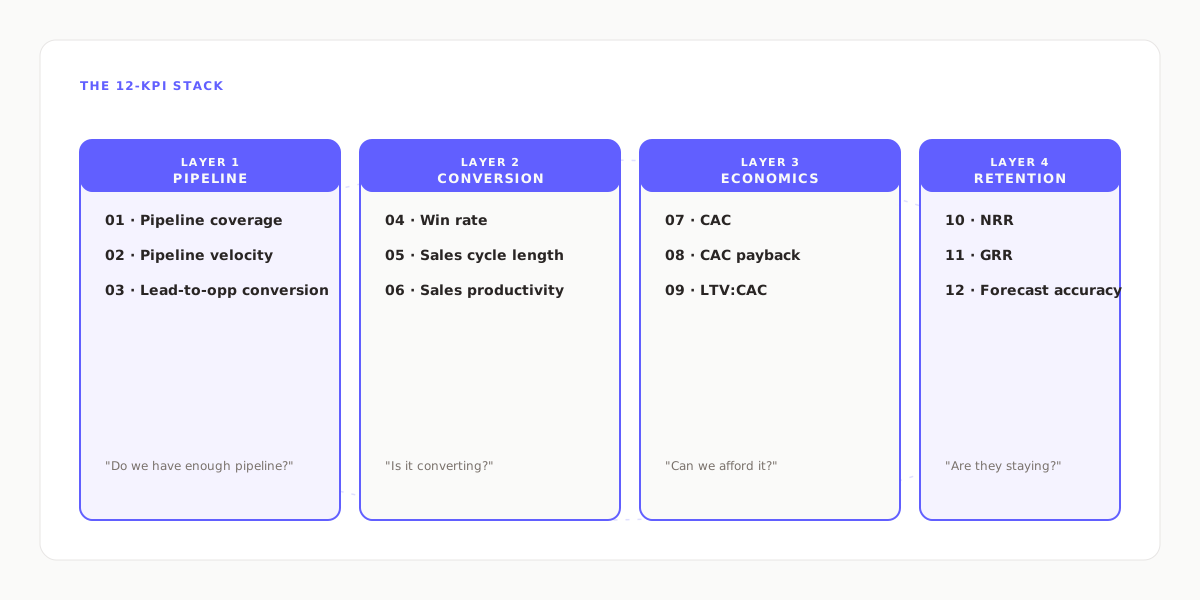
Group the KPIs by what they answer, not by which team owns them. Grouping by team produces a siloed dashboard. Grouping by question produces an operating review.
Layer 1: pipeline generation
1. Pipeline coverage
Formula: Open pipeline value ÷ Quarterly target. Benchmark: 3x is the rule of thumb; the correct number is 1 ÷ historical win rate. Trap: Counting late-stage pipeline the same as Stage 1. Weight each stage by historical conversion to avoid false comfort.
2. Pipeline velocity
Formula: (Number of opportunities × Avg deal value × Win rate) ÷ Sales cycle days. Benchmark: Trend, not absolute. Watch the slope. Trap: Ignoring segment-level differences — SMB and enterprise velocity are different businesses.
3. Lead-to-opportunity conversion
Formula: Opportunities created ÷ Qualified leads. Benchmark: 10–20% for SMB inbound; 20–30% for BDR-sourced. Trap: Counting re-engaged leads as new ones. Tag the source cohort at creation, not at conversion.
Layer 2: conversion efficiency
4. Win rate
Formula: Deals won ÷ Deals closed (won + lost). Benchmark: 20–30% for B2B SaaS inbound; higher for warm referrals. Trap: Excluding no-decisions. A deal that stalled for 9 months is a loss even if nobody clicked "Closed Lost."
5. Average sales cycle length
Formula: Median days from opportunity creation to closed-won. Benchmark: 30–60 days SMB; 90–180 days mid-market; 180+ enterprise. Trap: Using the mean. The long tail pulls the average and hides the real distribution — always use the median or both.
6. Sales productivity
Formula: Annual new booked revenue ÷ Fully-loaded AE cost. Benchmark: 3–5x for healthy B2B SaaS. Trap: Counting only base salary instead of fully loaded (salary, commission, benefits, tooling).
Key insight
Every metric has a version that flatters the team and a version that tells the truth. The job of RevOps is to publish the second one.
Layer 3: unit economics
7. CAC
Formula: Sales + marketing spend in period ÷ New customers acquired in period. Benchmark: Varies widely by model. Trap: Excluding BDR salaries, tooling, or free-trial conversion costs. Use fully loaded CAC only.
8. CAC payback
Formula: CAC ÷ Monthly contribution margin per customer. Benchmark: < 12 months D2C subscription; < 18 months SMB SaaS. Trap: Using gross margin instead of contribution. See the full CAC payback post.
9. LTV:CAC
Formula: Customer lifetime value ÷ CAC. Benchmark: 3x healthy; 5x strong. Trap: Using theoretical LTV (ARR ÷ churn rate) instead of observed cohort LTV. Theoretical LTV always flatters.
Layer 4: retention
10. Net revenue retention (NRR)
Formula: (Starting ARR + expansion − contraction − churn) ÷ Starting ARR, from the same cohort a year ago. Benchmark: 110%+ SMB SaaS; 120%+ mid-market and enterprise. Trap: Mixing cohorts. NRR must follow the same customers through time.
11. Gross revenue retention (GRR)
Formula: Starting ARR − churn − contraction, divided by Starting ARR. Excludes expansion. Benchmark: 90%+ SMB; 95%+ enterprise. Trap: Reporting NRR without GRR. High NRR can hide low GRR if expansion is carrying the number.
12. Forecast accuracy
Formula: 1 − |Forecast − Actual| ÷ Forecast, at the segment level. Benchmark: +/- 5% at quarterly segment level is strong. Trap: Reporting only blended accuracy. Blended forecasts often hit while segment forecasts miss in opposite directions.
Benchmarks at a glance
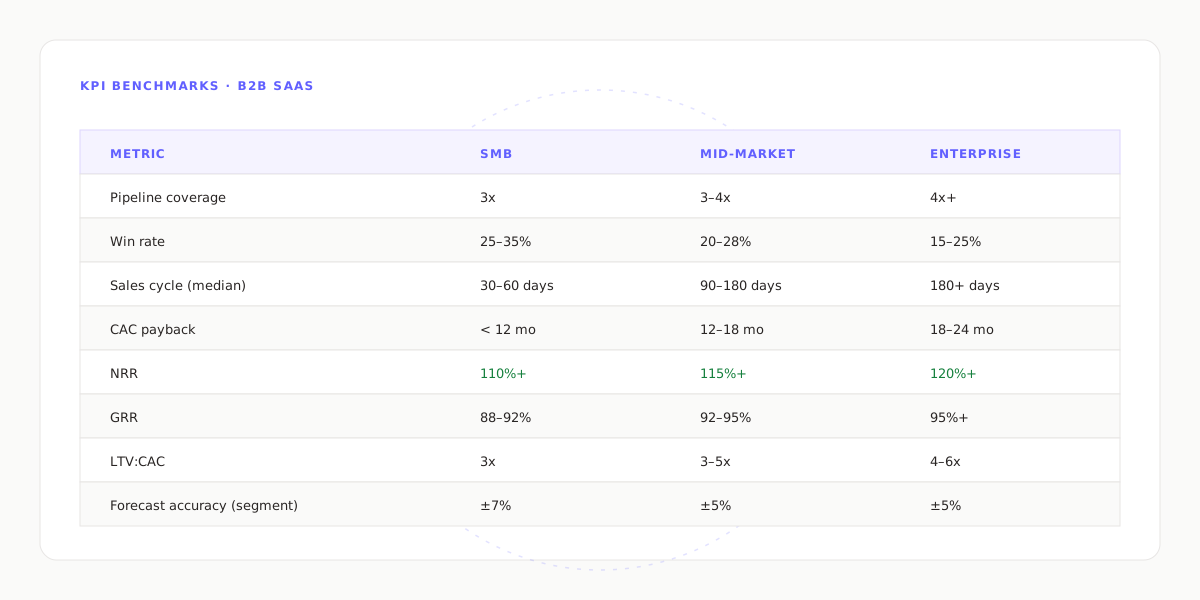
The table is directional. Always read a benchmark against your own historical baseline before reacting to it. A 25% win rate is bad if you used to do 35%; a 25% win rate is good if you used to do 18% and the team is finally getting better at qualification.
Operating cadence for each KPI
| Cadence | KPIs | Forum |
|---|---|---|
| Weekly | Pipeline coverage, forecast vs commit, stage velocity | Pipeline review |
| Monthly | Win rate, sales cycle, CAC, lead-to-opp conversion | Ops review |
| Quarterly | NRR, GRR, LTV:CAC, sales productivity, forecast accuracy | QBR / board |
| Annually | Cohort LTV, segment-level unit economics | Strategy |
Quote-ready
A weekly operating review with five trusted metrics beats a monthly review with twenty disputed ones.
How Fairview tracks RevOps KPIs automatically
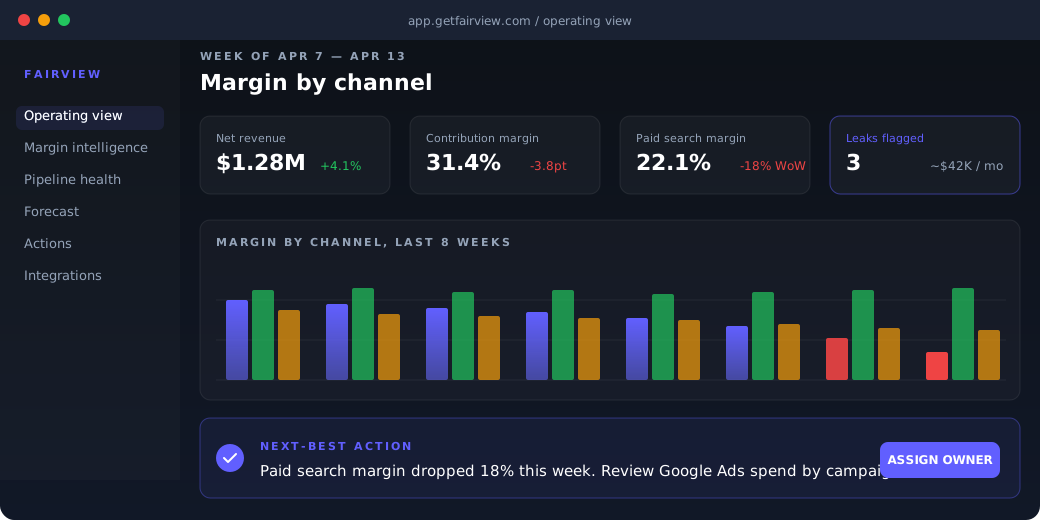
Fairview connects natively to HubSpot, Salesforce, Pipedrive, Stripe, QuickBooks, Xero, Google Ads, and Meta Ads. Once connected, the Operating Dashboard calculates all twelve KPIs on the same definition every time, with segment-level breakdowns for win rate, NRR, and forecast accuracy. The Forecast Confidence Engine scores the commit so RevOps knows which segment is optimistic before the quarter ends.
When a KPI moves outside its historical band, Fairview writes a named next-best action: "Pipeline coverage on the Mid-Market segment dropped from 3.2x to 2.1x in two weeks. Driver: BDR-sourced opps down 41% since the March campaign ended. Consider reopening outbound on the ICP-match accounts flagged in the segment view."
See pricing and tiers for the plan that fits your RevOps team.
12
KPIs tracked out of the box
By segment
SMB, MM, enterprise splits
Daily
Refresh across the stack
Key takeaways
- The twelve RevOps KPIs live across four layers: pipeline, conversion, economics, retention.
- Forecast accuracy is the most load-bearing metric. Pipeline coverage is a close second.
- Every KPI has a trap. Publish the honest version, not the flattering one.
- Match cadence to metric: weekly for pipeline, monthly for conversion, quarterly for economics.
- Segment-level views beat blended ones — especially for win rate, NRR, and forecast.
One scoreboard for every RevOps KPI.
Connect your CRM, billing, and ad platforms. Fairview returns all twelve KPIs in a single trusted view, refreshed daily. 14-day trial, no card required.
Frequently asked questions
RevOps KPIs are the cross-functional revenue metrics a RevOps team owns to measure pipeline health, sales efficiency, customer retention, and forecast reliability. They span marketing, sales, and customer success, and they give leadership one view of the revenue engine rather than three competing ones.
Forecast accuracy is the single most load-bearing RevOps metric. If the forecast is wrong, every downstream decision about hiring, spend, and cash is wrong. Pipeline coverage is the closest runner-up because it drives the forecast, and weak coverage makes every other metric cosmetic.
Ten to twelve active KPIs is typical. Fewer than six means the team cannot diagnose problems. More than fifteen means attention gets diluted and definitions drift. Most mature RevOps functions keep a core dozen plus a second-tier diagnostic set they pull only when an anomaly needs a root cause.
3x the quarterly target is the common rule of thumb. The correct number depends on your historical win rate: divide 1 by the win rate to get the coverage you actually need. A 25% win rate needs 4x coverage; a 33% win rate is fine at 3x. Use a stage-weighted view for the honest answer.
110% or higher is strong for SMB SaaS. 120% or higher is strong for mid-market and enterprise. Under 100% means the existing book is shrinking, and new sales have to cover the leak before any net growth begins. Always read NRR alongside gross revenue retention to see whether expansion is masking churn.
Weekly for pipeline coverage and forecast. Monthly for CAC, win rate, and sales cycle. Quarterly for NRR, GRR, LTV:CAC, and efficiency ratios. A weekly operating review with the same five metrics every time produces more behavior change than a monthly deep-dive into twenty.