Two tools, two completely different jobs. Here is what each one actually does — and which one your team needs.
Founder, Fairview
TL;DR
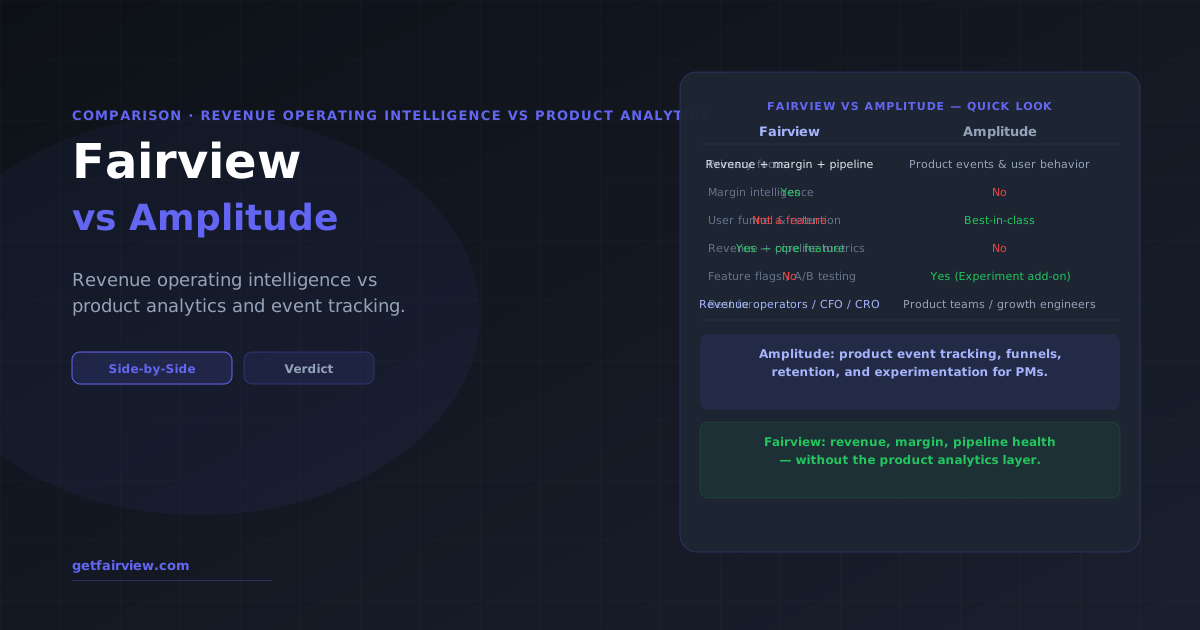
Fairview and Amplitude solve fundamentally different problems. Amplitude tracks what users do inside your product — funnels, retention, feature adoption. Fairview tracks how your business performs — revenue, margin, pipeline. Most growth-stage companies need both: Amplitude for product decisions, Fairview for revenue decisions.
The Core Difference in One Sentence
Amplitude answers: "What are users doing inside the product?" Fairview answers: "How is the business performing — revenue, margin, and pipeline?"
These are not competing questions. They are asked by different people at different moments for different decisions. Conflating the two is one of the most common mistakes growing B2B companies make when evaluating their analytics stack.
What Amplitude Does
Amplitude is a product analytics platform. It was built to help product managers, growth engineers, and data scientists understand user behavior inside a digital product. The core capability is event tracking: you instrument your application to fire events when users take specific actions, and Amplitude captures, analyzes, and visualizes those events.
Amplitude's Core Capabilities
- Event tracking and funnels: Track any user action — button clicks, feature usage, page views — and build conversion funnels to see where users drop off
- Retention analysis: Cohort-based retention charts showing how many users return to your product after day 1, day 7, day 30
- User segmentation: Slice behavior by user properties — plan type, geography, company size — to understand what drives engagement
- Experiment (A/B testing): Feature flag management and experiment analysis to measure the impact of product changes
- Behavioral cohorts: Group users by actions they have taken — "users who activated feature X but not feature Y" — and compare their outcomes
- Session replay (Amplitude Session Replay): Watch individual user sessions to understand qualitative behavior alongside quantitative trends
Amplitude is genuinely excellent at what it does. It has become the default product analytics tool for many SaaS companies for good reason — the depth of behavioral analysis is hard to match.
What Amplitude Does Not Do
Amplitude does not track revenue health, margin, or pipeline. It does not connect to your CRM to show you deal velocity. It does not show you contribution margin by channel or product line. It does not surface anomalies in your MRR expansion or flag when net revenue retention is trending down. That is not a criticism — it is simply outside Amplitude's scope.
What Fairview Does
Fairview is a revenue operating intelligence platform. Where Amplitude is built for product teams analyzing user behavior, Fairview is built for revenue operators — CFOs, CROs, RevOps leaders, and CEOs — who need to understand how the business is performing at the revenue, margin, and pipeline level.
Fairview's Core Capabilities
- Revenue metrics dashboard: MRR, ARR, expansion, contraction, churn — unified from your billing system and CRM in real time
- Margin intelligence: Gross margin, contribution margin by segment, customer acquisition cost with full cost attribution — not just revenue optics
- Pipeline health monitoring: Deal velocity, stage conversion rates, pipeline coverage ratio, and forward-looking forecast signals
- Marketing channel ROI: Spend vs pipeline vs closed revenue by channel — connecting marketing investment to business outcome
- AI-powered anomaly detection: Fairview surfaces metric anomalies automatically — a sudden drop in win rate, an unusual spike in churn — before your next board meeting
- Cross-source metric unification: Pulls from Salesforce, HubSpot, Stripe, QuickBooks, and your data warehouse into a single operating view
Fairview is not trying to replace your CRM or your BI tool. It is the layer that sits above your data sources and gives revenue operators a live, actionable picture of business health — something that used to require a full RevOps team and hours of spreadsheet work each week.
Fairview vs Amplitude: Feature-by-Feature Comparison
| Feature / Capability | Fairview | Amplitude |
|---|---|---|
| Primary audience | CFO, CRO, RevOps, CEO | Product managers, growth engineers |
| Revenue metrics (MRR, ARR, churn) | Yes — core feature | No |
| Margin intelligence | Yes — gross + contribution margin | No |
| Pipeline / deal health | Yes | No |
| Marketing channel ROI | Yes | No |
| User event tracking | No | Yes — best-in-class |
| Funnel analysis | No | Yes |
| Retention cohorts | No | Yes |
| A/B testing / experiments | No | Yes (add-on) |
| AI anomaly detection | Revenue metric anomalies | Behavioral signals only |
| Setup time | 1–2 days | Days to weeks (instrumentation required) |
| Pricing model | Flat / growth-stage accessible | Event volume + feature tiers |
Who Buys Amplitude vs Who Buys Fairview
This is the clearest way to understand the distinction: the buyer profile is almost completely different.
The Amplitude Buyer
Amplitude is bought by product organizations. The champion is typically a VP of Product, Head of Growth, or a senior product manager. The use case is understanding what users do inside the product — where they drop off, which features drive retention, how experiments affect activation. The success metric is product engagement: DAU, feature adoption rate, D30 retention.
The Fairview Buyer
Fairview is bought by revenue organizations. The champion is typically a CFO, VP of Revenue Operations, CRO, or CEO. The use case is understanding how the business is performing financially — whether revenue is on track, where margin is eroding, whether the pipeline can support the growth plan. The success metric is business performance: MRR growth, gross margin, CAC payback period.
In a well-run B2B SaaS company, both buyers exist. The product team has Amplitude. The revenue team has Fairview. They use different tools because they have different jobs.
The Overlap: Where Both Teams Intersect
There is one area where Amplitude and Fairview data are genuinely complementary: understanding the relationship between product usage and revenue outcomes.
Amplitude can tell you which features correlate with high retention. Fairview can tell you which customer segments have the highest gross margin and lowest churn. When you combine both views, you can answer questions like:
- "Which product features do our most profitable customers use most?"
- "Does activating Feature X within 30 days predict better net revenue retention?"
- "Which user cohort has the best margin profile — and what did they do differently in onboarding?"
These questions require both tools, not one or the other. The data does not live in one place, and smart teams use both to drive product-led growth strategies that are actually tied to business outcomes.
Pricing and Stack Considerations
Amplitude uses event-volume-based pricing. The free tier allows up to 10 million events per month. Paid plans — Starter, Growth, and Enterprise — scale with event volume and unlock advanced features like Amplitude Experiment and Data. For high-event-volume applications, Amplitude costs can grow quickly.
Fairview is priced as an operating platform, not by data volume. Pricing is flat and accessible for growth-stage companies — not the $60,000+ per year that enterprise revenue tools like Clari or Gong can reach.
From a stack perspective, Amplitude slots into your product instrumentation layer alongside tools like Segment or Mixpanel. Fairview slots into your revenue data layer alongside Salesforce, HubSpot, Stripe, and your accounting system. These are separate layers, and you almost never need to choose between them.
How Fairview Handles Revenue Operating Intelligence
Fairview was built specifically for the problems that revenue operators face: fragmented data across too many tools, metrics that take hours to pull together, and no early warning system when something goes wrong.
The core workflow is simple. Fairview connects to your existing systems — CRM, billing, marketing platforms, accounting — and unifies those data sources into a single revenue operating view. You see RevOps KPIs, margin trends, and pipeline health in one place, updated continuously.
The AI anomaly detection layer surfaces issues before they become crises. If your win rate in a specific segment drops 8 points week over week, Fairview flags it. If a key account's usage data (via integration) suggests churn risk while the CRM shows no activity, Fairview surfaces the signal. This is the kind of insight that previously required a dedicated RevOps analyst running weekly reports.
For teams evaluating their analytics stack, the question is not "Fairview or Amplitude." It is "do we have both the product visibility and the revenue visibility we need to make good decisions?" Most companies in the $5M–$50M ARR range are underinvested on the revenue intelligence side — strong product analytics, weak revenue operating intelligence.
Book a demo to see how Fairview fits into your existing stack alongside tools like Amplitude.
Can Fairview replace Amplitude? +
Who uses Amplitude versus Fairview? +
Does Amplitude track revenue or pipeline metrics? +
See Fairview's Revenue Intelligence
Amplitude covers your product. Fairview covers your revenue. See the operating layer your team is missing.
Book a Demo