TL;DR
A weekly revenue cadence is a set of recurring meetings — weekly, monthly, and quarterly — that a revenue team uses to catch problems early, make decisions with data, and stay aligned on targets. The best cadences are short (30 minutes weekly), metric-first, and action-mandatory: every session ends with named owners and deadlines, not open discussions.
What Is a Revenue Cadence?
A revenue cadence is the rhythm your team uses to review business performance, catch problems early, and make decisions together. It is not a single meeting — it is a structure of meetings at different frequencies, each covering a different time horizon.
Most revenue teams have some version of a cadence already. The problem is that it usually looks like this: a Monday sales standup that becomes a status report, a monthly all-hands that recaps last month without making a single decision, and a quarterly business review that everyone dreads because nobody is sure what it is supposed to accomplish.
A well-designed revenue cadence is different. It is disciplined about what belongs at each level, who attends, and what the expected output is. A 30-minute Monday meeting that ends with three clear actions is worth more than a 90-minute Tuesday check-in that ends with "let us see how the week goes."
The goal of a revenue cadence is not to share information. Information sharing is what dashboards and Slack are for. The goal is to make decisions — specifically, the decisions that move the business toward its targets for the current quarter.
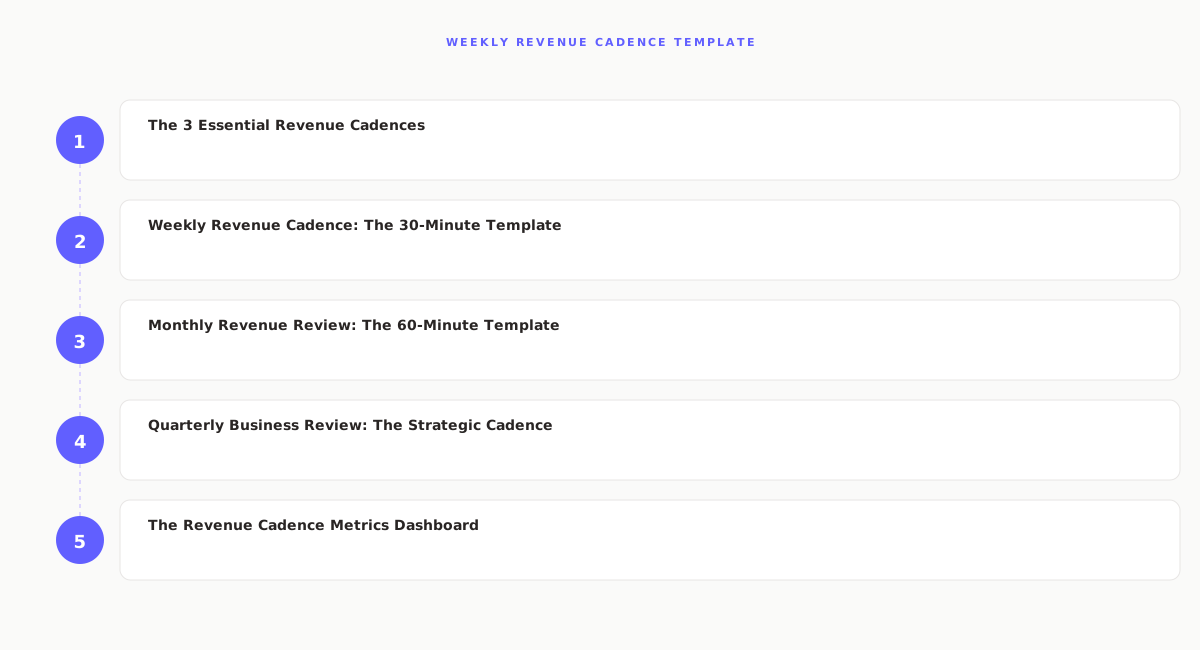
The 3 Essential Revenue Cadences
Every revenue team needs three distinct meeting types, each covering a different time horizon. Conflating them — trying to do weekly operations work and monthly trend analysis in the same meeting — is one of the most common reasons cadences fail.
| Cadence | Frequency | Length | Primary Question | Output |
|---|---|---|---|---|
| Revenue Pulse | Weekly (Monday) | 30 min | What needs attention this week? | 3 actions with owners |
| Revenue Review | Monthly | 60 min | Are we on track for the quarter? | Forecast update + 1 strategic call |
| Quarterly Business Review | Quarterly | 2–3 hours | What do we do differently next quarter? | Updated plan + budget reallocations |
Each cadence feeds the next. The weekly pulse surfaces tactical problems. The monthly review tracks whether those fixes are working and updates the forecast. The quarterly review asks whether the strategy itself is right.
Run your revenue cadence with live data.
Fairview surfaces the metrics you need for your weekly, monthly, and quarterly reviews — all in one place, always current.
See how it works →Weekly Revenue Cadence: The 30-Minute Template
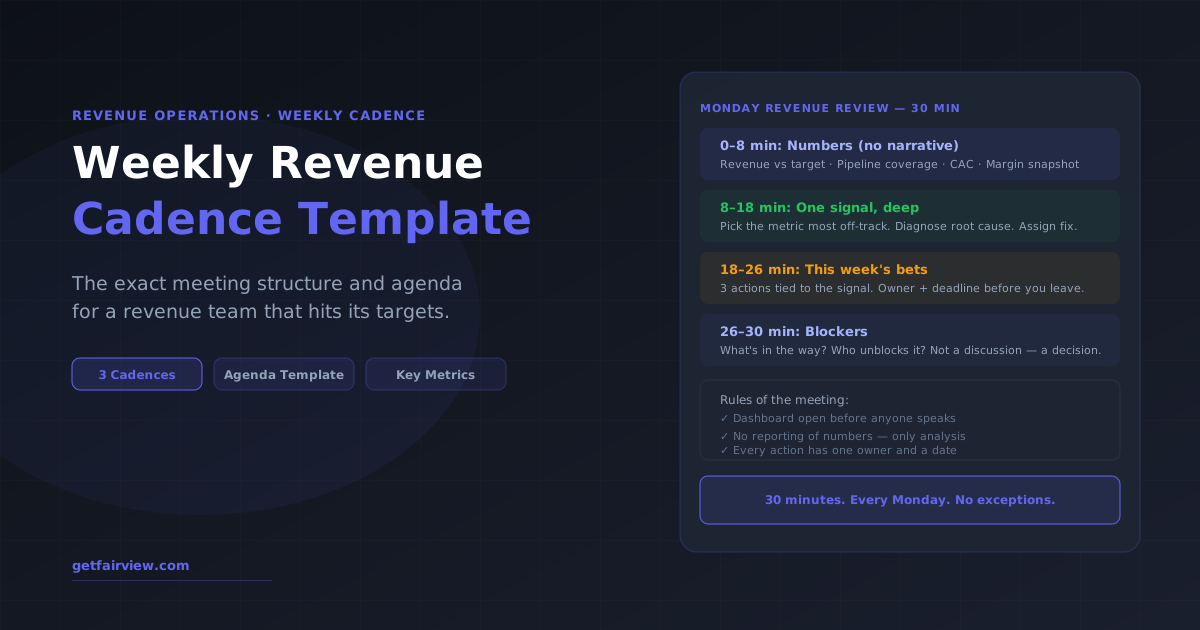
The weekly revenue pulse is the heartbeat of the cadence. It happens Monday morning before the week starts. The rule: 30 minutes, dashboard open, every action has an owner. No exceptions.
Read the dashboard out loud. Revenue MTD vs target. Pipeline coverage. CAC this week. Margin snapshot. No discussion. Just the numbers.
Pick the metric most off-track. Ask: why? Get to root cause in two levels of "why." No tangents. One metric gets the time, not five.
Three actions tied to the signal. Each action: who owns it, what done looks like, when it is complete. Write them in the shared doc before moving on.
What is preventing the actions from happening? Who unblocks it? Not a discussion — a decision. If it cannot be resolved in 4 minutes, it goes to a separate call.
What to Review on the Weekly Dashboard
The weekly dashboard should have exactly six metrics. Not twelve. Not twenty. Six. Any more and the meeting devolves into reporting instead of decision-making.
- Revenue MTD vs target — where are we and what does the EOM projection look like at current pace?
- Pipeline coverage ratio — total qualified pipeline ÷ remaining quota. Benchmark: 3x minimum
- New pipeline created this week — is marketing feeding the top of the funnel at the rate needed?
- Deals at risk — deals stuck in stage 20+ days or with no activity in 10 days
- CAC this week — spend-to-acquisition cost versus prior week and target
- Gross margin snapshot — are we growing profitably or just growing?
If you cannot read all six numbers in under 8 minutes, the dashboard is not ready and the meeting needs to start later. Never begin a weekly review without a working, live dashboard.
Monthly Revenue Review: The 60-Minute Template
The monthly review is where you step back from operational firefighting and ask: are we on track for the quarter? This meeting should happen in the first week of each month, covering the prior month's performance.
Revenue actual vs target. CAC by channel. Gross margin by product line. Win rate and pipeline coverage. Pre-read required — no one reads the numbers out loud.
Which metrics moved month-over-month? What drove the change? Focus on the 1–2 metrics where the trend line is heading in the wrong direction.
Where does Q end based on current pipeline and close rates? Bottom-up by deal and rep, not top-down by hope. What needs to change to hit target?
The meeting ends with one real decision: a budget reallocation, a channel pause, a pricing change, a hire. Not next steps. A decision.
The monthly review requires a pre-read sent 24 hours before. Anyone who has not read the pre-read does not attend. This rule alone will cut the time spent on number-sharing in half.
Quarterly Business Review: The Strategic Cadence
The quarterly review is where you assess whether the strategy itself is working — not just whether the team executed. It should feel different from a monthly review. More time on "why" and "what do we change," less time on "what happened."
| Section | Time | Owner | Output |
|---|---|---|---|
| Revenue performance vs plan | 20 min | CRO | Actuals vs plan by segment, rep, channel |
| Pipeline and forecast audit | 20 min | RevOps | Pipeline quality assessment, EOM Q+1 forecast |
| Channel ROI review | 25 min | Marketing | True ROI by channel after COGS and overhead |
| What we got wrong last quarter | 20 min | All | 3 explicit mistakes + root causes |
| Next quarter plan and bets | 30 min | Leadership | Updated plan, budget reallocations, 3 strategic bets |
| Decisions log | 15 min | RevOps | Written record of every decision made |
The "what we got wrong" section is the most important one and the most commonly skipped. Teams that never audit their mistakes repeat them. Block 20 minutes for it, name the mistakes explicitly, and assign root causes. This is not a blame exercise — it is how the strategy improves.
The Revenue Cadence Metrics Dashboard
Each cadence level needs its own metrics view. Using the same dashboard for the weekly pulse and the quarterly review is like using the same map for a city block and a country — the scale is wrong.
| Metric | Weekly Pulse | Monthly Review | Quarterly Review |
|---|---|---|---|
| Revenue vs target | MTD, projected EOM | Month actual, Q projection | Full quarter actual vs plan |
| Pipeline coverage | Current week | 30/60/90-day buckets | Pipeline health score |
| Win rate | Rolling 4-week | Monthly, by segment | Quarterly trend, vs prior year |
| CAC | Weekly blended | By channel, month | By channel, quarter, vs LTV |
| Gross margin | Blended snapshot | By product line | By SKU, channel, and customer segment |
| Deals at risk | Stuck deals list | Churn signals, late-stage | Lost deal analysis, pattern review |
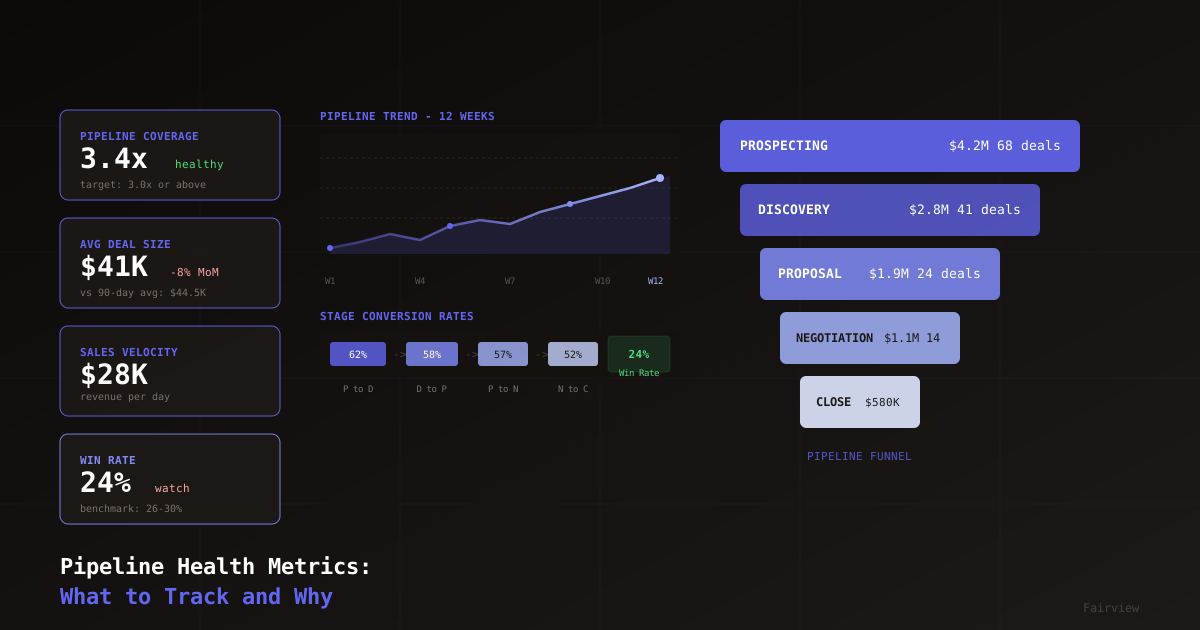
These metrics connect to the pipeline health metrics your team should track continuously. The cadence is where you discuss them — the dashboard is where they live between meetings.
The Rules That Make a Revenue Cadence Work
The template above is not magic. Most revenue teams have had some version of a weekly meeting for years. What separates the cadences that drive results from the ones that become scheduling overhead is a small set of non-negotiable rules.
Dashboard before discussion
The meeting does not start until the shared dashboard is open and visible to everyone. This eliminates the 10-minute warm-up where people describe data from memory with no shared reference.
No reporting — only analysis
If a number is visible on the dashboard, no one reads it out loud. The meeting time is for interpreting the numbers, not describing them. Pre-reads enforce this.
Every action has one owner and one deadline
"The team will look into this" is not an action. Actions are specific ("Sarah pulls the channel-level CAC data by Thursday 5pm") and assigned to one person. Group ownership means no one owns it.
The first 5 minutes of the next meeting is a previous-action review
Every weekly meeting opens by reviewing the actions from last week. Did they happen? If not, why? This creates accountability without surveillance.
Metrics must be live, not exported
If your dashboard is a manually updated spreadsheet, you will spend the first 10 minutes of every meeting debating whether the numbers are accurate. Live dashboards eliminate this entirely.
Common Revenue Cadence Failures
Most cadences fail not because the structure is wrong but because one of a small number of failure modes corrupts them over time.
Failure 1: The Meeting Becomes a Status Report
Symptoms: the majority of time is spent describing what happened, not deciding what to do about it. Fix: enforce the pre-read and the "dashboard before discussion" rule. If people come prepared with the data already in front of them, there is nothing to report — only to analyze.
Failure 2: No Decision Is Made
Symptoms: the meeting ends with "we should think about this more" or "let us revisit next week." Fix: every weekly meeting must close with at least one concrete decision, even a small one. The discipline of deciding matters as much as what you decide.
Failure 3: The Wrong People Are in the Room
Symptoms: the meeting is too large, tangents multiply, and no one is accountable for the decisions. Fix: the weekly pulse should have 4–5 people maximum — the people who own the metrics on the dashboard. Everyone else gets the written summary.
Failure 4: The Cadence Skips When Things Get Busy
Symptoms: the meeting is cancelled during crunch weeks or end of quarter. Fix: the cadence is most important precisely when things are hardest. Protecting the cadence during a bad quarter is what gives you the information to recover from it. Make it non-cancellable.
Failure 5: Stale Data
Symptoms: 10–15 minutes of each meeting is spent reconciling whose numbers are right. Fix: invest in a single source of truth for revenue metrics. The weekly cadence cannot function if the data foundation is broken. This is the most common reason cadences collapse — not bad meeting structure, but unreliable data.
How Fairview Supports Your Revenue Cadence
The single biggest accelerant to a productive revenue cadence is having a live, accurate, unified data view before the meeting starts. Without it, meetings become debates about the numbers. With it, meetings become debates about what to do about the numbers — which is the right conversation.
Fairview is built for this. It connects your CRM, ad platforms, finance data, and product analytics into one view — and keeps it current. For a weekly revenue pulse, you open Fairview on Monday morning and the six key metrics are already there, updated, with any anomalies flagged automatically.
Specific capabilities that support each cadence level:
- Weekly pulse: Live revenue vs target, pipeline coverage ratio, CAC by channel — all in one dashboard with no manual exports required
- Monthly review: True channel ROI after COGS and overhead, margin by product line, month-over-month trend views
- Quarterly review: Deal velocity analysis, win rate by segment, margin intelligence at the product and channel level
- Between meetings: Anomaly alerts that notify you when a key metric breaks — so you find out about problems before the next cadence meeting, not because of it
If your team currently spends the first 15–20 minutes of every revenue meeting reconciling numbers, book a demo to see how Fairview changes that dynamic.
30 minutes is the right length for a weekly revenue review. Longer than that and it becomes reporting theater. The meeting should have a dashboard open before anyone speaks, cover numbers in the first 8 minutes, spend 10 minutes diagnosing one key signal, and close with action assignments. If it takes longer, the data is not ready or the wrong people are in the room.
A weekly revenue meeting should cover: (1) revenue vs target (MTD and projected EOM), (2) pipeline coverage ratio, (3) new pipeline created this week, (4) deals at risk or stuck, (5) CAC trend vs LTV, and (6) gross margin snapshot. Limit to 6–8 metrics — any more and the signal-to-noise ratio collapses.
A sales cadence is a sequence of outreach touchpoints for prospecting (email, call, LinkedIn over a set number of days). A weekly revenue cadence is an internal meeting rhythm for reviewing business performance. The two are unrelated — one is an outbound sales motion, the other is an operational review structure.
The weekly revenue review should include: the CRO or VP Sales, the VP Marketing or head of demand gen, the RevOps lead, and the CEO or COO (in early-stage companies). Finance attends monthly, not weekly. Keep the room small — 4–6 people max. Add people only if they own a metric on the dashboard.
Key Takeaways
- A revenue cadence is three meetings at three frequencies: weekly pulse (30 min), monthly review (60 min), and quarterly business review (2–3 hours).
- The weekly pulse covers six metrics in 8 minutes, diagnoses one signal in 10 minutes, and closes with three named actions — every time.
- The five rules that make cadences work: dashboard first, no reporting (only analysis), one owner per action, previous-action review at the start, and live data only.
- The most common failure modes are status reports masquerading as meetings, no decisions, wrong attendees, and stale data causing number debates.
- A live, unified data platform is the single biggest accelerant to a productive cadence — it eliminates number reconciliation and focuses the meeting on decisions.
Ready to run a revenue cadence with live data?
Fairview keeps your revenue, pipeline, and margin metrics current — so your Monday meeting starts with answers, not debates.
Book a demo →Founder of Fairview. Building operating intelligence for revenue teams who need answers before the weekly meeting, not during it.