TL;DR
- Customer success operations is the function that runs the systems, processes, data, and technology that make customer success execution possible. It is not the CSM role. It is the operating layer underneath it.
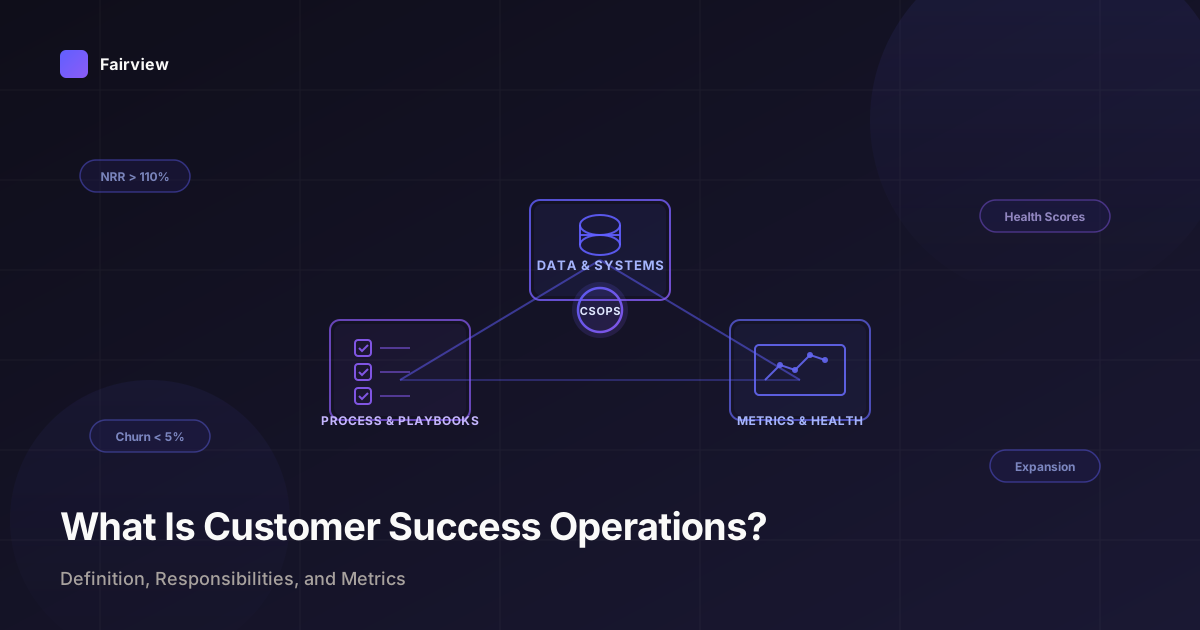
- The six core responsibilities are: technology management, health score and risk modeling, onboarding and expansion operations, data governance, measurement and reporting, and process design.
- CSOps tracks four categories of metrics: retention metrics (GRR, NRR, churn), health metrics (health score, TTV, adoption), expansion metrics (expansion ARR, upsell rate), and operational metrics (CSM capacity, playbook execution).
- According to the State of Customer Success Report 2025, 48.5% of organizations now have a dedicated CSOps function, with the role increasingly reporting into RevOps rather than the VP of Customer Success.
- Most companies hire their first CSOps person when the CSM team reaches five to eight people or when the customer base exceeds 100 accounts — whichever comes first.
Customer success operations is the function that runs the systems, processes, data, and technology that make customer success execution possible. It is not the QBR. It is not the renewal call. It is the operating layer underneath all of it: the health score that tells the CSM which accounts to prioritize, the onboarding playbook that ensures every customer reaches value in 30 days, the forecast that tells the CFO whether next quarter's renewal number is real, and the data hygiene that prevents the same account from appearing three times in the quarterly business review.
Most companies do not struggle with hiring CSMs. They struggle with making CSMs effective at scale. The team is growing, the account load is increasing, and nobody can answer a simple question: which customers are at risk, which are ready to expand, and is the team delivering outcomes? Customer success operations exists to make those questions answerable. It turns customer success from a relationship function that reports sentiment into a revenue function that reports outcomes.
This article covers what customer success operations is, the six responsibilities that define the function, the metrics that prove it is working, and where it fits inside a modern revenue operations org. If you are building a customer success team, hiring a CSOps lead, or trying to understand why your renewal forecasting is broken, this is the field guide.
What customer success operations actually is
Definition
Customer success operations (CSOps): the function that manages the people, processes, data, and technology required to execute customer success strategy and measure its revenue impact. Its job is to make customer success execution repeatable, measurable, and connected to the rest of the revenue engine.
The definition above is deliberate. Customer success operations is not a subset of customer success management. It is not a senior CSM who pulls reports. It is a distinct operating function with its own scope, skills, and metrics. According to the State of Customer Success Report 2025, 48.5% of organizations now have a dedicated CSOps function — up from a minority just three years ago. The function has moved from a nice-to-have in enterprise SaaS to a standard component of any B2B company with more than 100 accounts.
It helps to read the function at two levels. The strategic view is what the VP of Customer Success and the CRO care about: net revenue retention, gross revenue retention, expansion pipeline, churn risk by segment, and the forecast for what the CS team will renew and expand next quarter. The operational view is what the CSOps manager does on a Tuesday: configuring the health score model, fixing a broken data sync between the CS platform and the CRM, reconciling product usage data, building the renewal forecast dashboard, and enforcing data standards so the quarterly board report is not a five-day fire drill.
The gap between those two views is where most customer success teams break. The VP wants a renewal forecast by segment. The CSOps person needs clean contract data, consistent health score inputs, and a CRM that records expansion opportunities correctly. If any one of those inputs is missing, the forecast is fiction — and the CRO makes hiring and investment decisions on fiction. Customer success operations closes that gap by owning the inputs, not just the outputs.
For a broader view of how customer success operations connects to the full revenue engine, see our complete guide to revenue operations for B2B teams. This article stays at the customer-success-operations layer.
The six core responsibilities of customer success operations
Customer success operations wears multiple hats. The exact mix varies by company size, but the six responsibilities below are the ones that appear in every mature CSOps function. If your CSOps team is missing more than two of these, you have a gap that will show up in your renewal rate.
1. Technology management
The customer success technology stack is the foundation. CSOps owns platform selection, configuration, integration, and maintenance. This includes the customer success platform (Gainsight, ChurnZero, Totango), the CRM connection, the product analytics tools, the survey platforms, the BI tools, and the data warehouse if one exists.
The typical CS stack for a B2B SaaS company at $25M ARR contains 8 to 14 tools. The productive band — where CS teams have visibility without drowning in complexity — is 6 to 10 tools. Below 6, teams lack capability. Above 12, admin overhead exceeds value. The most common failure mode is buying a CS platform and under-configuring it: the health scores are default templates, the playbooks are never activated, and the CRM sync breaks silently.
A disciplined CSOps function audits the stack quarterly, measures configuration coverage, and retires tools that do not earn their cost. The rule we see work: every tool must connect to at least one revenue metric the VP of Customer Success reports to the board.
2. Health score and risk modeling
Health score and risk modeling is the core analytical responsibility of CSOps. It involves defining what "healthy" means for a customer, building the scoring model that quantifies it, and maintaining the model as the product and customer base evolve.
A health score is a composite metric that combines product usage data, support ticket volume, NPS or CSAT responses, contract value, engagement frequency, and expansion signals into a single number — usually red, yellow, or green. The CSOps function designs the weighting, sources the data, validates the predictive accuracy, and adjusts the model when it drifts.
The most common failure mode is building a health score that CSMs do not trust. This happens when the model includes metrics that do not correlate with renewal outcomes, or when the data feeding the model is stale or incomplete. A health score that flags 40% of accounts as "at risk" is not useful — it is noise. CSOps fixes this by validating the model against actual churn data, narrowing the signals to the 3 to 5 that actually predict risk, and communicating the logic transparently to the CSM team.
3. Onboarding and expansion operations
Onboarding and expansion operations is the execution layer: building the playbooks, workflows, and automated sequences that guide customers from sale to value realization and from value realization to expansion. CSOps designs the onboarding journey, defines the milestones that indicate success, builds the expansion opportunity detection rules, and creates the QBR templates that CSMs use.
Without onboarding operations governance, every CSM invents their own onboarding process. Some customers get a 90-minute kickoff call. Others get a series of emails. Time-to-value varies from 7 days to 60 days depending on which CSM was assigned. CSOps prevents this by writing the standards, building templates, and measuring compliance. The best CSOps teams also build reusable playbook frameworks — pre-built email sequences, milestone checklists, and expansion talk tracks — so CSMs can deliver consistent outcomes without reinventing the wheel.
Research from the TSIA 2025 Report shows that companies with structured onboarding programs achieve 25% higher first-year retention than those without. The difference is not the CSM talent. It is the process.
4. Data governance
Data governance is the least visible CSOps responsibility and the most consequential. It covers data standards, field mapping, deduplication, enrichment, and compliance. When data governance fails, everything upstream fails: health scores use stale fields, renewal forecasts include duplicate accounts, and expansion reports are built on incorrect contract data.
The data governance challenge in customer success is particularly acute because CS data lives in multiple systems: the CRM for contract and contact data, the product analytics tool for usage data, the support platform for ticket data, the survey tool for sentiment data, and the finance system for billing data. CSOps is the function that reconciles these sources, defines which system is the source of truth for each data type, and builds the integrations that keep them in sync.
A complete data governance program covers three layers: data completeness (are the required fields populated?), data accuracy (do the fields contain correct values?), and data freshness (how old is the data?). CSOps measures all three and fixes gaps before they corrupt the health score or the renewal forecast.
5. Measurement and reporting
This is what most people think CSOps does, and it is important — but it is only one of six responsibilities. Measurement and reporting includes building dashboards, defining KPIs, running cohort analysis, and producing the weekly or monthly report that tells leadership what the CS team produced.
The key discipline is connecting customer success metrics to revenue metrics. Activity metrics (QBRs conducted, emails sent, calls made) are useful for the CS team. Revenue metrics (net revenue retention, gross revenue retention, expansion ARR, churn rate) are what the CRO and CFO care about. CSOps builds the bridge between the two by designing reports that show how CS activity drives revenue outcomes.
For a deeper treatment of net revenue retention and how to calculate it, see our guide to net revenue retention.
6. Process design
Process design is the meta-responsibility: building the workflows, SLAs, and handoff rules that make the other five responsibilities repeatable. This includes the onboarding-to-value process, the renewal process, the expansion opportunity process, the escalation process, and the quarterly business review process.
Good process design is invisible. Bad process design is expensive. A broken handoff between sales and customer success costs pipeline. A broken renewal process produces surprises. A broken escalation process turns a solvable product issue into a churned account. CSOps designs these processes, documents them, and enforces them — not with bureaucracy, but with clear standards and measurable outcomes.
Customer success operations vs customer success management
The boundary between customer success operations and customer success management is where most org-chart confusion lives. Here is the clean distinction.
Customer success management is the frontline function. CSMs own relationships, run QBRs, drive product adoption, manage renewals, and identify expansion opportunities. They are measured on net revenue retention, logo churn, and customer outcomes. Their job is to make customers successful.
Customer success operations is the backend function. CSOps builds the health scores that tell CSMs which accounts to prioritize, the playbooks that guide customer conversations, the dashboards that measure team performance, and the forecasts that predict renewal outcomes. They are measured on forecast accuracy, health score coverage, playbook execution rate, and data quality. Their job is to make CSMs effective.
The critical handoff is between insight and action. CSOps generates the insight: "Account XYZ has dropped 40% in product usage, opened 6 support tickets in 30 days, and missed the last QBR." The CSM takes the action: reaching out, diagnosing the issue, and building a recovery plan. When CSOps is weak, CSMs spend their time on low-value accounts because they have no signal for which accounts matter. When CSOps is strong, CSMs spend their time on the accounts that actually need attention.
For a comparison of how CSOps fits alongside sales operations and marketing operations inside RevOps, see our guide to marketing operations.
The CSOps tech stack
The customer success operations tech stack has grown from a CRM and a spreadsheet a decade ago to a median of 8 to 14 tools today. The stack can be organized into seven categories that appear in 80% or more of B2B SaaS companies at $25M ARR and above.
| Category | Purpose | Common tools |
|---|---|---|
| CS platform | Health scores, playbooks, lifecycle management | Gainsight, ChurnZero, Totango |
| CRM | Contract data, opportunity tracking, contact management | Salesforce, HubSpot, Pipedrive |
| Product analytics | Usage data, feature adoption, engagement tracking | Mixpanel, Amplitude, Pendo |
| Support platform | Ticket data, response times, issue tracking | Zendesk, Intercom, Freshdesk |
| Survey tools | NPS, CSAT, sentiment tracking | Delighted, Medallia, Typeform |
| Business intelligence | Reporting, dashboards, data warehouse | Looker, Tableau, Metabase |
| Communication | QBRs, email sequences, customer communication | Gong, Zoom, Outreach |
The key insight from CS platform evaluations: adding a 12th tool rarely moves retention. Operationalizing the first 7 always does. CSOps teams should audit the stack on a quarterly rhythm: which tools are used, which are redundant, which integrations are broken, and which contracts are renewing soon. A disciplined stack audit typically recovers 15 to 25% of CS tooling spend in the first year.
Key metrics customer success operations tracks
Customer success operations is judged on metrics, not dashboards built or tools deployed. The metrics fall into four categories: retention, health and engagement, expansion, and operational. Here is the complete set.
Retention metrics
Retention metrics track whether customers stay and whether revenue persists. These are the numbers the CEO and board care about.
| Metric | Formula | Why it matters |
|---|---|---|
| Gross revenue retention (GRR) | Starting ARR minus churned ARR, divided by starting ARR | Measures revenue persistence without expansion; baseline health metric |
| Net revenue retention (NRR) | Starting ARR plus expansion minus churn, divided by starting ARR | The single metric that captures retention plus growth; target is 110%+ |
| Logo churn rate | Churned customers divided by total customers at period start | Customer count health; a rising rate signals product or fit issues |
| Revenue churn rate | Churned ARR divided by starting ARR | Dollar-weighted churn; can differ significantly from logo churn |
For B2B SaaS companies, the median gross revenue retention is 88% to 90%, and the median net revenue retention is 106%. Top-quartile companies achieve NRR above 120%. The difference between median and top quartile is often not the product — it is the CSOps infrastructure that catches at-risk accounts early and systematizes expansion.
Health and engagement metrics
Health and engagement metrics measure whether customers are actively using the product and whether they are satisfied. These are leading indicators of renewal.
- Customer health score: composite score combining usage, tickets, NPS, engagement, and contract value. Track coverage (what percentage of accounts have a score) and accuracy (how well the score predicts churn).
- Time-to-value (TTV): days from contract signature to first meaningful outcome. Companies with structured onboarding achieve 25% faster TTV.
- Product adoption rate: percentage of licensed features or modules actively used. Customers using more than 70% of core features are 2 times more likely to renew.
- NPS / CSAT: customer sentiment scores collected at key lifecycle moments. Track trend, not just absolute number.
Expansion metrics
Expansion metrics measure whether the CS team is growing existing accounts. These are the numbers that separate a cost center from a revenue function.
- Expansion ARR: annual recurring revenue from upsells, cross-sells, and seat expansions. Track by CSM, by segment, and by product line.
- Upsell conversion rate: percentage of expansion opportunities that close. Good is 30%. World-class is 45% or higher.
- CS-qualified lead conversion: percentage of expansion leads sourced by CS that close. Track separately from sales-sourced leads.
- Net dollar retention (NDR): same as NRR but often calculated monthly or quarterly for faster signal. See our NDR benchmark guide for targets by company size.
Operational metrics
Operational metrics measure how well the CSOps function itself is performing. These are internal to the customer success team.
- CSM capacity utilization: number of accounts per CSM divided by target capacity. Above 120% is a signal to hire. Below 80% is a signal to resegment.
- Playbook execution rate: percentage of accounts that receive each playbook step on schedule. Below 70% means the playbook is too complex or the tooling is broken.
- Onboarding completion rate: percentage of new customers who complete all onboarding milestones within the target timeframe.
- QBR coverage: percentage of strategic accounts that receive a quarterly business review on schedule. Track by tier.
- Renewal forecast accuracy: predicted renewal rate vs. actual renewal rate. Target is within 5% at 30 days before renewal.
How CSOps fits inside a RevOps org
The shift of customer success operations from reporting to the VP of Customer Success to reporting into RevOps is one of the most significant org-design changes in B2B SaaS over the past three years. According to the State of Customer Success Report 2025, CSOps roles increasingly report to either higher-level customer success leaders or the leadership team of a broader revenue operations department. The trend is clear: CSOps is moving from a customer-success support function to a revenue infrastructure function.
When CSOps reports to the VP of Customer Success, it optimizes for CS efficiency: better health scores, faster onboarding, higher NPS. When CSOps reports to RevOps, it optimizes for revenue efficiency: cleaner renewal forecasts, better handoffs between sales and CS, more accurate expansion pipeline, and a single data model across the full customer lifecycle. Both are valid. The second is more valuable at scale.
The practical difference shows up in three places. First, health scoring. A CSOps team under the VP of CS optimizes for coverage and CSM usability. A CSOps team under RevOps optimizes for predictive accuracy and revenue correlation. The scoring models look different. Second, renewal forecasting. CS-owned CSOps forecasts renewals based on CSM sentiment. RevOps-owned CSOps forecasts renewals based on contract data, usage signals, and historical patterns. Third, the weekly review. CS-owned CSOps reports activity metrics. RevOps-owned CSOps reports revenue metrics in the same meeting as sales operations and marketing operations.
The transition point is usually $20M to $40M ARR. Below that, CSOps under the VP of CS is simpler and faster. Above that, the cross-functional coordination required makes RevOps reporting more effective. Companies that make the transition too early add bureaucracy. Companies that make it too late find their CSOps team optimizing for CS metrics that do not align with revenue goals.
When to hire your first CSOps person
Most B2B companies hire their first customer success operations person when the CSM team reaches five to eight people or when the customer base exceeds 100 accounts. The headcount guide by company stage follows a predictable pattern.
| Company ARR | CSM team size | Typical CSOps structure |
|---|---|---|
| $5M | 2–4 CSMs | No dedicated CSOps; senior CSM absorbs ops work |
| $10M | 4–7 CSMs | One CSOps generalist, often shared with RevOps |
| $25M | 8–15 CSMs | One senior CSOps manager plus one specialist |
| $50M | 15–25 CSMs | Manager plus specialists in analytics, platform, and enablement |
| $100M | 25–40 CSMs | Full CSOps team with dedicated roles by domain |
The earlier signals that you need CSOps are operational, not size-based. Hire when: health scores are calculated manually or do not exist; renewal forecasting requires a spreadsheet marathon every quarter; onboarding completion rates vary wildly by CSM with no standard process; or the VP of Customer Success cannot answer what the net revenue retention was last quarter. Before this point, a senior CSM or team lead usually absorbs CSOps work part-time.
CSOps maturity: three stages
Customer success operations maturity progresses through three stages. Each stage has different priorities, different metrics, and different tooling needs. Knowing where you are prevents premature investment and missed capability gaps.
Stage 1: Foundation. The CSOps function is one person or a part-time responsibility. The focus is on basic execution: manual health scoring, informal onboarding, simple reporting, and ad-hoc renewal forecasting. The tech stack is small. Data governance is informal. The metric that matters is whether renewals happen on time and customers do not churn unexpectedly. Most companies under $10M ARR are here.
Stage 2: Optimization. The CSOps function has dedicated headcount and a defined scope. The focus shifts to efficiency: automated health scores, standardized playbooks, structured onboarding, and dashboard-based reporting. The tech stack is integrated. Data governance is documented. The metrics that matter are health score coverage, onboarding completion rate, and forecast accuracy. Most companies between $10M and $50M ARR are here.
Stage 3: Strategic. The CSOps function is a team with specialized roles. The focus is on revenue impact: predictive churn modeling, advanced expansion detection, automated QBR preparation, and cross-functional process design. The tech stack is connected to the data warehouse. Data governance is automated. The metrics that matter are net revenue retention, expansion ARR, and forecast accuracy at the account level. Companies above $50M ARR with mature RevOps are here.
Research from the TSIA 2025 Report emphasizes that "you cannot run a Version 1.0 CS org and expect 2.0 results." The gap between stages is not talent. It is infrastructure: mature teams have the tools, processes, and data quality to measure and optimize. Nascent teams are still building the foundation.
How Fairview supports customer success operations
Fairview is the operating intelligence layer that connects customer success data to the rest of the revenue engine. Once HubSpot or Salesforce, Stripe, QuickBooks or Xero, and your product analytics tool are connected, Fairview computes net revenue retention, gross revenue retention, expansion ARR, customer health trends, and forecast confidence — in one connected view.
For a customer success operations team, this means the renewal forecast that used to take a day to assemble now updates automatically. The health score that lived in a spreadsheet now runs on connected data. The NRR calculation that required manual reconciliation between the CRM, the billing system, and the product analytics tool now updates daily.
When a metric drifts — NRR drops below target, churn risk rises in a segment, expansion pipeline stalls — Fairview writes a named next-best action into the weekly operating report. The same rhythm that keeps the forecast honest also catches customer success problems before they show up in the quarterly board deck.
See pricing and tiers or the product overview for how Fairview connects customer success operations to the full revenue view.
Key takeaways
- Customer success operations is the function that runs the systems, processes, data, and technology underneath customer success execution. It is distinct from customer success management.
- The six core responsibilities are technology management, health score and risk modeling, onboarding and expansion operations, data governance, measurement and reporting, and process design.
- Metrics fall into four categories: retention metrics (GRR, NRR, churn), health metrics (health score, TTV, adoption), expansion metrics (expansion ARR, upsell rate), and operational metrics (CSM capacity, playbook execution).
- 48.5% of organizations now have a dedicated CSOps function, with the role increasingly reporting into RevOps rather than the VP of Customer Success.
- Most companies hire their first CSOps person when the CSM team reaches five to eight people or the customer base exceeds 100 accounts.
- Companies with structured onboarding achieve 25% higher first-year retention. The difference is process, not talent.
Conclusion
Customer success operations is not a support function. It is the operating system that makes customer success execution repeatable, measurable, and connected to revenue. The companies that treat it as such build a foundation for scale. The companies that do not find themselves with CSMs who are busy but ineffective, health scores that nobody trusts, and a renewal forecast that surprises the board every quarter.
The version of the question worth asking is not "what is customer success operations" in the abstract. It is: does your customer success team have one person who owns the technology, the data, the measurement, and the handoff to sales — and if not, what is breaking because they do not?
What does a customer success operations manager do?
A customer success operations manager owns the CS technology stack, customer health score models, renewal forecasting workflows, onboarding and expansion playbooks, data governance, and performance reporting. They configure the CS platform and CRM, build health scoring logic, design automated alerts for at-risk accounts, create QBR templates, enforce data standards, and serve as the bridge between customer success, sales operations, product, and finance. In most B2B companies, the role also includes managing vendor relationships, capacity planning, and cross-functional process design.
How is customer success operations different from customer success management?
Customer success management is the frontline function: CSMs own relationships, run QBRs, drive adoption, and manage renewals and expansions. Customer success operations is the backend function that makes the frontline effective. CSOps builds the health scores that tell CSMs which accounts to prioritize, the playbooks that guide customer conversations, the dashboards that measure team performance, and the forecasts that predict renewal outcomes. CSMs execute. CSOps enables execution at scale.
What metrics does customer success operations track?
Customer success operations tracks metrics across four categories: retention metrics (gross revenue retention, net revenue retention, logo churn rate), health and engagement metrics (customer health score, time-to-value, product adoption rate, NPS), expansion metrics (expansion ARR, upsell conversion rate, net dollar retention), and operational metrics (CSM capacity utilization, playbook execution rate, onboarding completion time, QBR coverage). The most important metric is net revenue retention, because it is the single number the CEO, CFO, and board all understand.
When should a company hire its first customer success operations person?
Most B2B companies hire their first customer success operations person when the CSM team reaches five to eight people or when the customer base exceeds 100 accounts. Earlier signals include: health scores are calculated manually or do not exist, renewal forecasting requires a spreadsheet marathon every quarter, onboarding completion rates vary wildly by CSM with no standard process, or the VP of Customer Success cannot answer what the net revenue retention was last quarter. Before this point, a senior CSM or team lead usually absorbs CSOps work part-time.