TL;DR
- Revenue operations aligns sales, marketing, and customer success on one data layer, one forecast, and one accountable owner. This guide covers how to build it from 10 to 500+ people.
- Org design shifts predictably by size: founder-led under $1M ARR, dedicated RevOps lead from $2–5M, VP RevOps under a CRO from $10M+, and a full department at $30M+.
- The B2B RevOps tech stack has five layers — CRM, marketing automation, billing/finance, analytics/forecasting, and sales enablement — with a budget ceiling of 5–8% of ARR.
- Seven metrics prove RevOps is working: pipeline coverage, forecast accuracy, win rate, cycle length, CAC payback, NRR, and GRR. All seven should come from one source of truth every Monday.
- The five most common mistakes — premature hiring, sales-owned RevOps, tools-before-process, activity metrics, and weak data foundations — are all preventable with the right sequencing.
Most B2B companies do not fail because they lack talent in sales, marketing, or customer success. They fail because those three teams operate from different playbooks, different data, and different definitions of success. Revenue operations is the function that fixes this. This guide covers what RevOps is, how to structure it by company size, what tech to deploy, which metrics to track, and the mistakes that stall even well-funded teams.
The companies that get RevOps right share one trait: they treat revenue as a system, not a collection of individual performances. The sales team closes deals. Marketing generates demand. Customer success retains accounts. RevOps makes sure all three functions operate from the same numbers, the same forecast, and the same weekly rhythm. When that alignment exists, leadership gets one revenue answer instead of three. When it does not, the handoffs leak margin and the forecast becomes fiction.
This guide is written for operators, founders, and COOs who are building or scaling a RevOps function. It assumes you have a B2B revenue engine that is working but not yet systematized. Every section includes specific decisions, benchmarks, and the sequencing that separates working RevOps from expensive theater.
What Is Revenue Operations? (The B2B Definition)
Definition
Revenue operations (RevOps): the operating function that aligns sales, marketing, and customer success on one shared data layer, one forecast, one set of metrics, and one accountable owner for the revenue number. Its job is to close the handoff gaps between go-to-market teams that quietly cost growing B2B companies revenue, margin, and forecast credibility.
The B2B context matters. In B2B, the revenue cycle is long, multi-touch, and cross-functional. A typical enterprise deal involves marketing for demand generation, sales for qualification and closing, customer success for onboarding and expansion, and finance for billing and recognition. Each function has its own tools, its own metrics, and its own definition of a "good" outcome. RevOps exists to unify those definitions and make the handoffs explicit.
RevOps is not sales ops with a new title. Sales ops serves one team and reports to the VP of Sales. RevOps serves all three GTM functions and reports to a neutral senior leader — the CRO, CFO, or CEO. The reporting line is what makes the difference real. A sales-ops leader cannot reset marketing's MQL definition or customer success's renewal handoff process. A RevOps leader can. For a deeper definitional walkthrough, see our explainer on what is RevOps and how it differs from sales ops.
Gartner predicted that 75% of the highest-growth companies would deploy a revenue operations model by 2025. That prediction tracked. By 2024, RevOps had moved from a coastal SaaS curiosity into a mainstream go-to-market function. Most companies did not adopt RevOps because it sounded current. They adopted it because the alternative — three separate ops functions reporting to three separate VPs with three separate priorities — had stopped scaling.
The RevOps Strategy: Alignment, Process, and Data
A RevOps strategy has three pillars. Most teams over-index on one and under-invest in the others. The result is lopsided: great data with no process to act on it, or great process with data nobody trusts. All three pillars must carry equal weight.
1. Alignment. Alignment means shared definitions, shared goals, and shared accountability. The marketing team agrees on what counts as an MQL. The sales team agrees on what counts as a qualified opportunity. Customer success agrees on what counts as a healthy account. RevOps writes these definitions and enforces them. Without this layer, every function optimizes for its own metric and the system as a whole suffers. The most common failure mode is marketing hitting its MQL target while sales complains about quality — both are right, and the only fix is a shared definition owned by neither team.
2. Process. Process means documented, repeatable workflows for every revenue-critical handoff. Lead-to-opportunity. Opportunity-to-close. Close-to-onboard. Onboard-to-expand. Each handoff has an owner, a SLA, and a quality gate. RevOps designs these processes, measures their throughput, and iterates based on data. The test of a working process is simple: can a new hire execute the handoff correctly in their first week without asking three people how it works?
3. Data. Data means one source of truth for pipeline, revenue, and customer health. Not three dashboards that disagree. Not a spreadsheet the founder updates on Sundays. One connected data layer that every function references. RevOps owns the data model, the integration rules, the field standards, and the hygiene cadence that keeps the data accurate. The data layer is the foundation. Everything else — forecasting, attribution, next-best actions — sits on top of it. If the foundation is cracked, the entire structure is unstable.
Key insight
The sequence matters. Start with alignment, build process on top of it, then connect the data layer. Teams that buy a BI tool before defining their pipeline stages end up with beautiful dashboards showing garbage.
Org Design by Company Size
RevOps org design is not one-size-fits-all. The right structure depends on team size, ARR, and how mature the revenue motion is. Below is the pattern we see across B2B companies from 10 to 500+ people.
10 People: The Founder-Led Stage
At 10 people, there is no dedicated RevOps function. The founder or CEO owns the revenue number. There is one shared CRM, one weekly meeting, and one spreadsheet that serves as the forecast. This is not a problem — it is the right structure for the stage. The risk is premature formalization: hiring a RevOps manager before the sales motion is repeatable locks in the wrong process and slows decision-making.
What to do at this stage: keep the CRM clean, write down the pipeline stages, and run one weekly revenue review with the same agenda every week. Do not buy a forecasting tool. Do not build a dashboard. Do not hire a RevOps analyst. The founder's intuition plus a clean deal log is more accurate than any model at this stage.
50 People: The First Dedicated RevOps Hire
At 50 people, the founder can no longer hold every revenue conversation. Sales, marketing, and customer success each have leads. The handoffs are starting to leak. This is when most B2B companies hire their first dedicated RevOps lead.
The first RevOps hire should be a generalist: someone who can clean the CRM, build a forecast model, write attribution rules, and run the weekly operating cadence. They report to the CFO, COO, or CEO — not the VP of Sales. Reporting to a neutral senior leader gives them the authority to arbitrate cross-functional disagreements. For a full hiring playbook including the job description, interview questions, and salary benchmarks, see our guide on building a RevOps team.
The first hire's priorities in order: clean the CRM data, define pipeline stages with input from all three functions, build a simple forecast model, and establish the weekly revenue review as a non-optional meeting. Everything else — attribution, territory design, quota setting — comes after these four are stable.
200 People: The VP of RevOps Stage
At 200 people, RevOps is no longer a single hire. It is a function with 3–5 direct reports: a sales-ops specialist, a marketing-ops specialist, a systems administrator, and an analyst. The function is led by a VP of RevOps who reports to the CRO. The CRO owns the revenue number to the board. The VP of RevOps owns the system that produces it.
At this stage, RevOps runs a full operating rhythm: daily pipeline checks, weekly revenue reviews, monthly forecast calls, and quarterly business reviews. The team also owns the tech stack decisions, the data governance policy, and the enablement content that helps reps use the systems correctly. The test of maturity at this stage is whether the Monday revenue review can run without the CEO in the room.
500+ People: The RevOps Department
At 500+ people, RevOps becomes a full department with specialist teams. A typical structure includes: a forecasting and analytics team, a deal desk and pricing team, a GTM systems team that owns the CRM and integrations, and a revenue enablement team that trains reps on process and tooling. The VP of RevOps still reports to the CRO, but the scope has expanded to include margin analysis, territory planning, and board-ready revenue reporting.
The mistake at this stage is adding headcount without adding clarity. Each specialist team needs a clear mandate, a clear metric, and a clear handoff to the other teams. Without this, the RevOps department becomes another silo — exactly what it was created to prevent.
| Size | Owner | Team | Key deliverable |
|---|---|---|---|
| 10 people | Founder / CEO | None | One CRM, one forecast, one weekly meeting |
| 50 people | RevOps lead → CFO/COO | 1 generalist | Clean CRM, forecast model, operating cadence |
| 200 people | VP RevOps → CRO | 3–5 specialists | Full operating rhythm, stack governance, enablement |
| 500+ people | VP RevOps → CRO | 8–15 specialists | Department-level forecasting, margin analysis, board reporting |
The B2B RevOps Tech Stack
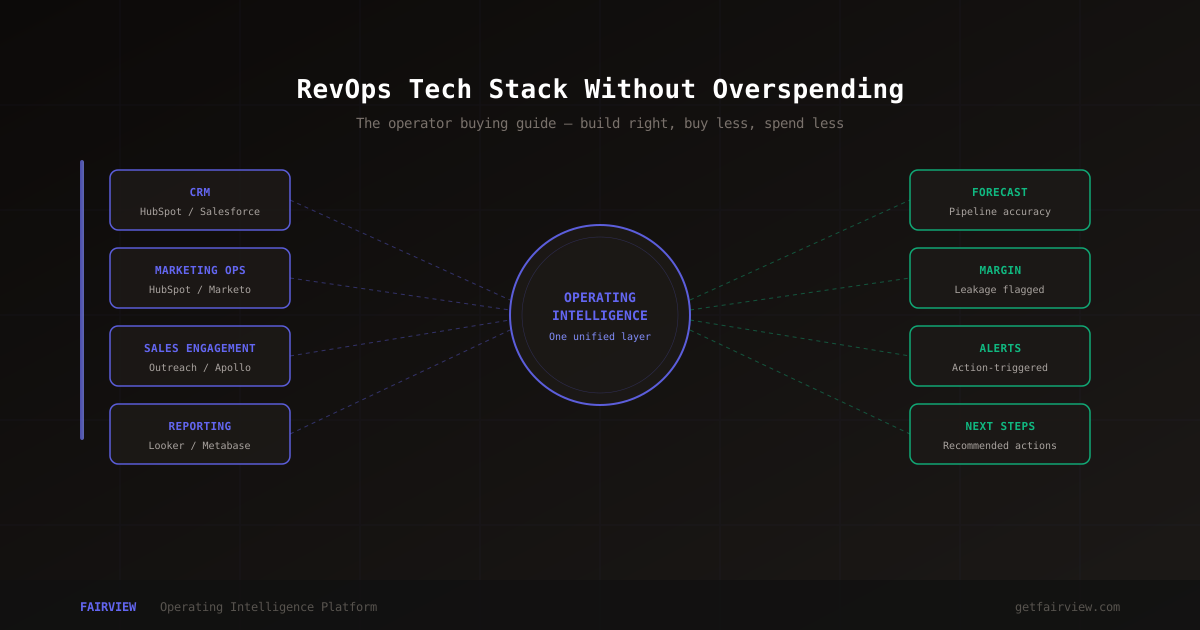
The B2B RevOps tech stack has five layers. One tool per layer. The most common mistake is buying multiple tools in the same layer and hoping they integrate. They rarely do. The second most common mistake is buying tools before the process is defined. The result is shelfware — expensive software that nobody uses because the workflow it supports does not exist yet.
Layer 1: CRM. The system of record for every customer interaction. HubSpot, Salesforce, and Pipedrive are the three standards. Choose based on complexity and team size: HubSpot for simplicity and fast setup, Salesforce for enterprise scale and customization, Pipedrive for sales-first teams that need a clean pipeline view. The CRM is non-negotiable. Every other tool connects to it or pulls from it.
Layer 2: Marketing automation. The platform that manages lead flow, scoring, and nurture. HubSpot Marketing Hub, Marketo, and Customer.io are the common choices. This layer owns the top-of-funnel data: where leads came from, how they scored, which campaigns drove them. The handoff to sales happens here, and the quality of that handoff determines sales efficiency.
Layer 3: Billing and finance. The systems that recognize revenue and track costs. Stripe for subscription billing, QuickBooks or Xero for accounting. This layer is where revenue gets validated against cash. Without it, the sales team reports bookings while finance reports something different, and nobody knows which number is real.
Layer 4: Analytics and forecasting. The layer that turns raw data into operating decisions. This is where Fairview sits: one connected view across CRM, billing, accounting, and ad platforms that computes the seven KPIs a CRO asks about every Monday. Alternatives include a data warehouse with BI tooling, though that route typically requires dedicated data engineering time.
Layer 5: Sales enablement. The tools that make reps more productive. Gong or Chorus for conversation intelligence, Outreach or Salesloft for sequence automation, LinkedIn Sales Navigator for prospecting. This layer does not directly feed the forecast, but it directly affects the inputs: call quality, follow-up speed, and pipeline generation.
Budget rule
The RevOps tech stack should cost 5–8% of ARR. Above 10% and the stack is eating the margin it is supposed to protect. Below 3% and critical layers are likely missing or under-invested.
For a deeper breakdown of each layer with specific vendor comparisons and red flags, see our guide on how to build a RevOps tech stack without overspending.
Metrics That Matter for B2B RevOps
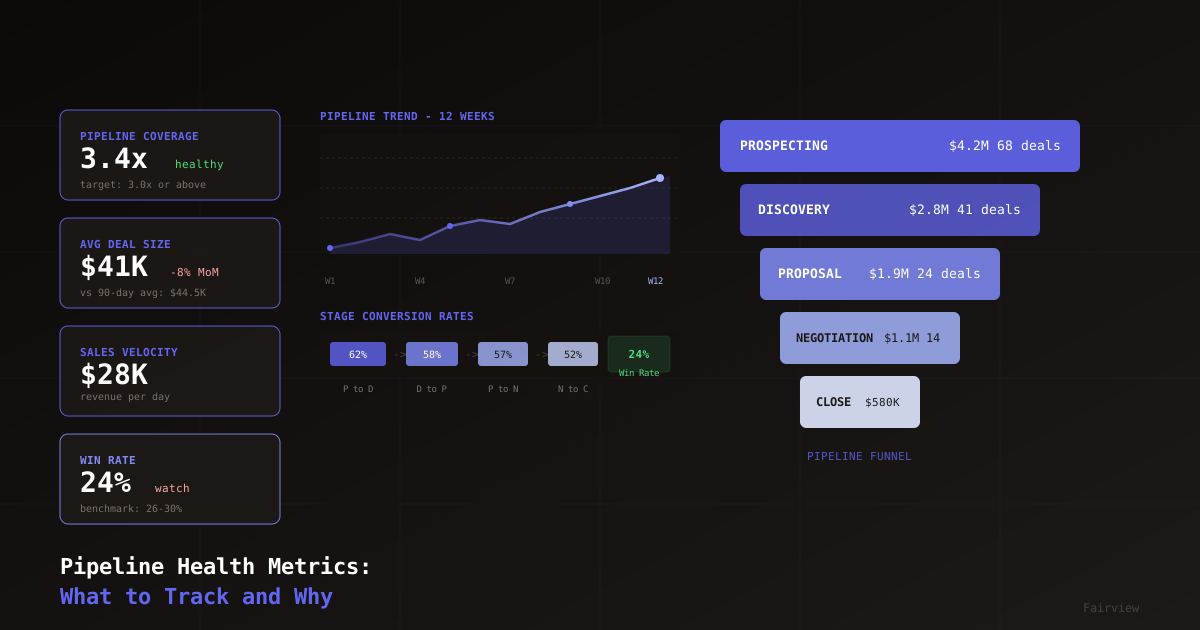
A working RevOps function is judged on a tight set of numbers. Not on dashboards built. Not on tools deployed. Not on processes documented. The seven KPIs every CRO and CFO returns to are these:
| KPI | Formula | Healthy range |
|---|---|---|
| Pipeline coverage | Open pipeline ÷ quota | 3–4× |
| Forecast accuracy | Commit vs. actual | ±5% at 2 weeks out |
| Win rate | Closed-won ÷ all closed | 22–35% SMB, 15–25% enterprise |
| Sales cycle length | Days from opp create to close | Tracked by segment |
| CAC payback | Months to recover CAC | Under 15 months (SaaS) |
| Net revenue retention | Expansion − churn | Above 110% top-quartile |
| Gross revenue retention | 1 − logo/dollar churn | Above 90% |
The Scale Venture Partners public SaaS benchmark tracks most of these across listed SaaS companies each quarter. For a deeper treatment of the definitions, formulas, and how to track them in a single weekly view, see our post on RevOps KPIs that matter.
A practical test: a working RevOps function reports all seven of these numbers in one place, on the same cadence, with the same definitions, every Monday. If you are rebuilding the dashboard each week or stitching reports across five tools, the function is not yet doing its job.
Common Mistakes B2B Companies Make
The mistakes below are not theoretical. We see them in engagements with B2B companies at every stage. Each one is preventable with the right sequencing.
1. Hiring RevOps before product-market fit. If your sales motion is still being figured out — different reps closing different ICPs at different price points — there is no system to systematize. Hiring a RevOps person to "get our processes in place" before the motion is repeatable is a way to lock in the wrong process. The fix: keep the founder or VP of Sales running the Monday review, with a single shared CRM and deal log. Formalize nothing else until the motion is repeatable.
2. Letting the VP of Sales own RevOps permanently. Early-stage companies often have RevOps reporting into the VP of Sales by default. This is reasonable temporarily. Past $3M ARR, it becomes a problem. If RevOps reports to the VP of Sales, it has the authority to set process inside sales but not to reset marketing's lead definitions or customer success's renewal handoff. That authority gap is exactly what makes RevOps necessary. The fix: move RevOps to a neutral senior leader — CFO, COO, or CEO — so it can arbitrate cross-team disagreements.
3. Buying tools before defining processes. The shiny-tool trap is real. A team buys a forecasting platform before agreeing on pipeline stages. They buy an attribution tool before agreeing on what counts as a qualified lead. The result is expensive software that produces numbers nobody trusts because the definitions underneath are still contested. The fix: write the process first, validate it for 30 days, then buy the tool that supports it.
4. Measuring activity instead of outcomes. Calls made, emails sent, meetings booked — these are activity metrics. They tell you the team is busy. They do not tell you the team is effective. RevOps should track outcomes: pipeline generated, deals closed, revenue retained, forecast accuracy. Activity metrics have a place in sales coaching. They have no place in the weekly revenue review. The fix: remove activity metrics from the CRO dashboard. Keep them in rep-facing coaching tools.
5. Skipping the data foundation. A team builds a beautiful dashboard on top of a CRM that has duplicate records, stale close dates, and deals in the wrong stage. The dashboard looks impressive in a demo. It is useless in practice. The fix: before building any dashboard, run a data audit. Deduplicate records. Standardize fields. Enforce stage-entry rules. The data foundation is not glamorous. It is everything.
How Fairview Supports B2B RevOps
Fairview is the operating intelligence layer underneath a working RevOps team. Once HubSpot or Salesforce, Stripe, QuickBooks or Xero, and your ad platforms are connected, Fairview computes the seven KPIs in one connected view — the same numbers a CRO or CFO asks about every Monday, without a RevOps analyst rebuilding the dashboard each week.
The Fairview operating dashboard aggregates data from connected sources into one screen: margin by channel, pipeline health, forecast confidence, and anomaly alerts. The Pipeline Health Monitor tracks deal progression and flags deals that are stalling or have slipped close dates. The Forecast Confidence Engine generates a weekly revenue forecast with a confidence score based on pipeline composition. The Margin Intelligence feature breaks revenue down into actual profitability by channel, campaign, and customer segment.
When a number drifts past the threshold a RevOps lead sets, Fairview's Next-Best Action Engine generates a specific, named recommendation — not a generic alert. Examples: "Margin on paid search dropped 18% this week. Review Google Ads spend by campaign." Or: "3 deals in stage 4 have no activity in 14+ days. Assign follow-up tasks." These actions appear in the dashboard and can be assigned to a team member. The same rhythm that keeps the forecast honest also surfaces margin and retention drift earlier than a stitched-together BI stack would catch.
Fairview also generates a structured weekly operating report — sent to the operator's inbox every Monday morning. It summarizes the prior week: revenue vs. forecast, margin vs. prior period, pipeline changes, and open action items. Operators arrive at their Monday review already briefed. For teams building or scaling RevOps, this replaces 4–6 hours of weekly manual reporting.
7
Core RevOps KPIs in one view
Weekly
Operating rhythm baked in
10 min
Setup to first dashboard
How is RevOps structured at different company sizes?
At 10 people, RevOps is informal — the founder or CEO owns the revenue number with a shared CRM. At 50 people, a dedicated RevOps lead reports to the CFO or COO and cleans the CRM, builds the forecast model, and writes the operating cadence. At 200 people, a VP of RevOps reports to the CRO and centralizes sales, marketing, and CS ops with a team of 3–5. At 500+ people, RevOps becomes a full department with specialist analysts for forecasting, deal desk, and GTM systems, reporting to a CRO who owns the number to the board.
What tech stack does a B2B RevOps team need?
A B2B RevOps tech stack has five layers: CRM (HubSpot, Salesforce, or Pipedrive) as the system of record; marketing automation (HubSpot Marketing Hub, Marketo, or Customer.io) for lead flow and attribution; billing and finance (Stripe, QuickBooks, or Xero) for revenue recognition; analytics and forecasting (Fairview, a data warehouse, or BI tool) for the operating view; and sales enablement (Gong, Outreach, or Salesloft) for rep productivity. One tool per layer. Budget ceiling: 5–8% of ARR.
What are the most important RevOps metrics for B2B?
The seven metrics every B2B RevOps function should report weekly in one place are: pipeline coverage (3–4x target), forecast accuracy (within ±5% at two weeks out), win rate (22–35% for SMB, 15–25% for enterprise), sales cycle length (tracked by segment), CAC payback (under 15 months for SaaS), net revenue retention (above 110% for top-quartile), and gross revenue retention (above 90%). A working RevOps function reports all seven from one source of truth every Monday.
What are the most common RevOps mistakes B2B companies make?
The five most common mistakes are: hiring RevOps before product-market fit and locking in the wrong process; letting the VP of Sales own RevOps permanently, which prevents cross-functional arbitration; buying tools before defining processes, resulting in shelfware; measuring activity instead of outcomes, which optimizes for busyness rather than revenue; and skipping the data foundation, which produces dashboards nobody trusts. Each mistake is preventable with the right sequencing: process first, then tools, then measurement.
When should a B2B company hire its first RevOps manager?
Most B2B companies hire their first dedicated RevOps manager between $2M and $5M ARR, once sales, marketing, and customer success are each staffed and the handoff gaps are visibly costing revenue. The better trigger is operational: hire when three or more readiness signals appear — conflicting revenue answers from different teams, forecast variance over 15%, marketing-sales blame on pipeline quality, 10+ disconnected tools, or missed renewals nobody saw coming. Below $1M ARR with under 10 people, a fractional RevOps consultant for two days a month is usually the right structure.
How does Fairview support a B2B RevOps team?
Fairview is the operating intelligence layer underneath a RevOps team. Once HubSpot or Salesforce, Stripe, QuickBooks or Xero, and ad platforms are connected, Fairview computes pipeline coverage, forecast confidence, NRR, CAC payback, and margin by channel in one connected view. When a metric drifts past threshold, Fairview generates a named next-best action with estimated dollar impact in the weekly operating report. The same rhythm that keeps the forecast honest also surfaces margin and retention drift earlier than a stitched-together BI stack would catch.
Key Takeaways
- Revenue operations aligns sales, marketing, and customer success on one data layer, one forecast, and one accountable owner. It is broader than sales ops and reports higher.
- Org design shifts by size: founder-led at 10 people, dedicated RevOps lead at 50, VP RevOps under a CRO at 200, and a full department at 500+.
- The B2B RevOps tech stack has five layers — CRM, marketing automation, billing/finance, analytics/forecasting, and sales enablement — with a 5–8% of ARR budget ceiling.
- Seven metrics prove RevOps is working: pipeline coverage, forecast accuracy, win rate, cycle length, CAC payback, NRR, and GRR. All seven should come from one source of truth every Monday.
- The five most common mistakes — premature hiring, sales-owned RevOps, tools-before-process, activity metrics, and weak data foundations — are all preventable with the right sequencing.
- Fairview computes the seven KPIs in one connected view and generates named next-best actions when metrics drift. The weekly operating report replaces 4–6 hours of manual reporting.