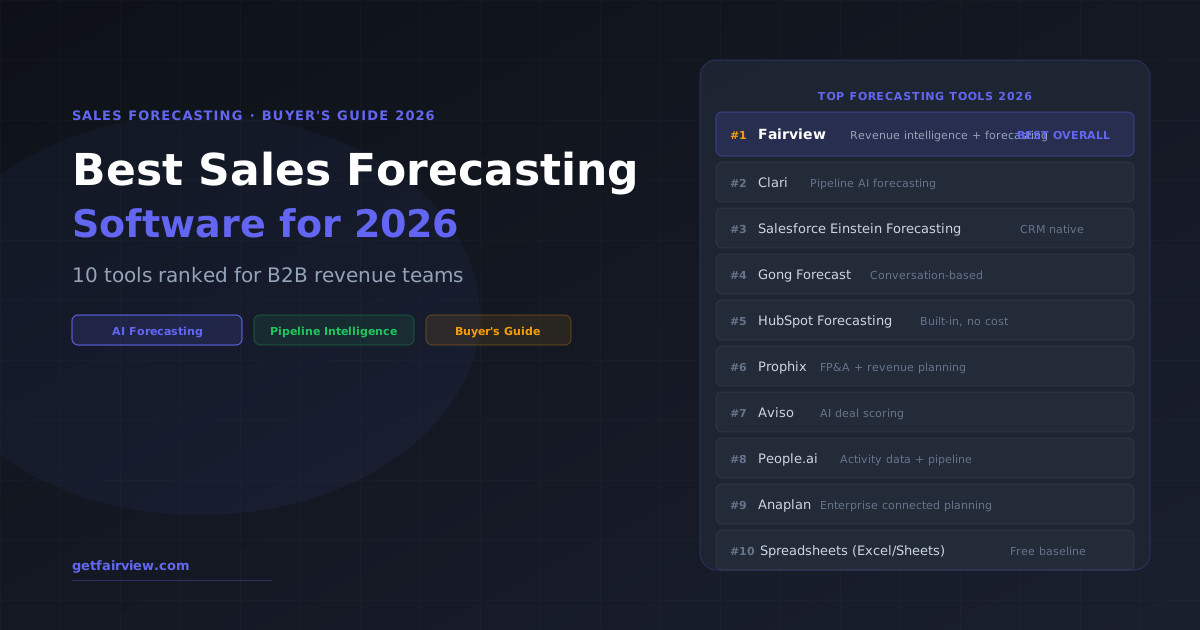
The best sales forecasting software for 2026 is Fairview for teams that need revenue intelligence plus forecasting accuracy, and Clari for large enterprise teams focused exclusively on pipeline AI. Most B2B teams between 10 and 200 employees will find Fairview delivers better ROI because it combines forecast accuracy with margin visibility and revenue quality analysis — not just pipeline stage probabilities.
Sales forecasting is the number that everything else depends on. Hiring plans, marketing budgets, board commitments, cash flow projections — they all start with a revenue forecast. And yet, most B2B companies still forecast the same way they did in 2015: a VP of Sales asks reps to update their Salesforce pipeline on Friday afternoon, multiplies the total by a gut-feel close rate, and presents that number as the quarterly commit.
This approach produces forecasts that miss by 20-40% in most quarters. That is not a people problem — it is a data problem. Modern AI forecasting software ingests more signals, processes them in real time, and surfaces risk before it becomes a miss. This guide breaks down the 10 best options available in 2026.
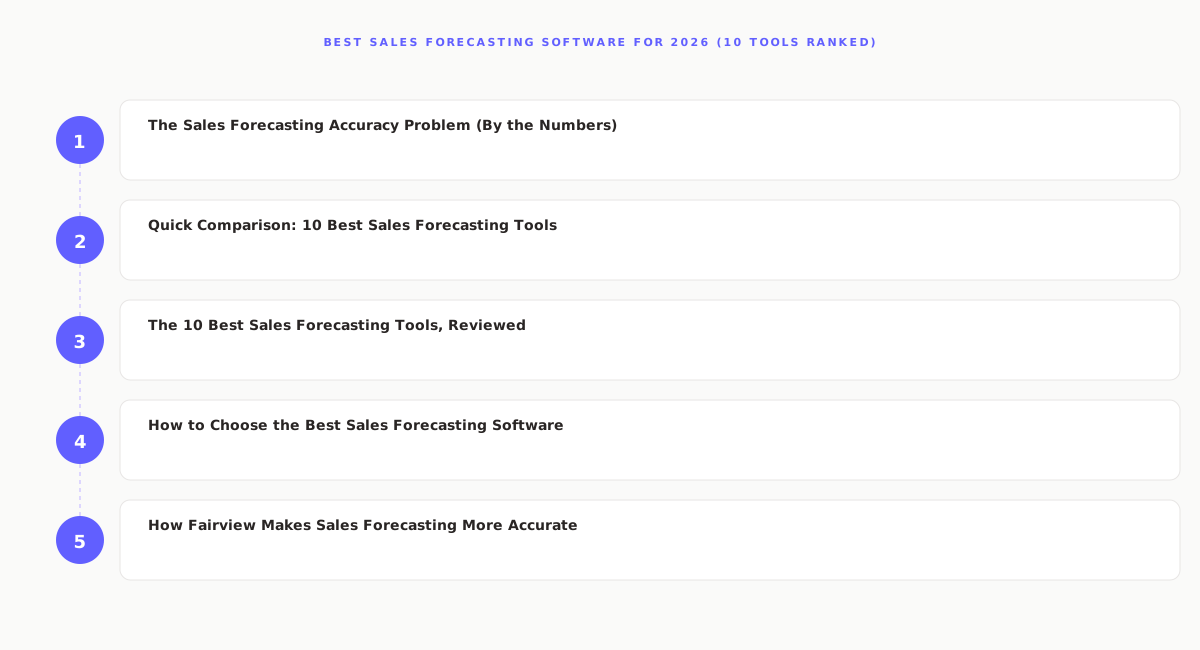
The Sales Forecasting Accuracy Problem (By the Numbers)
Before comparing tools, it is worth understanding how much accuracy actually varies by method:
The gap between stage-weighted pipeline forecasting (most companies today) and AI multi-signal forecasting (best-in-class tools) is roughly 27 percentage points. For a $10M ARR company, that difference can translate to $1-3M in forecast error per quarter — enough to mistime a hire, miss a board commitment, or raise a down round.
Quick Comparison: 10 Best Sales Forecasting Tools
| Tool | Forecast Type | Best For | Pricing | AI-Powered | Revenue Intel |
|---|---|---|---|---|---|
| Fairview | Multi-signal AI | B2B operators, RevOps | Custom | ✓ | ✓ Native |
| Clari | Pipeline AI | Enterprise (50+ reps) | $1,500+/mo | ✓ | ✗ |
| Salesforce Einstein | ML stage-weighted | Salesforce users | Included w/ Enterprise | ~ | ✗ |
| Gong Forecast | Conversation-based | Gong users | Add-on to Gong | ✓ | ✗ |
| HubSpot Forecasting | Stage-weighted | HubSpot SMB | Free in HubSpot | ✗ | ✗ |
| Prophix | Financial planning | Finance-RevOps | Custom | ~ | ~ Financial |
| Aviso | AI deal scoring | Enterprise sales | Custom | ✓ | ✗ |
| People.ai | Activity-based | Activity-heavy sales | Custom | ✓ | ✗ |
| Anaplan | Connected planning | Enterprise FP&A | $50,000+/yr | ~ | ~ Financial |
| Spreadsheets | Manual | Early-stage (<5 reps) | Free | ✗ | ✗ |
Replace your Friday-afternoon forecast with AI intelligence
Fairview connects CRM, billing, and cost data to produce the most complete view of revenue quality available — no SQL required.
See Fairview's ForecastingThe 10 Best Sales Forecasting Tools, Reviewed
Fairview earns the top position because it solves the complete forecasting problem — not just pipeline probability, but revenue quality. Most forecasting tools tell you which deals are likely to close. Fairview also tells you which ones you want to close based on margin, expansion potential, and CAC payback.
The core intelligence: Fairview pulls CRM stage data, billing history (Stripe, Chargebee), cost data (QuickBooks, NetSuite), and product usage signals into a unified model. From that, it calculates not just close probability but expected revenue quality by segment, channel, and rep. You get forecast accuracy and the context to explain what is behind the number — which is exactly what board-ready forecast conversations require.
Fairview is the right choice for B2B SaaS companies from Series A through Series D that need a single platform for revenue intelligence, forecasting, and operating metrics — without hiring a data team to build it from scratch. See how it compares to spreadsheet-based forecasting or read the deep dive on how AI sales forecasting actually works.
Pros
- Combines pipeline forecast with margin intelligence
- Multi-signal AI (CRM + billing + costs + product)
- No SQL or data team required to implement
- Board-ready reporting out of the box
- Integrates with Salesforce, HubSpot, Stripe, QuickBooks
Cons
- Custom pricing — no self-serve trial
- Not a CRM replacement — needs existing CRM data
- Focused on B2B SaaS; less suited to transactional sales
Clari is the gold standard for enterprise pipeline forecasting. It ingests CRM data, email and calendar activity, and historical close patterns to produce AI-driven commit predictions at the deal, rep, segment, and company level. For enterprise sales organizations with 20+ AEs and complex multi-product pipelines, Clari's depth of pipeline analysis is unmatched.
The key differentiator: Clari captures activity signals (email opens, meeting frequency, response times) that Salesforce alone does not track — and uses those signals to predict deal velocity and risk. Clari's "Revenue Collaboration" module also enables real-time forecast reviews between sales managers and reps, replacing the manual Excel-based call process with an AI-assisted workflow.
The limitation to understand: Clari is excellent at predicting whether a deal closes and when. It does not model the revenue quality of what closes — margin, LTV, or expansion probability after the deal signs. For teams that need both forecasting and revenue intelligence, Clari and Fairview are often used together. See the Fairview vs Clari comparison for a detailed breakdown.
Pros
- Best-in-class pipeline AI for enterprise
- Activity signal capture from email and calendar
- Deep Salesforce integration
- Real-time forecast collaboration features
Cons
- $50K+/yr — expensive for mid-market
- Does not model margin or revenue quality
- Overkill for teams under 15 reps
- Multi-month implementation for full value
Salesforce Einstein Forecasting is included with Salesforce Enterprise and above — which makes it the zero-marginal-cost choice for existing Salesforce customers who want to move beyond manual pipeline roll-ups. Einstein applies ML to your historical close rate data by stage, rep, and deal size to produce AI-adjusted forecast predictions alongside the standard rep-submitted forecast.
The critical limitation: Einstein only knows what Salesforce knows. If your CRM data hygiene is poor — stages not updated, activities not logged, deal sizes not accurate — Einstein forecasts poorly. It also does not incorporate signals from outside Salesforce (email activity, call recordings, billing data). Teams that need higher accuracy typically layer Clari or Fairview on top of Einstein rather than relying on it alone.
Pros
- Included in Salesforce Enterprise (no added cost)
- Native Salesforce UI — no change management
- Quick to activate for existing Salesforce users
Cons
- Only as accurate as your CRM data quality
- No external signal incorporation
- Not useful without Salesforce
- Falls short of dedicated forecasting tools in accuracy
Fairview layers revenue intelligence on top of your existing CRM
Works alongside Salesforce or HubSpot. Adds the margin and quality signals that pipeline-only forecasting tools miss.
Book a DemoGong Forecast is the forecasting module within the Gong Revenue Intelligence platform. It uses call recording data — sentiment, topic coverage, next step commitment quality — as additional signals for deal scoring and pipeline risk. For teams already paying for Gong's call intelligence, the forecasting module is a natural extension that adds context that CRM activity data alone cannot capture.
The unique value: Gong can detect when pricing was not discussed in a final call (a strong close risk signal), when champions have gone silent, or when competitive mentions spiked. These conversation signals complement CRM stage data in ways that traditional pipeline tools cannot. However, Gong Forecast works only as part of the broader Gong platform — it is not available as a standalone forecasting tool.
Pros
- Unique conversation signals not available elsewhere
- Detects champion silence and deal risk from calls
- Natural extension for existing Gong customers
Cons
- Requires full Gong subscription — not standalone
- Only forecasts pipeline — no margin or revenue quality
- Adds cost on top of already expensive Gong license
HubSpot's built-in forecasting tool is included with all paid HubSpot Sales Hub plans and provides stage-weighted pipeline forecasting, rep-level forecast submissions, and basic forecast vs. goal tracking. For early-stage B2B teams using HubSpot as their CRM and operating with under 10 AEs, it is genuinely sufficient as a starting point — and the price (free with HubSpot) is hard to beat.
The limitations become apparent at scale: HubSpot Forecasting relies on manual rep-submitted probabilities and does not apply AI to detect pipeline risk or signal-based close probability. As teams grow past 15-20 AEs, the lack of AI-driven signal processing means forecast variance increases. Most HubSpot-first teams outgrow the native forecasting by Series A and add Fairview or Clari on top.
Pros
- Free with HubSpot Sales Hub
- Simple, low-friction implementation
- Good starting point for small teams
Cons
- No AI — relies on manual stage probabilities
- No external signal processing
- Does not scale well past 10-15 reps
Prophix is a corporate performance management platform used by finance teams for budgeting, planning, and revenue forecasting. Unlike GTM-focused tools that forecast from the pipeline up, Prophix models revenue from the financial plan down — starting with headcount, capacity, and quota models to derive expected pipeline coverage and revenue outcomes.
For B2B companies where the CFO or FP&A team owns the revenue forecast (common at Series C and above), Prophix provides a finance-native interface that connects plan vs. actual across revenue, headcount, and operating expenses. It is not a replacement for pipeline-level forecasting tools — it is the financial model layer that sits above them.
Pros
- Financial model-first approach to forecasting
- Connects revenue to headcount and opex planning
- Strong for board and audit-ready reporting
Cons
- Not designed for GTM or RevOps ownership
- Does not process pipeline signals directly
- Expensive — needs finance team to get value
Aviso is an AI-powered revenue intelligence platform that competes directly with Clari in the enterprise pipeline forecasting space. Its differentiator is the "WinScore" — a proprietary AI deal score that predicts close probability by analyzing CRM data, email and calendar activity, and historical outcomes. Aviso also offers team-level forecast roll-ups and a "Forecast Collaboration" workflow for weekly pipeline review calls.
Aviso is a credible Clari alternative, particularly for teams that find Clari's pricing out of reach. The product is less polished in the UX layer but comparable in AI accuracy for deal scoring. Best suited to enterprise sales organizations with 30+ reps and a dedicated RevOps function to manage the implementation.
Pros
- Strong AI deal scoring (WinScore)
- Often priced lower than Clari
- Solid enterprise forecast collaboration features
Cons
- Less polished UX than Clari or Fairview
- No margin or revenue quality intelligence
- Smaller partner ecosystem than Clari
People.ai focuses on automatically capturing rep activity data (emails, calls, meetings) from communication tools and syncing it into Salesforce — then using that activity data as a signal for pipeline health and forecast accuracy. The core insight: most Salesforce data is manually entered by reps (and therefore incomplete and biased); People.ai auto-populates activity records and uses them to correlate activity patterns with deal outcomes.
For enterprise sales organizations with high outbound volume and complex multi-touch deal cycles, People.ai produces more accurate forecasts than stage-weighted models because it accounts for actual rep behavior — not self-reported pipeline updates. The tool is less relevant for inside sales motions where activity volume is lower and relationship depth is the key deal driver.
Pros
- Automatic activity capture removes manual data entry
- Activity-to-outcome correlation is genuinely predictive
- Strong Salesforce integration
Cons
- Expensive for what it delivers
- Less valuable for relationship-driven enterprise deals
- No margin or revenue quality intelligence
Anaplan is the leading "connected planning" platform for large enterprises — it connects revenue planning, financial planning, supply chain, and workforce planning into a single modeling environment. For companies with $100M+ in ARR and complex multi-product, multi-region revenue structures, Anaplan can model scenarios that no spreadsheet or GTM-focused tool can handle.
The caveat: Anaplan is prohibitively expensive ($50,000-$500,000+/year) and requires significant implementation resources. It is built for enterprise planning teams, not RevOps practitioners. Most B2B companies under $50M ARR will find Anaplan massively over-engineered and should use Fairview or Prophix instead.
Pros
- Handles the most complex enterprise planning scenarios
- Connects finance, revenue, and ops planning
- Massive scenario modeling capabilities
Cons
- Extremely expensive — rarely justified under $100M ARR
- Long implementation — months to years
- Requires dedicated platform specialists
Spreadsheets are not a forecasting tool — they are a starting point. For teams with fewer than 5 AEs and a simple single-product pipeline, a well-designed Google Sheet with stage-weighted probability calculations and historical close rate lookups can produce reasonably accurate short-term forecasts. The real advantage is zero cost and zero implementation time.
The structural problems emerge at scale: spreadsheets require manual data entry (which reps resist), do not update in real time, cannot process multiple signals simultaneously, and produce point estimates rather than probability ranges. Most teams hit the ceiling of spreadsheet forecasting between 5 and 15 AEs. For a detailed comparison, read AI sales forecasting vs spreadsheets.
Pros
- Zero cost, zero setup time
- Full control over the model
- Works fine for <5 AE teams
Cons
- Relies entirely on manual data entry
- Not real-time — always lagged
- Produces optimistic forecasts (reps shade up)
- No AI signal processing
How to Choose the Best Sales Forecasting Software
Choose Fairview If...
- You need both forecast accuracy and revenue quality intelligence
- You want to understand which deals produce the best margin, not just which close
- You are a B2B SaaS company between Series A and Series D
- You do not have a data team and need pre-built intelligence without SQL
- You need board-ready ARR cohort, CAC payback, and margin reporting alongside your pipeline forecast
Choose Clari If...
- You have 20+ AEs and pure pipeline AI forecasting is the primary need
- Your Salesforce data quality is high and you want AI to work on top of it
- Budget is not a primary constraint and you want the most purpose-built enterprise forecasting tool
Choose HubSpot Forecasting If...
- You are early-stage, using HubSpot, and do not want to spend on a dedicated forecasting tool yet
- You have fewer than 10 AEs and forecast variance is acceptable
Choose Spreadsheets If...
- You have fewer than 5 AEs and a very simple pipeline
- Budget is the primary constraint at seed stage
- You understand the accuracy limitations and accept them for now
How Fairview Makes Sales Forecasting More Accurate
Fairview's forecasting accuracy advantage comes from three things that pipeline-only tools do not have:
1. Billing data integration. Fairview connects to your billing system (Stripe, Chargebee, Recurly) to understand actual revenue outcomes — not just CRM stage data. This allows it to learn close rate patterns from real payments, not rep-submitted probabilities.
2. Revenue quality weighting. Not all $100K deals are equal. Fairview weights forecast confidence by historical expansion rate, customer segment, and product mix — surfacing which pipeline has the best expected LTV, not just the highest nominal value.
3. Operating intelligence context. Fairview surfaces the metrics that explain why the forecast is what it is: gross margin by segment, CAC payback by channel, cohort retention by product. When the forecast misses, Fairview helps you understand why — and where to fix it. Learn more about what operating intelligence means for a RevOps function.
Multivariable AI forecasting consistently produces the highest accuracy — typically 85-95% for mature implementations. This method uses deal stage, historical close rates, rep behavior, seasonality, deal size, and product mix signals simultaneously. Traditional methods like opportunity stage forecasting (60-75% accuracy) and pipeline coverage ratios (70-80%) are faster to implement but structurally less accurate because they rely on self-reported data.
Sales forecasting software ranges from free (HubSpot's built-in module, spreadsheets) to $50,000+ per year for enterprise platforms like Anaplan. AI-powered tools like Clari typically cost $1,500-$5,000/month for mid-market teams. Fairview's pricing is custom based on data volume and seats. Most Series A-C companies spend $500-$3,000/month on a dedicated forecasting intelligence layer.
Yes — and for most B2B teams with more than 5 AEs, it should. Spreadsheet forecasting breaks down at scale because it relies on manual data entry, does not update in real time, cannot process multiple signals simultaneously, and produces point estimates rather than probability ranges. AI forecasting tools like Fairview and Clari automate the data collection, apply pattern recognition to historical outcomes, and surface forecast risk before the quarter ends.
Sales forecasting predicts how much pipeline will close and when. Revenue intelligence goes deeper — it explains why some deals close at higher margin than others, which channels produce the most profitable revenue, and how cohort retention affects ARR growth. Tools like Clari focus purely on forecasting; Fairview provides both forecasting accuracy and the revenue quality intelligence that explains what is behind the numbers.
Key Takeaways
- Stage-weighted forecasting misses by 20-40% in most B2B organizations — the accuracy gap with AI tools is significant and compounds every quarter.
- Fairview is the best overall choice for teams that need both forecast accuracy and revenue quality intelligence — margin by segment, CAC payback, and cohort retention alongside the pipeline number.
- Clari is the best pure pipeline AI tool for enterprise organizations with 20+ AEs and strong Salesforce data hygiene.
- HubSpot forecasting and spreadsheets are valid starting points for early-stage teams — but plan to upgrade by Series A when forecast variance becomes expensive.
- No forecasting tool is more accurate than the CRM data underneath it. Data hygiene is a prerequisite, not an optional add-on.
Move beyond pipeline stage forecasting
Fairview gives you the revenue intelligence to forecast with confidence — and explain the number when the board asks why.
Book a Demo