TL;DR
- Spreadsheets stay cheap, fast to start, and auditable — but degrade quickly past ~50 active deals.
- AI forecasting wins on accuracy, weekly cost, confidence signals, and scenario modeling once you have four quarters of data.
- Switch triggers: 3+ hours of weekly updates, 50+ active deals, or forecast error above 15% for two quarters.
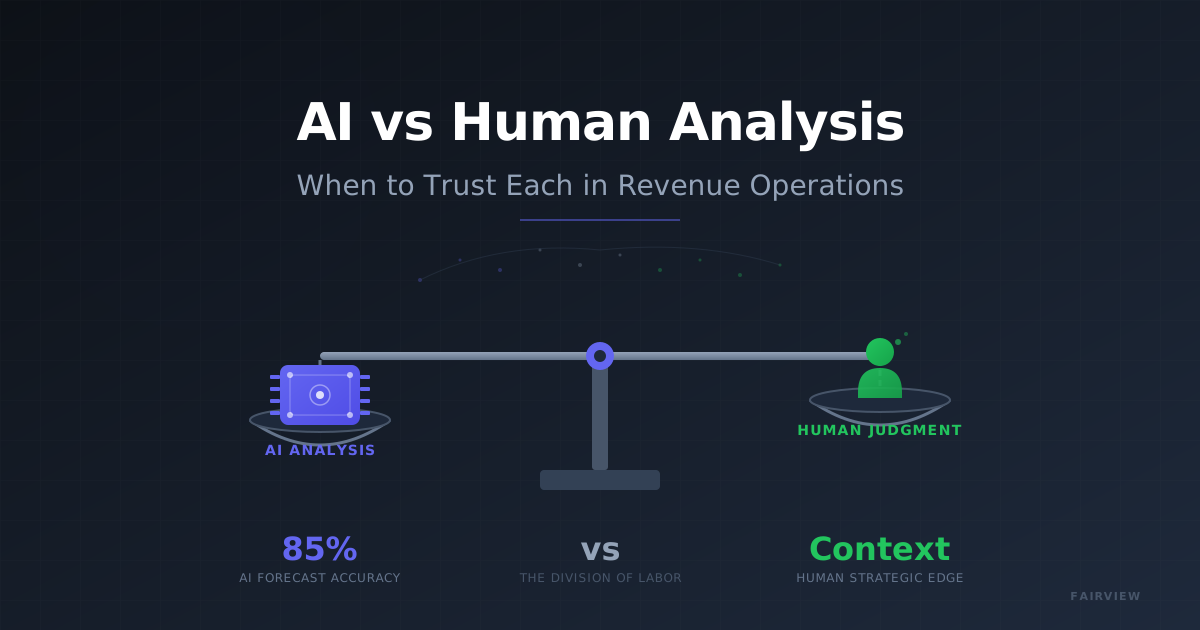
- AI doesn't replace sales-manager judgment. It replaces the baseline calculation so managers can focus on overrides.
- Fairview's forecast confidence engine delivers a range, a confidence grade, and auto-updating projections from your existing CRM + Stripe data.
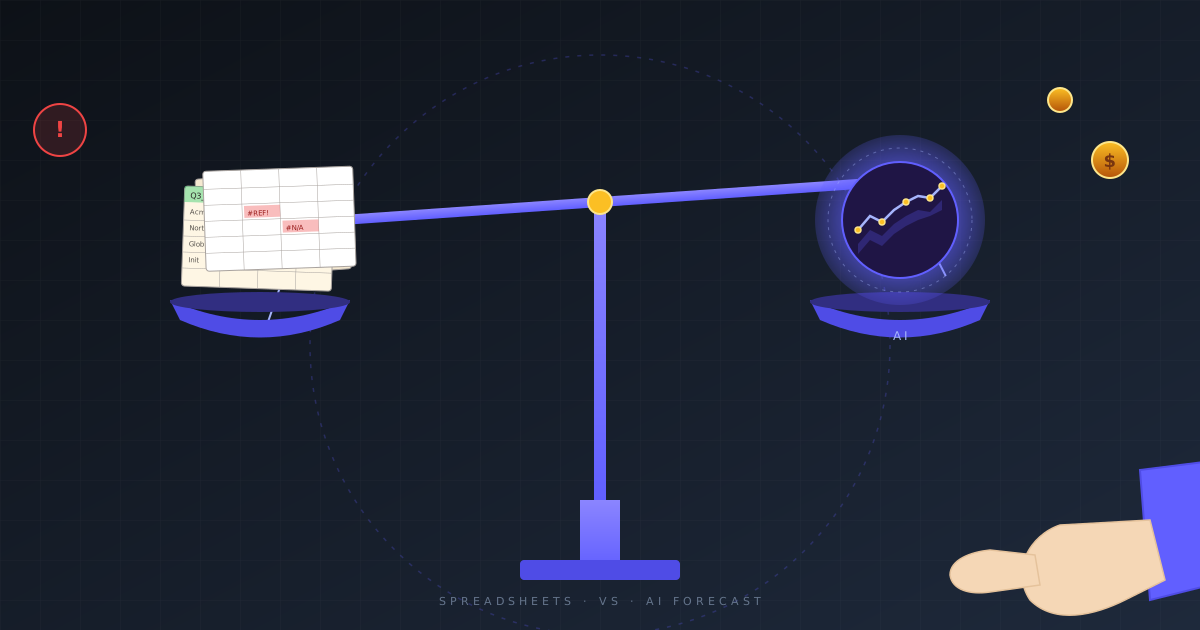
AI forecasting vs spreadsheets is not a religious debate. It is a capacity decision. At ten deals, a clean Google Sheet beats any AI model. At two hundred deals across five stages and three segments, the spreadsheet is a liability held together by macros the last RevOps lead wrote before they quit.
Most teams know this in their gut. They keep the spreadsheet anyway because it is familiar, because the last AI-forecasting pitch felt like a magic-8-ball demo, and because no one wants to explain to the CFO why last quarter's forecast was off by 22 percent right after paying for a new tool.
This post compares AI sales forecasting vs spreadsheets across seven dimensions that actually matter in a weekly forecast call: setup, accuracy, cost, confidence signals, scenario modeling, auditability, and manager override. It pairs with RevOps KPIs, the sales QBR guide, and CRM hygiene.
What "AI sales forecasting" actually means
Definition
AI sales forecasting: forecasting revenue using models that learn from historical deal data — stage transitions, close-date slippage, deal velocity, buyer signals — rather than fixed weighted-pipeline formulas. The output is a confidence-weighted range, not a single committed number.
Most tools labeled "AI forecasting" use some combination of three techniques: supervised learning on historical win/loss outcomes, time-series models on pipeline progression, and anomaly detection on deal activity. The math is standard statistics plus a calibration layer. The "AI" label is marketing; the capability is real.
For comparison, spreadsheet forecasting typically means weighted pipeline: stage probability × deal amount, summed. A reasonable starting point that ignores velocity, cohort drift, rep variance, and seasonality.
The seven-dimension comparison
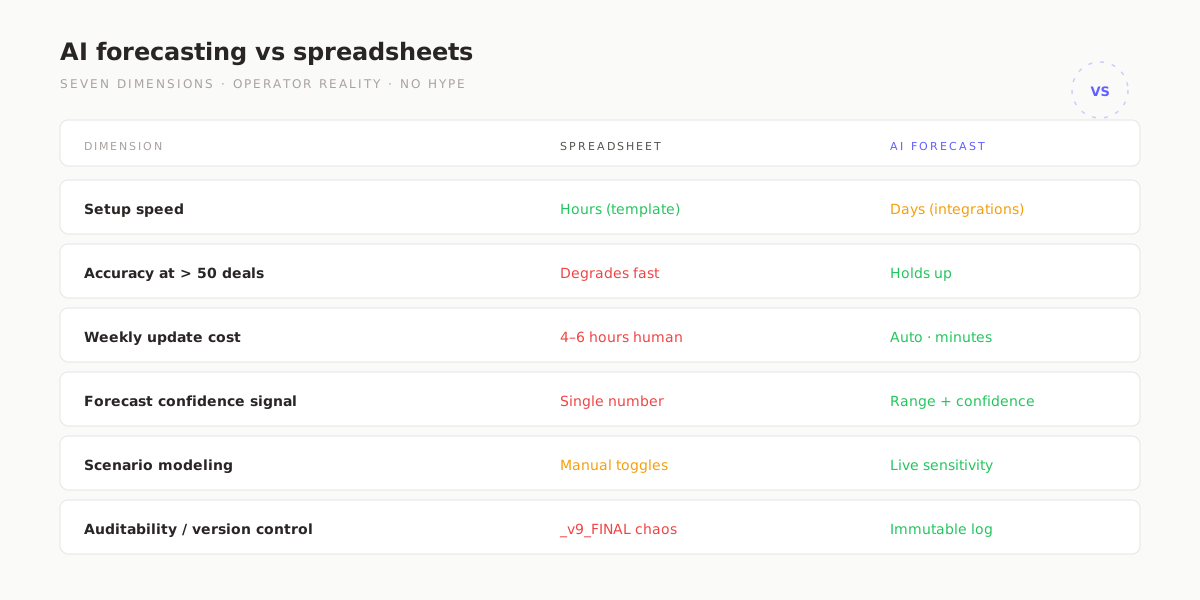
- Setup speed. Spreadsheet wins. A pipeline template + stage probabilities = forecasting in an afternoon. AI requires integration plumbing (CRM, billing, ad platforms) and a learning window of 2–3 quarters before the output stabilizes.
- Accuracy at scale. AI wins past ~50 active deals. Spreadsheets rely on blanket stage probabilities that mask rep variance and cohort drift; AI models these differences explicitly.
- Weekly update cost. AI wins. A RevOps lead spends 4–6 hours per week pulling CRM exports, reconciling with billing, and rebuilding the spreadsheet. AI refreshes from connected sources in minutes.
- Confidence signal. AI wins. A spreadsheet produces one number. AI produces a range (P10–P90) and a high/medium/low confidence grade tied to pipeline composition, which is the signal the CFO actually wants.
- Scenario modeling. AI wins. "What if we lose Globex?" requires manual toggles in a spreadsheet. AI tools recompute ranges instantly when a deal moves.
- Auditability and version control. AI wins in theory (immutable log of every projection and the inputs behind it). Spreadsheets drift into
Q3_Forecast_v9_FINAL_v2.xlsxchaos within three quarters. - Manager override. Tie. Good AI tools expose overrides as first-class actions; bad ones hide them. Spreadsheets are trivially overridable and trivially wrong when that happens. Governance, not technology, decides this one.
Key insight
Spreadsheets optimize for the setup moment. AI optimizes for every Monday after. If you update your forecast more than once a quarter, the math has already tilted.
Accuracy: what the data actually shows
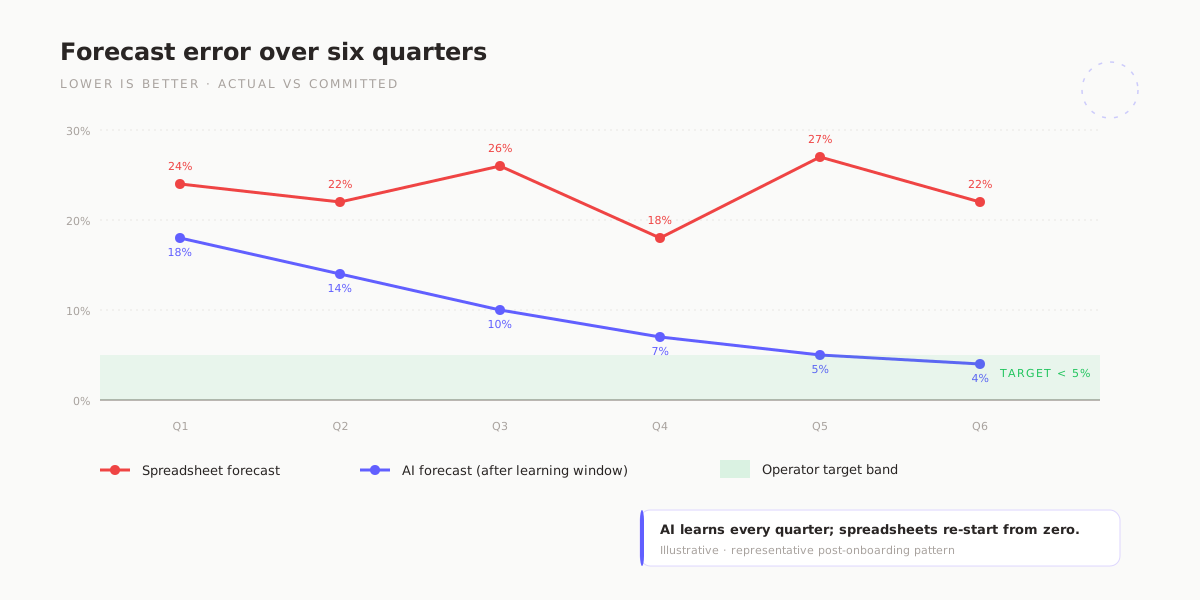
Accuracy claims in this space come with a lot of sales-engineer asterisks. Two honest reference points help:
- Gartner's CSO survey reports that the median sales team forecasts within 25 percent accuracy on a quarterly basis — about a quarter of revenue commits miss by more than that (Gartner, 2023).
- Harvard Business Review's summary of sales forecasting research found traditional pipeline-weighted methods rarely beat 20 percent error without continuous calibration (HBR, 2020).
- Well-implemented AI forecasting tools report 5–10 percent mean absolute error in their case studies. Real-world performance depends entirely on CRM data quality — garbage in, garbage out applies.
The pattern in the chart above is representative: spreadsheets plateau because they do not learn from the gap between last quarter's commit and last quarter's actual. AI systems feed that gap back into the model every cycle.
When spreadsheets are still the right call
A good AI tool on bad data is worse than a good spreadsheet on clean data. Stay on a spreadsheet if any of these apply:
- Under 30 active deals. Sample size defeats any model. A committed sales leader with a clean spreadsheet will beat AI at this volume.
- Short sales cycles (< 14 days). Transactional SaaS or SMB sales. The signal is volume, not deal-level patterns.
- Less than two quarters of CRM history. AI models need data to learn from. Before that, you are training the model on noise.
- Dirty CRM. If stage fields are empty, close dates are routinely wrong, or duplicate accounts are common, fix CRM hygiene before adding AI on top. Adding automation to dirty data amplifies the mess.
- A single-product, single-segment business. Complexity is where AI earns its keep. Simple businesses should not pay for it.
Three triggers to switch
Forget the marketing copy. The honest triggers for switching from spreadsheet to AI forecasting are concrete and measurable:
| Trigger | Threshold | Why it matters |
|---|---|---|
| Weekly update time | > 3 hours | RevOps time is the real cost. Above 3 hours, you are paying AI prices in salary anyway. |
| Active deal volume | > 50 | Past this point, blanket stage probabilities stop reflecting reality. |
| Forecast error (2 consecutive quarters) | > 15% | The spreadsheet has stopped being directionally useful. |
| Board-reported forecast | Required | Boards ask for ranges and confidence, not single numbers. AI tools make that native. |
Quote-ready
The right question is not "is AI better than a spreadsheet?" but "is my team spending more on the spreadsheet than the AI tool would cost?" For most $5M+ ARR B2B teams, the answer is yes — and they just have not priced it.
AI does not replace the sales manager
The worst deployments are the ones that treat AI forecasts as commandments. The best ones treat them as a well-calibrated baseline a sales manager can override with evidence.
Reasons managers override AI forecasts legitimately:
- A specific executive sponsor has committed verbally on a deal the model doesn't know about.
- A competitor just announced pricing changes that will affect close rates this quarter.
- A major customer is going through acquisition noise the CRM cannot see.
- Board-level strategic commitments that adjust the number for reasons other than deal probability.
Every override should be logged with a reason. That log is what separates a healthy forecast culture from wishful thinking.
How Fairview handles forecasting
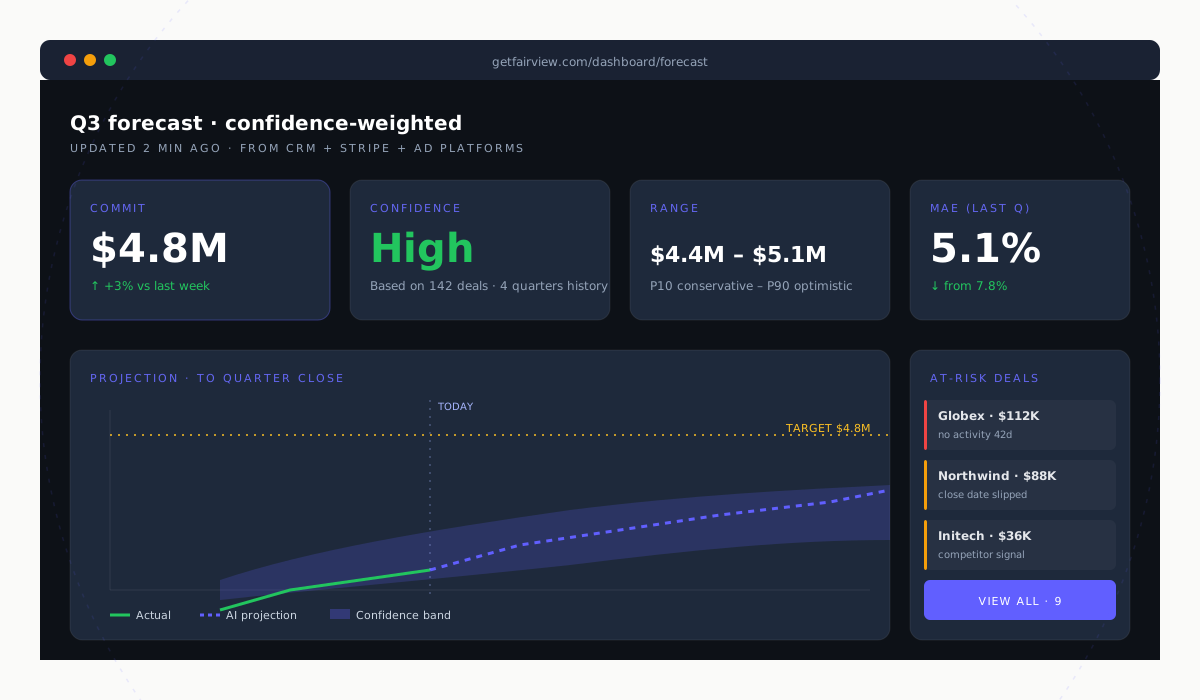
Fairview's Forecast Confidence Engine generates a weekly revenue projection from connected CRM (HubSpot, Salesforce, Pipedrive), billing (Stripe), and ad-platform data. The output is a range, a confidence grade (high / medium / low), and a tracked mean-absolute-error against prior commits so you can see the model's own accuracy over time.
When the forecast confidence drops, Fairview writes a named next-best action: "Confidence downgraded from High to Medium. Three large deals in Stage 4 have slipped close dates; weighted commit dropped from $4.8M to $4.3M. Review Globex, Northwind, Initech." The weekly forecast call opens on that screen, not on a rebuilt spreadsheet.
See pricing and tiers for the plan that fits your stack.
Range
P10 conservative to P90 optimistic
Weekly
Tracked MAE vs prior commits
Native
Manager-override workflow
Key takeaways
- Under 30 deals, spreadsheets are fine. Above 50, they are a liability.
- Accuracy gap widens after the AI learning window (2–3 quarters).
- Switch triggers: 3+ hours of weekly updates, 50+ active deals, or 15%+ error for two quarters.
- Clean CRM data is the precondition for every AI forecasting claim.
- AI supplies the baseline; managers supply the override — both get logged.
How accurate is AI sales forecasting?
Well-implemented AI forecasts typically converge to under 10 percent mean absolute error after a two-to-three-quarter learning window, often to 5 percent or less. Traditional spreadsheet methods tend to sit at 20–30 percent error because they do not feed back the gap between prior commits and actuals into the next cycle.
When should I switch from spreadsheets to AI forecasting?
Switch when weekly forecast updates take more than three hours of RevOps time, when the CRM holds over 50 active deals, or when forecast error has exceeded 15 percent for two consecutive quarters. Any one of these triggers means the spreadsheet is already more expensive than the AI tool — the cost is just showing up as salary instead of software.
What data does an AI sales forecast need?
CRM stage history, deal amounts, close-date change logs, last-activity timestamps, and closed-won revenue from Stripe or the billing system. Four quarters of history is the minimum before the confidence signal becomes useful. Clean CRM data matters more than the specific model — garbage in, garbage out still applies.
Can AI replace a sales manager's judgment?
No. AI produces a confidence-weighted baseline from observable pipeline data. Sales managers override for context the model cannot see: an executive sponsor's verbal commit, a budget freeze at a key account, a competitor announcement mid-quarter. Log every override with a reason so the model learns from them over time.
Are spreadsheet forecasts ever the right choice?
Yes. For teams with under 30 active deals, short sales cycles under two weeks, or a single-product single-segment business, a maintained weighted-pipeline spreadsheet is simpler, cheaper, and accurate enough. The problem starts when the team grows past that threshold and keeps the spreadsheet out of inertia rather than choice.