Data Integration: Three Flows You Need to Manage
Modern data stacks have three distinct data flows, each requiring different tooling:
ELT
Source → Warehouse
Extract from APIs, databases, SaaS tools. Load raw data into Snowflake, BigQuery, or Redshift. Transform in SQL.
Transformation
Raw → Modeled
SQL-based data modeling inside the warehouse. dbt converts raw tables into clean, analytics-ready datasets.
Reverse ETL
Warehouse → Operational
Sync warehouse data back to CRM, marketing, support, and advertising tools. Closes the data loop.
1. Fivetran — Best Managed ELT
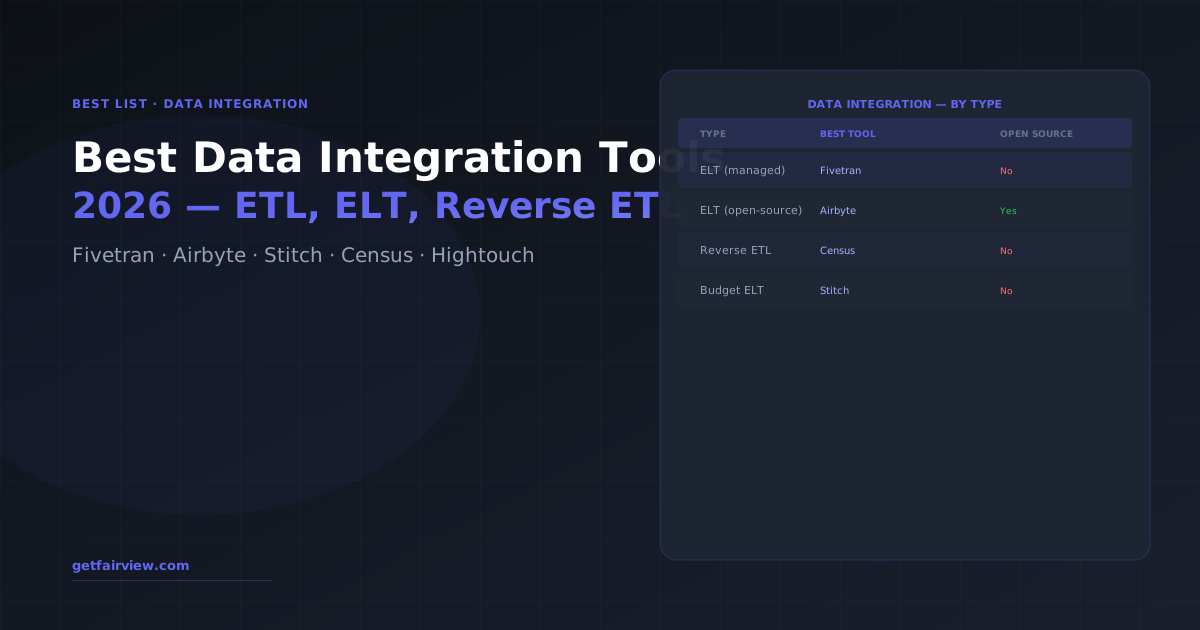
Fivetran is the gold standard for managed ELT. It maintains 500+ pre-built connectors that are automatically updated when source APIs change — eliminating the most painful part of data engineering: connector maintenance. For companies that need reliable, low-maintenance data pipelines from Salesforce, HubSpot, Stripe, Shopify, and hundreds of other sources, Fivetran is the enterprise default.
Pricing is based on Monthly Active Rows (MAR) — the number of rows synced per month. This can become expensive for high-volume data sources. Teams syncing millions of rows daily should model the cost carefully before committing.
Best for: Data teams that need managed, zero-maintenance ELT connectors with enterprise reliability and SLAs
2. Airbyte — Best Open-Source ELT
Airbyte is the leading open-source alternative to Fivetran. It offers 350+ connectors, a self-hosted deployment option (completely free), and an active community that contributes custom connectors for sources not covered by Fivetran. Airbyte Cloud starts at $10/month for small volumes.
The trade-off: self-hosted Airbyte requires engineering effort to set up and maintain. Connector reliability can be lower than Fivetran's managed connectors, particularly for less popular sources. For teams with engineering capacity and a need to minimize tooling cost, Airbyte is the right default.
Best for: Technical teams that want open-source ELT, full data ownership, and lower cost than Fivetran
Related: What is Reverse ETL? →
3. Stitch — Best Budget ELT
Stitch (acquired by Talend) is a simpler, less expensive ELT tool that covers the most common data sources without Fivetran's pricing complexity. It is a solid choice for small data teams that need managed pipelines from Salesforce, HubSpot, Stripe, and Google Analytics without needing 500+ connectors or enterprise SLAs.
Best for: Small data teams with 5–20 common data sources who want managed ELT at a lower price than Fivetran
4. dbt — Best SQL Transformation Layer
dbt (data build tool) is the standard SQL transformation layer for modern data stacks. It converts raw, ingested data into clean, analytics-ready models using version-controlled SQL. Every data team running Fivetran or Airbyte into Snowflake, BigQuery, or Redshift also uses dbt to transform raw data into usable models.
dbt Core is free and open-source. dbt Cloud adds a managed scheduler, documentation hosting, and collaboration features at $50–$100/seat/month. For teams without a dedicated data infrastructure engineer, dbt Cloud significantly reduces the operational overhead.
Best for: Any team with a cloud data warehouse that needs SQL-based data modeling, version control, and data lineage
5. Census — Best Reverse ETL
Census is the category leader for Reverse ETL — syncing data from your warehouse back to operational tools. It connects to Snowflake, BigQuery, and Redshift, and pushes enriched data to Salesforce, HubSpot, Intercom, Customer.io, and 200+ other destinations. For RevOps teams that want to enrich CRM records with warehouse data (product usage, billing status, health scores), Census is the standard.
Best for: RevOps and growth teams that want to sync warehouse-computed data (product scores, health indicators) back to Salesforce or HubSpot
6. Hightouch — Best Reverse ETL Alternative
Hightouch competes directly with Census in Reverse ETL. Its free tier covers two syncs and two destinations — sufficient for teams evaluating the approach before committing. Hightouch has strong integrations with advertising platforms (Meta, Google Ads, LinkedIn) for audience syncing, in addition to CRM and marketing automation destinations.
Best for: Teams evaluating Reverse ETL who want a free tier to test, or those with a focus on advertising audience syncing from the warehouse
7. Zapier — Best No-Code Workflow Automation
Zapier is the standard for no-code workflow automation between SaaS tools. It is not a data warehouse integration tool — it moves individual events or records between apps in near-real-time. For non-technical operations teams that need to connect Typeform to HubSpot, or Stripe webhooks to Slack alerts, Zapier is the fastest path.
Best for: Non-technical ops teams that need lightweight, event-driven integrations between SaaS tools without a data warehouse
8. Make — Best Zapier Alternative
Make (formerly Integromat) is the most flexible no-code automation platform and the primary Zapier alternative. It supports more complex, multi-step workflows with conditional logic, error handling, and data transformation at a lower price per operation than Zapier. For technical non-developers who need more than simple trigger-action automations, Make provides significantly more power.
Best for: Teams that outgrow Zapier's linear trigger-action model and need complex conditional workflows at lower cost
Frequently Asked Questions
Already running Fivetran or Airbyte into your warehouse?
Fairview connects directly to your CRM and billing systems — no warehouse or ETL pipeline required to get operating intelligence (MRR, NRR, pipeline) on day one.
Book a Demo →