TL;DR
- A sales forecast is a dated commitment about how much revenue will close in a defined window. The forecasting method is the rule that turns pipeline, history, and rep judgment into that number.
- Eight methods operators actually use: historical trend, pipeline-weighted, stage-based, opportunity-velocity, bottom-up rep-submitted, top-down target, regression, and AI / machine-learned.
- The median B2B team misses its quarterly forecast by 13% (Gartner, 2023). Within 10% is healthy; within 5% is best-in-class.
- Accuracy comes from blending methods, not picking the smartest one. Stage-based + bottom-up + historical, reconciled weekly, beats any single model.
- Fairview's Forecast Confidence Engine reconstructs stage-based and velocity forecasts from your CRM, scores confidence, and flags deals likely to slip before the quarter closes.
Sales forecasting is the practice of predicting, on a defined cadence, how much revenue will close in a defined window. The method you choose decides whether the board conversation is about growth or about why the number slipped.
Most forecasts are wrong. Gartner's 2023 CSO survey found the median B2B sales organisation misses its quarterly forecast by 13%, and only one in four forecasts came within 5% of actuals. The reason is almost never the formula. It is usually the inputs: stale CRM data, inconsistent stage definitions, and a rep-submitted number that nobody reconciles against the pipeline.
This pillar covers the eight forecasting methods RevOps teams actually run in 2026, how accurate each one is, and how to pick a blend that survives a messy quarter. It sits alongside the RevOps pillar, RevOps KPIs, and revenue attribution models.
What is a sales forecast?
Definition
Sales forecast: a dated, quantified commitment of how much revenue a team will close in a defined window, built from pipeline state, historical conversion behaviour, and rep judgment. Good forecasts are accurate, repeatable, and explainable — in that order of importance.
A forecast is not a goal. The goal is the number the CEO asks for. The forecast is the number the pipeline supports. When the two diverge, a healthy RevOps function says so out loud rather than padding the pipeline to close the gap.
The forecasting method is the rule that turns pipeline data into the forecast. Most teams use a blend. A stage-based engine produces the baseline, a rep-submitted forecast adds on-the-ground nuance, and a historical trendline catches the quarters when the pipeline looks nothing like last year's.
The eight sales forecasting methods, compared
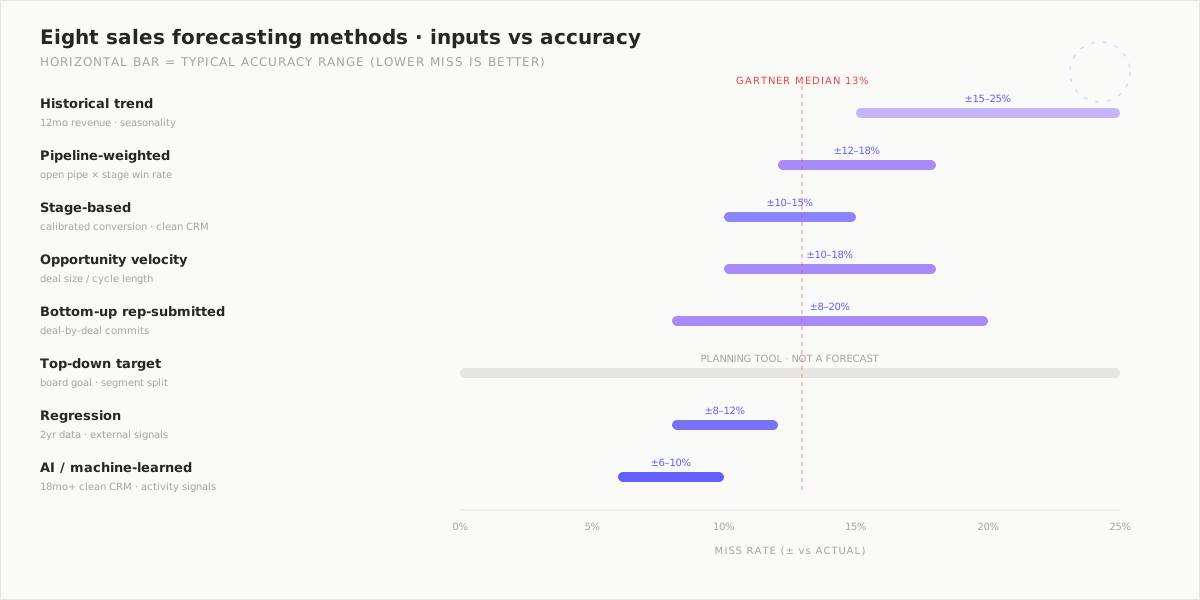
The eight methods split into three families: heuristic (history + pipeline math), judgmental (rep and leader input), and model-based (regression and machine learning).
| Method | Input required | Typical accuracy | Best for |
|---|---|---|---|
| Historical trend | 12+ months of revenue | ±15–25% | Early-stage sanity check |
| Pipeline-weighted | Open pipeline × stage win rate | ±12–18% | SMB SaaS default |
| Stage-based | Defined stages + historical conversion | ±10–15% | B2B with clean CRM |
| Opportunity velocity | Avg deal size / sales cycle length | ±10–18% | High-volume mid-market |
| Bottom-up rep-submitted | Deal-by-deal rep calls | ±8–20% | Enterprise, high-ACV |
| Top-down target | Board goal broken down by segment | Planning tool, not forecast | Annual planning |
| Regression / multivariate | 2+ years of clean data, external signals | ±8–12% | Mature RevOps teams |
| AI / machine-learned | 18+ months of CRM + activity data | ±6–10% | 500+ opp/qtr, data-mature |
Accuracy ranges are directional, based on composite data from Gartner CSO benchmarking and public RevOps literature. Your mileage depends almost entirely on CRM hygiene.
Heuristic methods: historical, pipeline-weighted, stage-based, velocity
Heuristic methods treat forecasting as arithmetic on what you already know. They are cheap to run and honest about their assumptions.
Historical trend extrapolates last year's revenue forward, adjusted for seasonality and growth rate. It is the sanity check every other method is measured against. If your stage-based forecast says $2.8M this quarter and last year's equivalent was $1.1M growing 40%, something in the pipeline is either unusually good or unusually cooked.
Pipeline-weighted multiplies each open deal by the historical win rate of its current stage. A $100K deal in a stage that closes 35% of the time contributes $35K. Fast, defensible, and the default starting point for most B2B SaaS teams under $20M ARR.
Stage-based is pipeline-weighted plus stage-specific conversion rates calibrated from your own closed-won and closed-lost history. It is more accurate than pipeline-weighted because it corrects for the fact that “Proposal” at your company might close at 52% while “Demo Scheduled” closes at 14%.
Opportunity velocity forecasts from flow rather than state. Revenue = (pipeline $ created × win rate) / sales cycle length. It catches pipeline acceleration and deceleration before stage-based methods do, which is why high-volume mid-market teams like it.
Key insight
Heuristic methods fail the same way every time: they assume next quarter looks like the last four. When the pipeline mix shifts — new segment, new product, bigger ACV band — accuracy degrades before anyone notices.
Judgmental methods: bottom-up and top-down
Judgmental methods trust humans to see what the numbers miss.
Bottom-up rep-submitted asks each rep to call their deals: commit, best-case, or pipeline. Managers roll up. Leadership reconciles. It is slow, political, and irreplaceable for enterprise sales where every deal is unique.
Accuracy varies wildly. A sales team with a strong qualification culture produces commit forecasts that land within 5% of actual. A team under quota pressure produces commit numbers that correlate more with fear than with probability. Use rep-submitted as a layer, not the whole forecast.
Top-down target starts with a board number ($32M ARR by end of year) and decomposes it into quarterly, segment, and rep targets. It is a planning method, not a forecasting method. Confusing the two is how teams end up with a "forecast" that is really a target wearing a forecast's clothes.
Model-based methods: regression and AI
Model-based methods treat forecasting as a prediction problem.
Regression fits a multivariate line to the variables that actually drive close rate in your pipeline: deal size, industry, source, number of stakeholders, days-since-last-activity. It is the most defensible non-AI method and usually lands in the ±8–12% range with two clean years of CRM data.
AI / machine-learned forecasting, offered by tools like Clari, Gong Forecast, and Salesforce Einstein Forecasting, trains on win/loss history plus signals like email engagement, call sentiment, and meeting density. Accuracy can reach ±6–10% once the model has 18+ months of consistent data.
AI does not replace the rep forecast. It replaces the intuition layer that used to ride on top of pipeline math. The best teams run AI as a second opinion and investigate disagreements rather than override them.
Forecast accuracy benchmarks
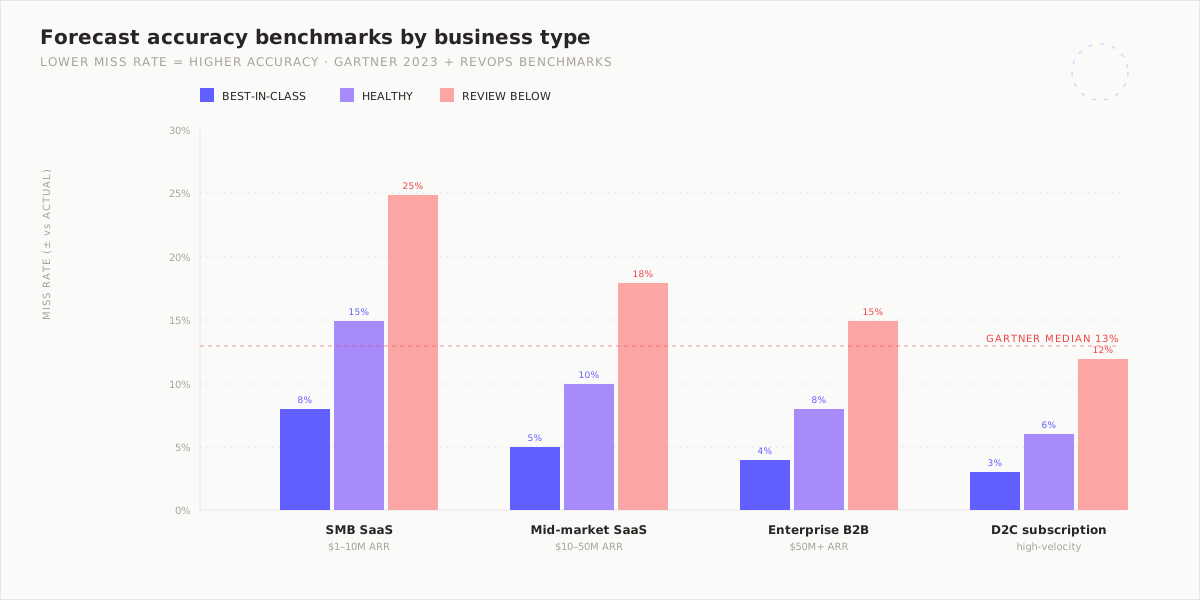
Gartner's 2023 benchmark shows the median B2B seller misses its quarterly forecast by 13%. The top quartile lands within 5%. The bottom quartile misses by more than 20%. Most of the gap is explained by pipeline data quality rather than forecasting sophistication.
| Business type | Healthy miss | Best-in-class | Review below |
|---|---|---|---|
| SMB SaaS ($1–10M ARR) | ±15% | ±8% | > 25% |
| Mid-market SaaS ($10–50M) | ±10% | ±5% | > 18% |
| Enterprise B2B | ±8% | ±4% | > 15% |
| D2C subscription | ±6% | ±3% | > 12% |
Quote-ready
Forecast accuracy is a CRM hygiene problem wearing a math problem's clothes. Clean stages and fresh activity logs outperform a better model, every time.
How to pick (and blend) a method
Single-method forecasts are fragile. A blend is what high-accuracy teams actually run.
- Under $2M ARR. Historical + pipeline-weighted. Anything more sophisticated costs more to maintain than the accuracy gain is worth.
- $2–20M ARR, defined funnel. Stage-based + rep-submitted commit + historical reality check. This blend is the pragmatic B2B SaaS default in 2026.
- $20–100M ARR, mature CRM. Add opportunity-velocity or regression as a third lens. Reconcile the three every Monday.
- $100M+ ARR or 500+ opps per quarter. Introduce AI forecasting as a fourth lens. Use it to interrogate the stage-based number, not replace it.
- Any size, messy CRM. Fix the data before upgrading the method. A pipeline-weighted forecast on clean data beats a machine-learned forecast on dirty data.
What breaks a forecast
Nearly every broken forecast traces to one of five root causes. None of them are the method.
- Stage definitions drift. When "Proposal" means different things to different reps, stage-based conversion rates become noise.
- Close dates do not update. Deals slip weekly but close dates move monthly, which backloads the forecast into the last two weeks of the quarter.
- Activity is not logged. If the last logged activity on a $400K deal is 47 days old, the model can't tell you whether it is alive.
- Reps sandbag or inflate. No math survives a sales team with misaligned incentives.
- The pipeline mix shifted quietly. New segment, new geography, new product tier — heuristic methods lag reality by one full quarter.
How Fairview forecasts pipeline automatically
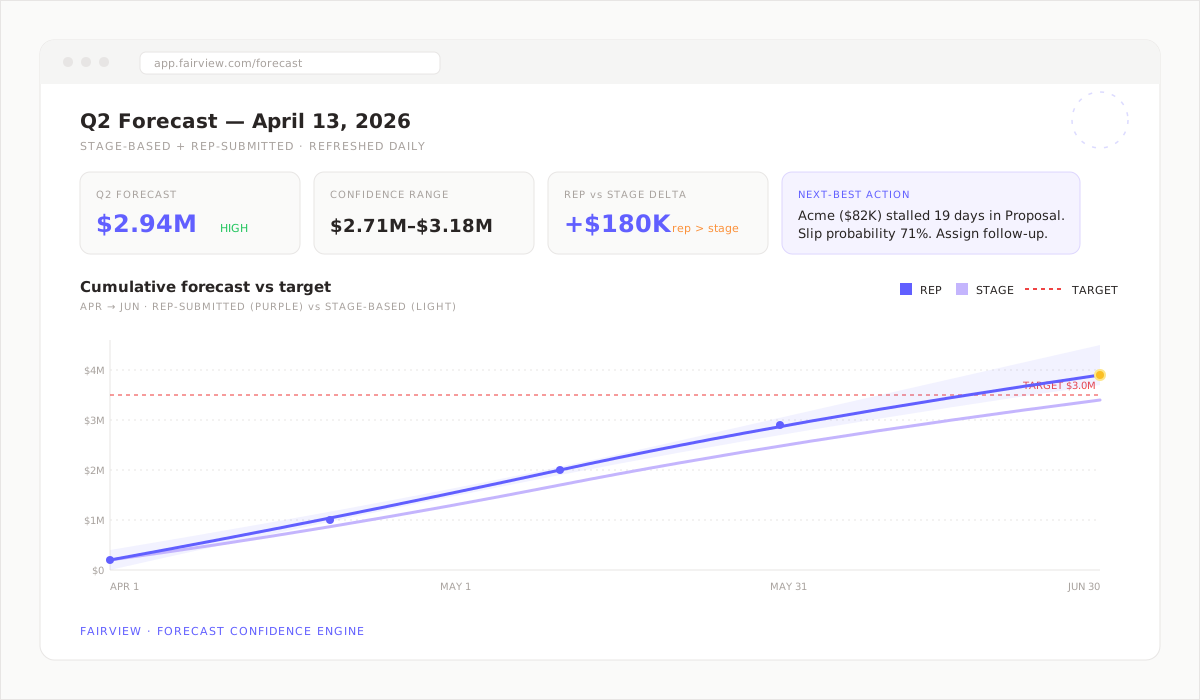
Fairview connects to HubSpot, Salesforce, Pipedrive, Stripe, QuickBooks, Xero, Shopify, Google Ads, Meta Ads, and HubSpot Marketing Hub via native OAuth. Once the CRM is connected, the Forecast Confidence Engine reconstructs stage-based conversion rates from your own history, generates a weighted forecast, and scores each deal High / Medium / Low confidence.
The Pipeline Health Monitor surfaces slip signals before the forecast catches them. When a deal in stage 4 has no activity in 14+ days, Fairview writes a named next-best action: "Acme ($82K) in Proposal has no logged activity for 19 days. Historical slip rate from this stage without activity is 71% over the next 14 days. Assign follow-up."
See pricing and tiers for the plan that fits your stack.
Weekly
Forecast refresh cadence
3 lenses
Stage, velocity, rep-submitted
10 min
First integration to live forecast
Key takeaways
- There are eight legitimate forecasting methods. None is universally best.
- The median B2B forecast misses by 13% (Gartner, 2023). Within 10% is healthy.
- Blend stage-based + rep-submitted + historical. That blend is the 2026 default.
- AI helps once you have 18+ months of clean CRM data. Before that, it is theatre.
- Accuracy is a data-hygiene problem more than a math problem. Fix the CRM first.
What is the difference between top-down and bottom-up forecasting?
Top-down starts from a market or revenue target and works down to account and channel plans. Bottom-up starts from individual deals and reps and rolls up. Top-down sets ambition; bottom-up grounds it in reality. Mature RevOps teams run both and reconcile the gap rather than pretending one is the forecast and the other is the goal.
What is a good sales forecast accuracy?
Within 10% of actual closed revenue is healthy for B2B SaaS; within 5% is best-in-class. Gartner's 2023 CSO survey found the median company misses its quarterly forecast by 13%. Accuracy below 75% usually means the pipeline data is dirty rather than the method is wrong — stage definitions drift, activity is not logged, close dates do not move when deals slip.
What is pipeline-weighted forecasting?
Pipeline-weighted forecasting multiplies the value of each open deal by the historical win rate of its current stage. A $100K deal sitting in a stage that closes 35% of the time contributes $35K to the forecast. It is fast, defensible, and the default starting point for most B2B SaaS teams under $20M ARR before they graduate to full stage-based forecasting.
Can AI replace the sales forecast?
Not in 2026. AI can flag deals likely to slip, re-weight stage probabilities, and generate a confidence-scored forecast. It still depends entirely on CRM hygiene. The most accurate AI forecasts run alongside a rep-submitted bottom-up number, with disagreements investigated rather than auto-resolved. Replacing humans at the forecasting table tends to reduce trust in the output faster than it improves the math.
How often should you update the sales forecast?
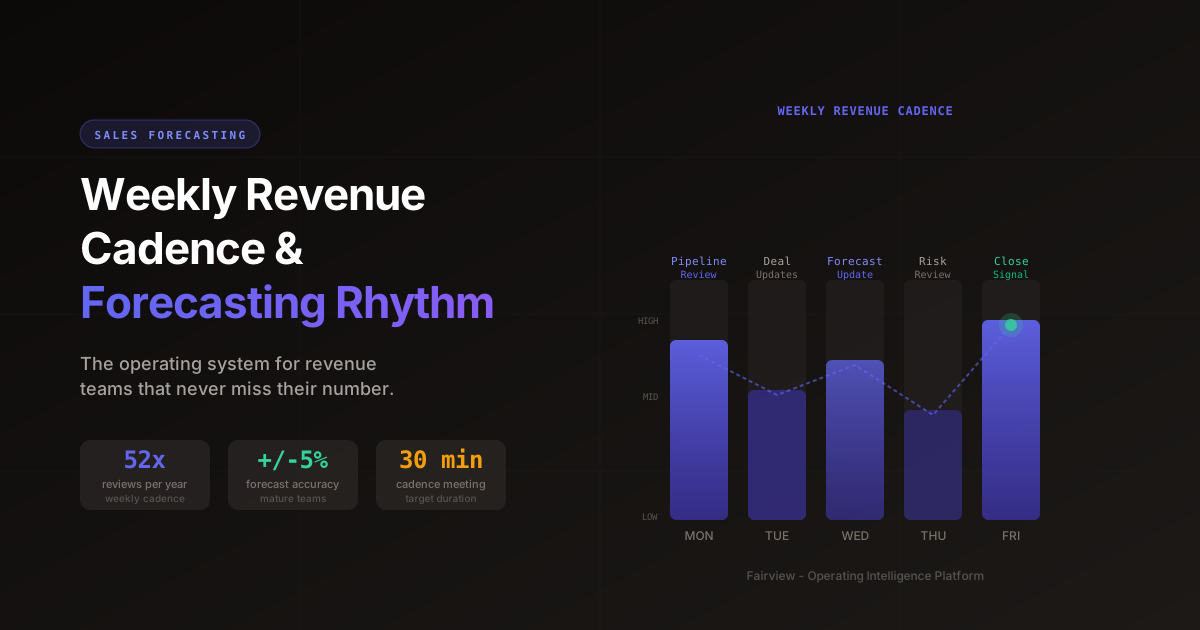
Weekly at the deal level, monthly at the channel and rep level, quarterly at the board level. Forecasts that update daily introduce noise and invite ad-hoc revisions. Forecasts that update monthly miss the slip signals that could still be acted on. Weekly is the cadence most high-accuracy B2B teams settle on, paired with an “always-on” alerting layer for deals that stall between updates.