TL;DR
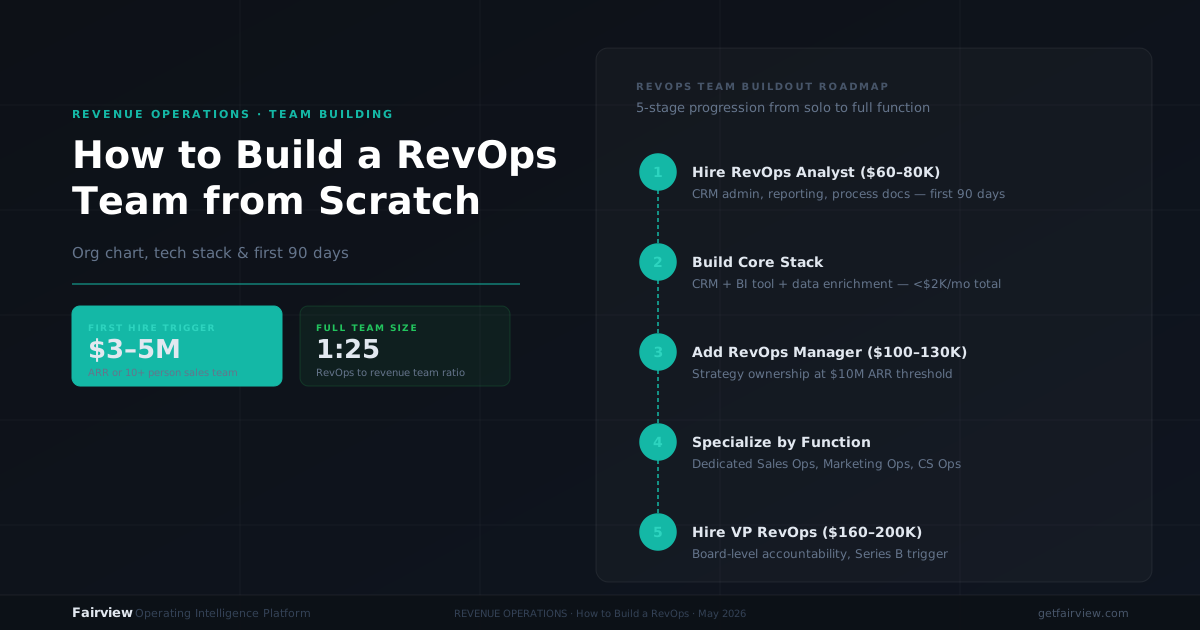
- Most B2B companies hire their first RevOps lead between $2M and $5M ARR, triggered by operational signals — not headcount.
- The first hire should be a generalist systems thinker, not a tool specialist. They need CRM fluency, finance literacy, and cross-functional authority.
- The 90-day build plan moves from audit (days 1-30) to clean data and forecast model (days 31-60) to operating cadence and attribution (days 61-90).
- Org charts scale predictably: fractional at 5-15 people, one dedicated lead at 50, a 3-4 person team at 100, and a VP-led function of 8-12 at 500.
- Buy the tech stack in order: CRM first, marketing automation second, finance integration third. Most companies do this backwards.
- Fairview is the operating intelligence layer that connects CRM, billing, accounting, and ad platforms into one RevOps view — one dashboard instead of five.
Most founders hire their first ops person for the wrong reason. They see a messy CRM, a broken forecast, or a spreadsheet that takes four hours to build every Monday. They post a job for a "RevOps manager" and hope the title fixes the problem. It does not. This guide covers how to build a revenue operations team from scratch — the right hire at the right stage, the 90-day sequence that actually works, and the org chart that scales from 5 people to 500.
The question of how to build a RevOps team is really three questions in sequence. When do you hire? Whom do you hire? And what do they do in the first 90 days? Most articles answer one of the three. This guide answers all three, with the org chart and tech stack decisions that come after the first hire is working.
If you are reading this because your Monday review has become a data-reconciliation exercise, or because your VP of Sales and your CMO just spent 20 minutes arguing about what counts as a qualified lead, the framework below is for you. For a deeper definitional grounding on what RevOps is and who owns it, see our explainer on what is RevOps.
When to Hire Your First RevOps Person
The headline answer most posts give is an ARR threshold: hire at $2M, or $5M, or when you hit 50 people. The thresholds are directionally correct but not the real trigger. The real trigger is operational pain that compounds faster than the founder or VP of Sales can absorb it.
Here are the five signals that say it is time. Three or more at once is the threshold.
- Three people give three different revenue answers. The CEO asks for committed pipeline and gets one number from sales, a different number from marketing, and a third from finance. None are wrong. They are just using different definitions. This is the single most reliable signal.
- Forecast accuracy is off by more than 15%. Most operators we work with see quarterly variance in the 15-30% range before formal RevOps. That much variance makes the forecast useless for hiring and capital decisions.
- Marketing and sales blame each other for pipeline. Marketing hits MQL targets and sales says the leads are unqualified. Both are partly right. The only fix is a shared definition owned by someone neither team reports to.
- The tool stack has grown to 10 or more disconnected tools. Every team bought their own add-on. The data layer is now the bottleneck. Sales' "closed-won" does not match finance's "billed."
- Renewals are getting missed and nobody saw it coming. Customer success reports healthy accounts right up until churn. The handoff data from sales never made it to CS.
If you have two of these, watch closely. If you have three, hire. The companies that wait until $10M ARR usually spend 12-18 months cleaning up the debt they accumulated between $3M and $10M. Stage 2 Capital's research on RevOps hiring confirms this pattern: the highest-growth companies formalize RevOps earlier, not later.
Below $1M ARR with under 10 people, a fractional RevOps consultant for 2 days per month is the right structure. A full-time hire at this stage is usually a six-figure cost against a revenue line that does not yet support specialist headcount.
The First RevOps Hire: Job Description and Profile
The most common hiring mistake is posting for a "Salesforce administrator" or "HubSpot expert" and expecting a systems thinker. The first RevOps hire is not a tool specialist. They are a generalist who can clean data, build a forecast model, write attribution rules, and arbitrate a disagreement between the VP of Sales and the CMO without taking sides.
The Profile
The ideal first RevOps hire has 3-5 years in revenue operations, sales operations, or marketing operations at a B2B company between $5M and $50M ARR. They have built a forecast model from scratch, cleaned a CRM with 10,000+ records, and written an attribution rule that both sales and marketing accepted. They are comfortable in SQL or equivalent, can read a P&L, and have presented a revenue number to a board. They are not a consultant who only designs process. They are not an engineer who only builds integrations. They do both.
The skills matrix breaks into four quadrants. Most candidates have two. The right candidate has at least three.
| Skill Area | What to Test For | Interview Signal |
|---|---|---|
| CRM and pipeline | Can rebuild pipeline stages with leadership buy-in | They ask about your current stage definitions before proposing changes |
| Forecast modeling | Can build a weighted forecast from deal-level data | They explain probability assignments by stage, not by rep optimism |
| Finance literacy | Can reconcile bookings, billings, and revenue | They distinguish between ARR, cash, and GAAP revenue |
| Cross-functional authority | Can set process across teams that do not report to them | They describe a time they changed a process a VP resisted |
The reporting line matters as much as the profile. The first RevOps lead should report to the CFO, COO, or CEO — not the VP of Sales. If RevOps reports to sales, it has authority inside sales but not to reset marketing's lead definitions or CS's renewal handoff. That authority gap is exactly what makes RevOps necessary. Early-stage companies under $3M ARR often have RevOps reporting to the VP of Sales by default. That is a reasonable temporary structure. Past $3M, it becomes a liability.
For salary context, Salary.com data puts the US median for RevOps manager roles at $115,000-$145,000 base, with 15-25% variable. In competitive markets (San Francisco, New York), the range shifts to $140,000-$180,000. A fractional consultant costs $3,000-$6,000 per month. Most companies under-invest in the first hire and over-invest in tools. The reverse is usually the better allocation.
The 90-Day RevOps Build Plan
The first 90 days of a RevOps hire are the most consequential period in the function's life. What gets built in this window becomes the foundation for the next two years. What gets skipped becomes technical debt that compounds. Here is the week-by-week plan we see work most consistently.
Days 1-30: Audit and Document
The first month is purely diagnostic. The new hire should not change anything yet. They should map what exists, interview every stakeholder, and produce a single gap report.
- Week 1: Tool inventory. Document every tool in the GTM stack, who owns it, what data it produces, and how it connects to everything else. Most companies discover 30-40% more tools than leadership thought they had.
- Week 2: Stakeholder interviews. One-on-ones with the heads of sales, marketing, customer success, and finance. Ask each: what revenue number do you report to the board, how do you calculate it, and where does the data come from? Document the differences.
- Week 3: Data audit. Pull a sample of 100 deals from the CRM. Check field completeness, stage accuracy, close date integrity, and whether the source data matches the attribution model. Most companies find 20-40% of records have material errors.
- Week 4: Gap report. A single document: current state, desired state, and the 90-day path between them. Present to the CEO and the GTM leadership team. Get sign-off before changing anything.
Days 31-60: Clean and Model
The second month is where the foundation gets built. CRM hygiene, pipeline stages, and the first forecast model.
- Week 5: CRM cleanup. Fix the data errors identified in the audit. Merge duplicates, backfill missing fields, correct stage assignments, and standardize close dates. This is tedious work and cannot be skipped.
- Week 6: Pipeline stage redesign. Define entry and exit criteria for each stage with the VP of Sales. Get sign-off from marketing on MQL-to-SQL handoff criteria. Get sign-off from CS on closed-won-to-onboarding criteria. Write it down. Publish it.
- Week 7: Forecast model v1. Build a weighted forecast using historical win rates by stage. Start simple: probability per stage, weighted pipeline, and a commit call. Do not over-engineer. The goal is a number that leadership trusts more than their current spreadsheet.
- Week 8: First weekly revenue review. Run the Monday meeting with the new numbers. One dashboard. One set of definitions. One accountable owner. Document what works and what does not.
Days 61-90: Cadence and Stack
The third month establishes the operating rhythm and makes the first tech stack decisions.
- Week 9: Attribution rules. Write the first version of how marketing gets credit for pipeline and revenue. Start with a simple model (first-touch or last-touch). Publish the rules. Get marketing and sales to agree in writing.
- Week 10: Tool consolidation. Identify redundant tools from the week-1 inventory. Cancel or consolidate. Most companies can remove 2-4 tools without losing capability.
- Week 11: Operating intelligence layer. Connect CRM, billing, and ad platforms into one operating view. This is where Fairview product fits — more on that below.
- Week 12: Month-one clean report. Deliver the first full month of weekly reports using the new model, new definitions, and new tools. Compare to the old numbers. Show variance. Explain the differences.
Key insight
The goal by day 90 is not a perfect system. It is one revenue answer that sales, marketing, and finance all trust — even if that answer is different from what they reported before. Trust comes from transparency about definitions, not from hiding the variance.
RevOps Org Chart by Company Stage
The org chart scales predictably. The mistake most companies make is jumping from "one person doing everything" to "a five-person team" without the revenue line to support it. Here is the progression we see work.
5-15 People: Fractional or Founder-Led
At this stage, there is no dedicated RevOps function. The founder or CEO runs the Monday review from a spreadsheet. The VP of Sales owns the CRM. A fractional RevOps consultant checks in twice a month to clean data and advise on tool decisions. The consultant costs $3,000-$6,000 per month. Do not hire full-time yet.
50 People: The First Dedicated Lead
One RevOps lead, reporting to the CFO, COO, or CEO. They own CRM hygiene, the forecast model, the weekly review, and the tool stack. They have no direct reports yet. They work closely with one sales ops or marketing ops specialist who may report into their functional VP but collaborates with RevOps on data standards. This structure works from roughly $2M to $10M ARR.
100 People: The Three-Person Core
The team expands to three or four people:
- RevOps lead (manager or senior manager): owns the operating rhythm, forecast, and cross-functional process.
- Systems admin: owns CRM configuration, integrations, field mapping, and data quality.
- Data analyst: owns reporting, attribution modeling, and the metrics that feed the weekly review.
- Sales ops specialist (optional, often shared): owns quota, territory, and comp plan administration.
500 People: The VP-Led Function
A VP of RevOps reports to the CRO with 8-12 direct reports across four sub-functions:
- Sales operations (3-4 people): pipeline, forecast, quota, territory, comp.
- Marketing operations (2-3 people): attribution, lead scoring, MAP administration, campaign operations.
- Customer success operations (1-2 people): health scoring, renewal forecasting, churn analysis, onboarding metrics.
- Revenue analytics (2-3 people): BI, data warehouse, executive reporting, board metrics.
| Stage | Headcount | RevOps team | Reports to |
|---|---|---|---|
| Seed / early | 5-15 | Fractional consultant | Founder / CEO |
| Growth | 50 | 1 dedicated lead | CFO / COO / CEO |
| Scale | 100 | 3-4 people | CFO / COO / CRO |
| Enterprise | 500 | 8-12 people, VP-led | CRO |
For a deeper look at the metrics that prove each stage is working, see our guide to RevOps KPIs.
The Essential RevOps Tech Stack
Most companies buy the tech stack backwards. They start with the analytics layer, or the enrichment tool, or the conversation intelligence platform. Then they discover their CRM is too dirty for any of it to work. The right order matters.
Buy Order
Layer 1: CRM of record. Layer 2: Marketing automation. Layer 3: Finance / billing integration. Layer 4: Conversation intelligence. Layer 5: Data enrichment. Layer 6: Operating intelligence. Layer 7: Sales enablement. Do not buy layer 5-7 before layers 1-3 are clean.
Here is what each layer does, why it matters, and when to buy it.
Layer 1: CRM of record. This is the system of truth for every deal, every contact, and every revenue event. HubSpot works for most companies under $10M ARR. Salesforce becomes the default past $10M. Pipedrive is a viable option for smaller teams with simpler motions. The decision is less important than the discipline: one CRM, one set of fields, one set of stage definitions. Do not migrate CRMs in the first 90 days of a RevOps build. Fix what you have first.
Layer 2: Marketing automation platform. HubSpot Marketing Hub, Marketo, or Pardot. The MAP generates leads, scores them, and passes them to the CRM. The integration between MAP and CRM is where most handoff failures begin. Test it weekly. The MQL-to-SQL conversion rate is the health metric for this layer.
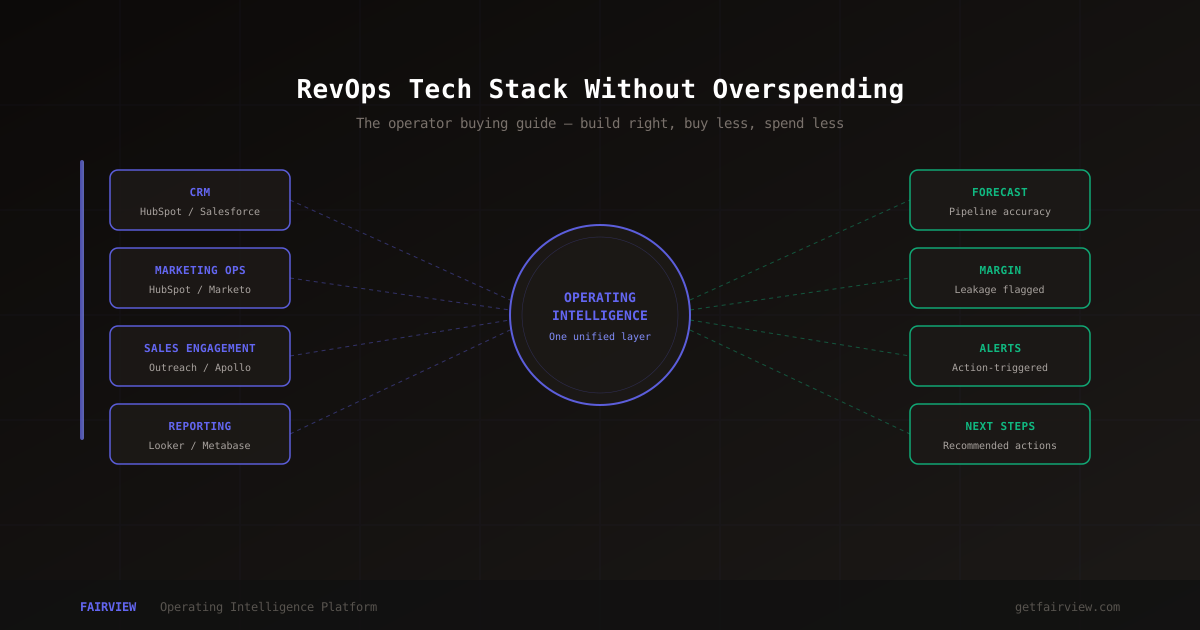
Layer 3: Finance or billing integration. Stripe, QuickBooks, or Xero connected to the CRM. This closes the loop between "deal closed" and "cash collected." Without it, the RevOps team is running two parallel revenue numbers that never reconcile. For a deeper guide on building the stack without overspending, see our RevOps tech stack guide.
Layer 4: Conversation intelligence. Gong, Chorus, or similar. Records calls, extracts themes, and feeds deal intelligence back into the CRM. Buy this when you have 3 or more AEs and the founder is no longer on every sales call.
Layer 5: Data enrichment. ZoomInfo, Clearbit, or similar. Keeps contact and account data current. Buy this when your CRM has more than 5,000 contacts and manual research is consuming rep time.
Layer 6: Operating intelligence. The layer that connects all sources into one operating view. This is where Fairview sits — see the next section.
Layer 7: Sales enablement. Highspot, Seismic, or similar. Content management, training, and playbook distribution. Buy this when you have a documented sales methodology and enough content to justify a system.
The total stack cost should run 5-8% of ARR. Most companies we work with are at 10-15% because they bought layers 5-7 before layers 1-3 were clean. The first RevOps hire's job is to bring that number down while improving output.
Common Mistakes When Building RevOps
We have seen the same five mistakes across dozens of engagements. They are all avoidable.
Mistake 1: Hiring a tool administrator instead of a systems thinker. The job post asks for "Salesforce certified" and "HubSpot expert." The candidate can configure workflows but cannot build a forecast model or arbitrate a dispute between sales and marketing. Six months later, the CRM is cleaner but the revenue number is still disputed. Hire for judgment and cross-functional authority first. Tool fluency is table stakes.
Mistake 2: Buying too many tools before the CRM is clean. The company buys enrichment, conversation intelligence, and a BI layer while 30% of CRM records have missing fields. The new tools amplify the bad data instead of fixing it. Rule: no new tools in month one. Audit first. Clean second. Buy third.
Mistake 3: Letting RevOps report to the VP of Sales. This is the most common structural error. When RevOps reports to sales, it optimizes the sales number at the expense of the revenue number. Marketing gets blamed for bad leads. CS gets blamed for churn. The real problems — misaligned definitions, broken handoffs, incomplete data — never get fixed because the owner lacks authority across functions.
Mistake 4: Documenting processes before the motion is repeatable. The company is still figuring out its ICP, its pricing, and its sales motion. RevOps formalizes pipeline stages and attribution rules anyway. Three months later, the ICP shifts and every document is obsolete. Process documentation should lag the motion by one quarter, not lead it.
Mistake 5: Measuring RevOps by dashboards built instead of forecast accuracy improved. The RevOps team ships beautiful reports every week. Leadership is impressed. But the forecast-to-actual variance is still 20%. The right metric for RevOps is forecast accuracy. Everything else is output, not outcome.
Key insight
The root cause of most RevOps failures is treating it as a tooling problem rather than an ownership and process problem. The right owner with a spreadsheet beats the wrong owner with a $50,000 tech stack.
How Fairview Fits Into a New RevOps Stack
Fairview is the operating intelligence layer underneath a working RevOps team. Once your CRM (HubSpot, Salesforce, or Pipedrive), your billing system (Stripe), and your accounting tool (QuickBooks or Xero) are connected, Fairview computes the seven KPIs every CRO asks about every Monday — in one connected view.
The Fairview Operating Dashboard shows margin by channel, pipeline health, forecast confidence, and anomaly alerts — updated in real time. The Pipeline Health Monitor flags deals that are stalling or have slipped close dates. The Forecast Confidence Engine generates a weekly revenue forecast with a confidence score, not just a single number. The Next-Best Action Engine writes specific recommendations when a number drifts past threshold: "Margin on paid search dropped 18% this week. Review Google Ads spend by campaign."
For a new RevOps team, Fairview replaces the weekly exercise of stitching together five different reports. The first integration is live in under 10 minutes. The Weekly Operating Report arrives every Monday morning with the prior week's summary, top anomalies, and open action items. Operators arrive at their Monday review already briefed.
See the Fairview product overview for what a RevOps cockpit looks like in practice. Fairview connects to HubSpot, Salesforce, Pipedrive, Stripe, QuickBooks, Xero, Shopify, Google Ads, Meta Ads, and HubSpot Marketing Hub.
Key Takeaways
- Hire your first RevOps lead between $2M and $5M ARR, triggered by three or more operational readiness signals — not by headcount alone.
- The first hire should be a generalist systems thinker with CRM fluency, finance literacy, and cross-functional authority. Not a tool specialist.
- The 90-day plan moves from audit (days 1-30) to clean data and forecast model (days 31-60) to operating cadence and attribution (days 61-90).
- The org chart scales from fractional (5-15 people) to one lead (50 people) to a 3-4 person team (100 people) to a VP-led function (500 people).
- Buy the tech stack in order: CRM first, marketing automation second, finance integration third. Most companies do this backwards.
- The five most common mistakes are: hiring a tool admin, buying too many tools early, reporting RevOps to sales, documenting before the motion is repeatable, and measuring dashboards instead of forecast accuracy.
When should you hire your first RevOps person?
Most B2B companies hire their first dedicated RevOps lead between $2M and $5M ARR. The better trigger is operational: hire when three or more readiness signals appear — conflicting revenue answers from different teams, forecast variance over 15%, marketing-sales blame on pipeline quality, 10 or more disconnected tools, or missed renewals nobody predicted. Below $1M ARR with under 10 people, a fractional RevOps consultant for 2 days per month is usually the right structure.
What does a RevOps org chart look like at different company sizes?
At 5-15 people, RevOps is a fractional consultant or part-time founder responsibility. At 50 people, one dedicated RevOps lead reports to the CFO, COO, or CEO and handles CRM, forecasting, and the weekly review. At 100 people, the team expands to 3-4 people: a RevOps lead, a systems admin, and a data analyst. At 500 people, a VP of RevOps reports to the CRO with 8-12 direct reports across sales ops, marketing ops, CS ops, enablement, and analytics.
What is the ideal RevOps tech stack?
Buy in this order: first, a CRM of record (HubSpot, Salesforce, or Pipedrive). Second, a marketing automation platform connected to the CRM. Third, a finance or billing integration to close the bookings-to-cash loop. Fourth, a conversation intelligence or call recording tool. Fifth, a data enrichment provider. Sixth, an operating intelligence layer that connects all sources into one view. Seventh, a sales enablement platform. Most companies overspend on layers 5-7 before layers 1-3 are clean.
What is a good 90-day plan for a new RevOps hire?
Days 1-30: audit every tool, interview each GTM leader, document current pipeline stages, and produce a gap report. Days 31-60: clean the CRM, rebuild pipeline stages with leadership sign-off, build the first forecast model, and establish the weekly revenue review. Days 61-90: write attribution rules, consolidate redundant tools, onboard the operating intelligence layer, and deliver the first month of clean weekly reports. The goal by day 90 is one revenue answer that sales, marketing, and finance all trust.
What are the most common mistakes when building RevOps?
The five most common mistakes are: hiring a tool administrator instead of a systems thinker; buying too many tools before the CRM is clean; letting RevOps report to the VP of Sales instead of a neutral senior leader; documenting processes before the motion is repeatable; and measuring RevOps by dashboards built instead of forecast accuracy improved. The root cause of most failures is treating RevOps as a tooling problem rather than an ownership and process problem.
How much does it cost to build a RevOps team?
A fractional RevOps consultant costs $3,000-6,000 per month. A first full-time RevOps lead in the US costs $110,000-160,000 base salary plus 15-25% bonus. A three-person RevOps team at 100 employees costs roughly $350,000-450,000 fully loaded. The tech stack typically runs 5-8% of ARR. Most companies under-invest in the first hire and over-invest in tools — the reverse is usually the better allocation.