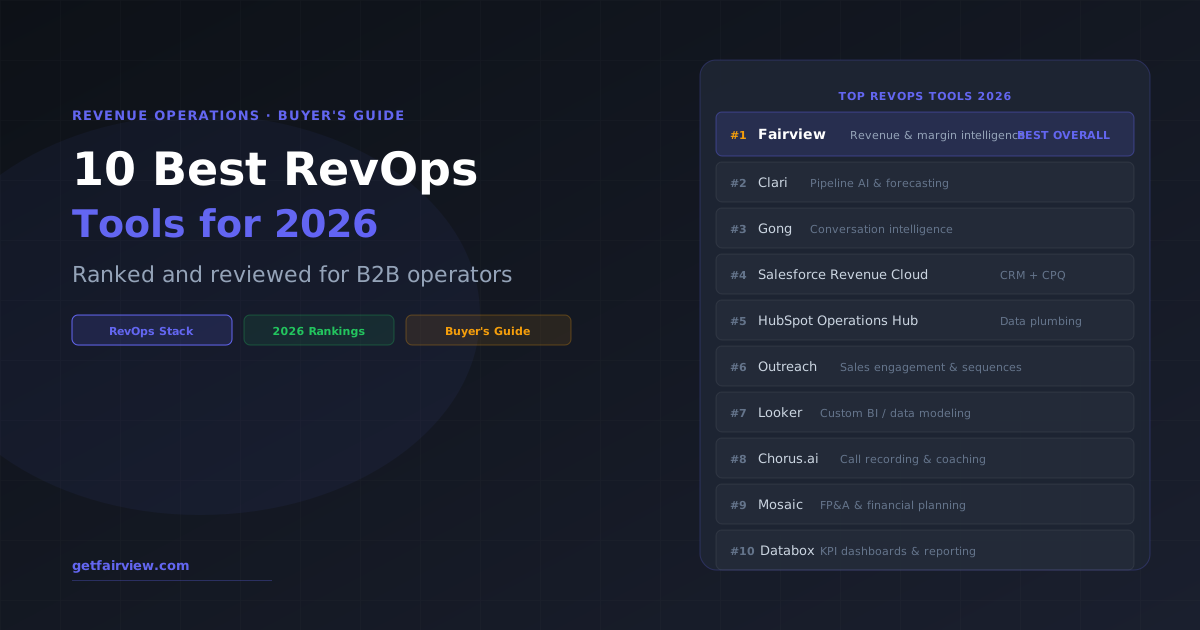
The best RevOps tools for 2026 are Fairview (revenue and margin intelligence), Clari (pipeline AI), Gong (conversation intelligence), Salesforce Revenue Cloud (CRM plus CPQ), and HubSpot Operations Hub (data plumbing). No single tool covers all of RevOps — the best teams build a deliberate stack where each layer solves a distinct problem without overlap.
Revenue operations is not a department — it is a philosophy. But that philosophy still needs software to execute. And in 2026, the RevOps software landscape has fractured into six distinct categories, each solving a different piece of the same puzzle: how do you turn raw deal data into predictable, profitable growth?
This guide ranks the 10 best RevOps tools available today, organized by what they actually do, how they fit into a broader stack, and who they are best suited for. Whether you are building your first RevOps function at Series A or rationalizing an over-tooled stack at Series D, this is the breakdown you need.
What Is a RevOps Tool?
A RevOps tool is any software that helps align sales, marketing, and customer success around a shared view of revenue. That is a broad definition — and deliberately so, because "RevOps tool" is not a product category. It is a job description mapped onto software.
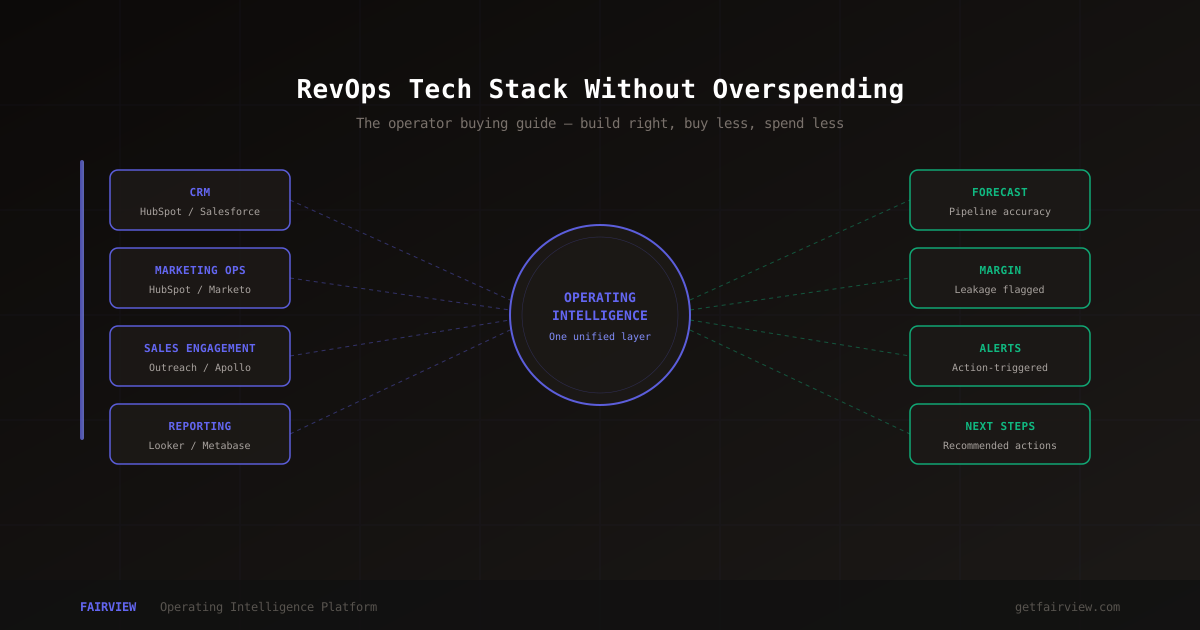
In practice, RevOps teams assemble a stack from several subcategories:
CRM & Data Foundation
The system of record. Where deal data, contacts, and pipeline stages live. Salesforce and HubSpot dominate this layer.
Revenue Intelligence
Turns raw pipeline data into forecast accuracy, margin visibility, and growth signals. Fairview and Clari operate here.
Conversation Intelligence
Records, transcribes, and analyzes sales calls to surface coaching opportunities and deal risk. Gong and Chorus lead here.
Sales Engagement
Automates outreach sequences, email cadences, and multi-channel prospecting. Outreach and Salesloft own this space.
Data Operations
Deduplicates, enriches, and syncs data across the stack. HubSpot Operations Hub and Fivetran play here.
Analytics & Reporting
Custom dashboards and data visualization. Looker, Tableau, and Databox serve this need for RevOps reporting.
The best RevOps stacks have exactly one tool in each category — no more, no fewer. The goal is zero redundancy and zero gaps.
Quick Comparison: All 10 Tools at a Glance
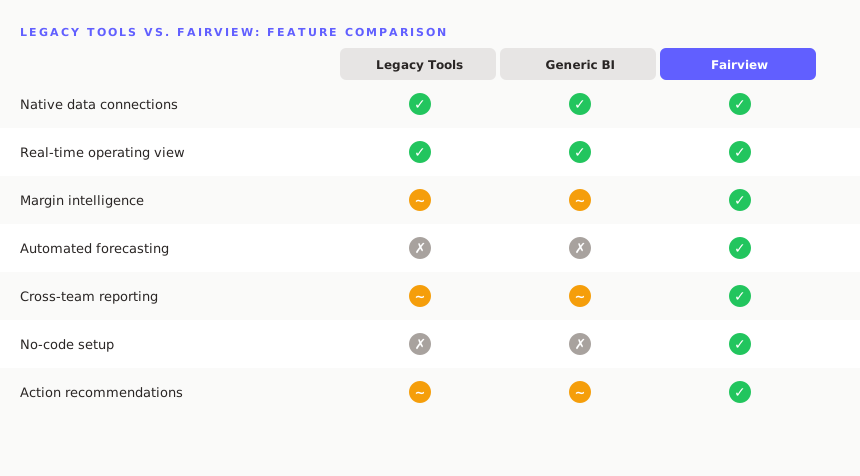
| Tool | Category | Best For | Pricing | Revenue Intel | Forecasting |
|---|---|---|---|---|---|
| Fairview | Revenue Intelligence | B2B operators, RevOps leads | Custom | ✓ Native | ✓ Native |
| Clari | Pipeline AI | Enterprise sales teams | $1,500+/mo | ~ Partial | ✓ Native |
| Gong | Conversation Intelligence | Sales coaching, deal risk | $100-200/user | ✗ No | ~ Limited |
| Salesforce Revenue Cloud | CRM + CPQ | Enterprise deal management | $150-300/user | ✗ No | ~ Basic |
| HubSpot Ops Hub | Data Operations | HubSpot-first stacks | $0-2,000+/mo | ✗ No | ✗ No |
| Outreach | Sales Engagement | SDR/AE outbound sequences | $100-150/rep | ✗ No | ✗ No |
| Looker | BI / Analytics | Data-mature teams, custom BI | $3,000+/mo | ~ Build it | ~ Build it |
| Chorus.ai | Conversation Intelligence | Mid-market call coaching | $8,000+/yr | ✗ No | ✗ No |
| Mosaic | FP&A | Finance-aligned RevOps | Custom | ~ Financial | ~ Planning |
| Databox | KPI Dashboards | SMB reporting, KPI visibility | $0-200/mo | ✗ No | ✗ No |
See how Fairview fits into your existing RevOps stack
Connect your CRM, warehouse, and billing data in under 30 minutes. No SQL required.
Book a DemoThe 10 Best RevOps Tools, Reviewed
Fairview is the only RevOps tool built specifically around the question operators actually need to answer: where is the money coming from, and how much of it is actually profitable? While tools like Clari focus on pipeline coverage ratios and Gong focuses on rep coaching, Fairview connects CRM data, billing data, and cost data into a single view of revenue quality — not just revenue volume.
The core use cases: gross margin by product and customer segment, ARR cohort analysis, CAC payback by channel, pipeline-to-revenue efficiency, and operating intelligence dashboards that surface the metrics your board actually asks about. Fairview integrates with Salesforce, HubSpot, Stripe, QuickBooks, and your data warehouse. Setup takes under 30 minutes.
Pros
- Revenue + margin intelligence in one place
- No SQL or data team required
- Pre-built metrics for RevOps, Finance, and GTM
- Connects CRM + billing + cost data natively
- Designed for operators, not data analysts
Cons
- Not a CRM replacement — needs Salesforce or HubSpot
- Not designed for conversation intelligence or coaching
- Custom pricing — no self-serve free tier
Clari is the dominant tool for enterprise sales teams that need AI-driven pipeline forecasting. It ingests CRM data, rep activity signals, and historical patterns to produce call-by-call forecast predictions and pipeline risk scores. Clari's "Revenue Platform" expanded significantly in 2023-2024 to include revenue collaboration, deal intelligence, and conversational AI for reps.
The primary value: Clari tells you which deals are going to close this quarter before the quarter closes. It surfaces at-risk pipeline before reps self-report it. For enterprise sales orgs with 20+ reps and a complex pipeline, it is the best purpose-built forecasting tool available. The limitation is that Clari focuses on pipeline volume — not on margin or revenue quality after the deal closes.
Pros
- Best-in-class AI pipeline forecasting
- Deep Salesforce integration
- Activity signal capture (email, calendar)
- Rep behavior analytics
Cons
- Expensive — often $50K+/yr for mid-market
- Does not track margin or unit economics
- Complex implementation — weeks, not days
- Over-built for teams under 20 reps
Gong records every sales call, transcribes it, and uses AI to analyze what happened: who talked more, what objections came up, how the next steps were set, and whether the deal risk has changed. It has become the default conversation intelligence platform for mid-market and enterprise B2B sales teams — largely because it does what it does better than any competitor.
Gong's "Deals" module attempts to extend into pipeline intelligence, and "Engage" adds a sales engagement layer. But Gong remains at its best as a coaching and call analysis tool. For RevOps, it surfaces which deals have gone quiet, which reps are avoiding pricing conversations, and where multi-threading is weak.
Pros
- Best-in-class call recording and AI analysis
- Identifies deal risk signals from conversations
- Strong coaching workflows for front-line managers
- Broad CRM integrations
Cons
- Does not provide revenue or margin intelligence
- Pipeline forecasting is secondary, not native
- Requires reps to use it consistently to deliver value
Fairview covers the gap every other RevOps tool leaves
Revenue intelligence, margin visibility, and pipeline analytics — connected to your existing CRM without any SQL.
See Fairview in ActionSalesforce Revenue Cloud combines Sales Cloud (CRM), CPQ (Configure, Price, Quote), and Billing into a single platform for enterprise deal management. For RevOps teams with complex deal structures — multi-year contracts, usage-based pricing, professional services — Salesforce is often the only tool capable of handling the full quote-to-cash motion.
Salesforce's native forecasting module is functional but limited — it relies on rep-submitted stage data, which is only as accurate as the CRM hygiene underneath. Most serious RevOps teams layer Clari or Fairview on top to compensate. Salesforce is the data foundation; the intelligence has to come from elsewhere.
Pros
- Most flexible CRM for complex deal structures
- CPQ handles multi-product, multi-year pricing
- Massive ecosystem of integrations and partners
- Standard system of record for enterprise RevOps
Cons
- Native forecasting is weak without add-ons
- Expensive to implement and maintain
- Requires dedicated Salesforce admin
- Over-engineered for early-stage B2B
HubSpot Operations Hub (rebranded as Data Hub in 2024) handles the plumbing: it deduplicates contacts, syncs data across your stack, and enables programmable automation within HubSpot's ecosystem. For teams already committed to HubSpot as their CRM, it is the logical layer for keeping data clean and workflows automated.
The free tier covers basic sync. The paid tiers ($20-$2,000+/month depending on plan) add programmable automation, custom field mappings, and dataset tools. HubSpot Ops Hub is not an analytics tool and not a forecasting tool — it is the data layer that makes analytics tools work correctly. Think of it as the plumbing; Fairview is the intelligence layer built on top.
Pros
- Free tier is genuinely useful
- Native deduplication and data sync
- Programmable automation without code (mostly)
- Seamless with the broader HubSpot ecosystem
Cons
- Only valuable if HubSpot is your CRM
- Not a reporting or analytics tool
- Advanced tiers are significantly more expensive
Outreach is the leading sales engagement platform for B2B teams running high-volume outbound. It manages email sequences, call tasks, LinkedIn touches, and multi-channel cadences — and syncs rep activity back to Salesforce or HubSpot automatically. For RevOps, it provides the activity data infrastructure that downstream analytics tools (including Fairview) can use to correlate rep activity with pipeline outcomes.
Outreach has expanded into "Revenue Intelligence" branding with its Kaia AI and pipeline review features, but it remains strongest as an execution tool for sequences. The intelligence layer still lives in dedicated tools like Fairview and Clari.
Pros
- Best-in-class sequence management
- Strong Salesforce/HubSpot sync
- Rep activity tracking for downstream analytics
- AI writing assistance for personalization
Cons
- Revenue intelligence features are secondary
- Not useful for RevOps teams without SDR function
- Pricing adds up quickly for large teams
Looker (now Google Cloud's BI tool) is a powerful SQL-based analytics platform that lets data teams build custom LookML models to answer any question from any data source. For RevOps teams with a mature data infrastructure and a dedicated analytics engineer, Looker can serve as the custom reporting layer across pipeline, revenue, and operational data.
The challenge: Looker requires significant upfront investment in data modeling. Without a data engineer or analytics engineer, most Looker implementations stall. It is not a self-serve tool — it is a platform for teams that want to build their own intelligence layer from scratch. For teams that want pre-built revenue intelligence without the build cost, Fairview is the faster path.
Pros
- Fully custom — answer any question
- Strong Google Cloud integration
- Semantic layer prevents metric drift
- Works with any data source
Cons
- Requires dedicated engineering resources
- Expensive — platform plus people cost
- Slow to deploy — months, not days
- Not designed for non-technical operators
Chorus.ai, now part of ZoomInfo, is the most common Gong alternative for mid-market B2B teams that want conversation intelligence at a lower price point. It records calls, surfaces coaching opportunities, and syncs call data to your CRM. After the ZoomInfo acquisition, Chorus gained access to intent data and contact enrichment — making the bundled pricing more attractive for teams already in the ZoomInfo ecosystem.
Chorus is the right choice if your team is Gong-curious but not Gong-budget. The core call recording and AI analysis features are comparable. The ecosystem integrations are slightly narrower, and the product roadmap moves more slowly now that it lives inside ZoomInfo.
Pros
- Lower cost than Gong for core features
- ZoomInfo bundle discounts available
- Solid call transcription and AI analysis
Cons
- Product development slower post-acquisition
- Best value only if you are already a ZoomInfo customer
- Gong still outperforms on AI quality and UX
Mosaic is a strategic finance platform that connects accounting, CRM, and HR data to enable real-time financial modeling and planning. For RevOps teams working closely with finance — particularly around ARR modeling, headcount planning, and board reporting — Mosaic closes the gap between top-of-funnel revenue operations and bottom-line financial planning.
Where Fairview focuses on operational revenue intelligence for RevOps and GTM teams, Mosaic focuses on financial planning for CFOs and FP&A teams. The two tools complement each other well in a mature finance-RevOps setup.
Pros
- Real-time financial modeling from live data
- Bridges CRM and accounting data
- Board reporting templates included
Cons
- Finance-first, not RevOps-native
- Does not provide pipeline or deal intelligence
- Requires finance team ownership to get value
Databox is a no-code dashboard and reporting tool that pulls data from 70+ integrations (HubSpot, Salesforce, Google Analytics, Stripe, and more) and displays it in visual KPI boards. For early-stage B2B teams that need a quick dashboard layer without a data team, Databox is a reasonable starting point — especially given the generous free tier.
The limitation is depth: Databox surfaces what your tools already report — it does not add new intelligence. For teams that need actual revenue analysis (margin by segment, CAC by channel, cohort retention), Databox becomes a display layer rather than an intelligence tool. It works best as a weekly KPI monitor for leadership, not as a RevOps analytics engine.
Pros
- Free tier is genuinely functional
- No-code dashboard builder
- 70+ native integrations
- Good for leadership KPI visibility
Cons
- No intelligence layer — just displays existing data
- Not suitable for advanced RevOps analysis
- Becomes inadequate as teams scale
How to Choose the Right RevOps Tools for Your Stack
The right RevOps stack is the one that covers all six layers — CRM, revenue intelligence, conversation intelligence, sales engagement, data operations, and reporting — without redundancy. Here is the decision framework Fairview recommends:
Step 1: Start with Your CRM
Every RevOps tool is downstream of your CRM. If you have not chosen a CRM yet, start there. For early-stage B2B, HubSpot is faster and cheaper to implement. For enterprise with complex deal structures, Salesforce is the standard. Do not add intelligence tools until your CRM data is clean and trusted.
Step 2: Add Revenue Intelligence Before Conversation Intelligence
Most teams buy Gong before they buy a revenue intelligence tool — because Gong is easy to justify (coaching conversations) and intelligence is harder to quantify. This is backwards. Revenue intelligence gives you the financial visibility to know which deals to coach on, which channels produce the most profitable customers, and where your pipeline is actually at risk. Start with Fairview or Clari, then add Gong once the intelligence layer is in place.
Step 3: Scale Sales Engagement With Rep Count
Sales engagement tools like Outreach only deliver ROI when you have enough reps running enough sequences to justify the complexity. For teams under 10 AEs, a simple email tool often outperforms Outreach. Add a dedicated sales engagement platform when your SDR or AE team hits 5+ headcount and sequence volume justifies the management overhead.
Step 4: Do Not Build Custom BI Until You Have Run Out of Pre-Built Options
Looker, Tableau, and custom data warehouses are powerful — but they require engineering resources and take months to deliver value. Before committing to custom BI, exhaust the pre-built options. Fairview, Clari, and even Databox can answer the majority of RevOps questions without a single line of SQL. Only invest in custom BI when the pre-built tools genuinely cannot answer your questions.
Stack Recommendations by Stage
| Stage | CRM | Revenue Intelligence | Conversation | Engagement | Est. Monthly Cost |
|---|---|---|---|---|---|
| Seed / Pre-Series A | HubSpot (free) | Fairview | — | — | $500–$1,500 |
| Series A | HubSpot Starter/Pro | Fairview | Gong | — | $2,000–$5,000 |
| Series B | Salesforce or HubSpot | Fairview + Clari | Gong | Outreach | $8,000–$15,000 |
| Series C+ | Salesforce Revenue Cloud | Fairview + Clari | Gong | Outreach + Salesloft | $20,000–$50,000+ |
How Fairview Fits into a RevOps Stack
Fairview is not trying to replace your CRM, your conversation intelligence tool, or your sales engagement platform. It fills the gap that all of those tools leave: what does revenue actually look like in terms of quality, margin, and predictability?
Most RevOps stacks tell you how much pipeline exists and what your reps are doing. Fairview tells you which pipeline will turn into profitable revenue, which customers have the best gross margin, which channels produce the highest LTV:CAC, and which parts of the business are actually growing vs. holding the topline flat with churn.
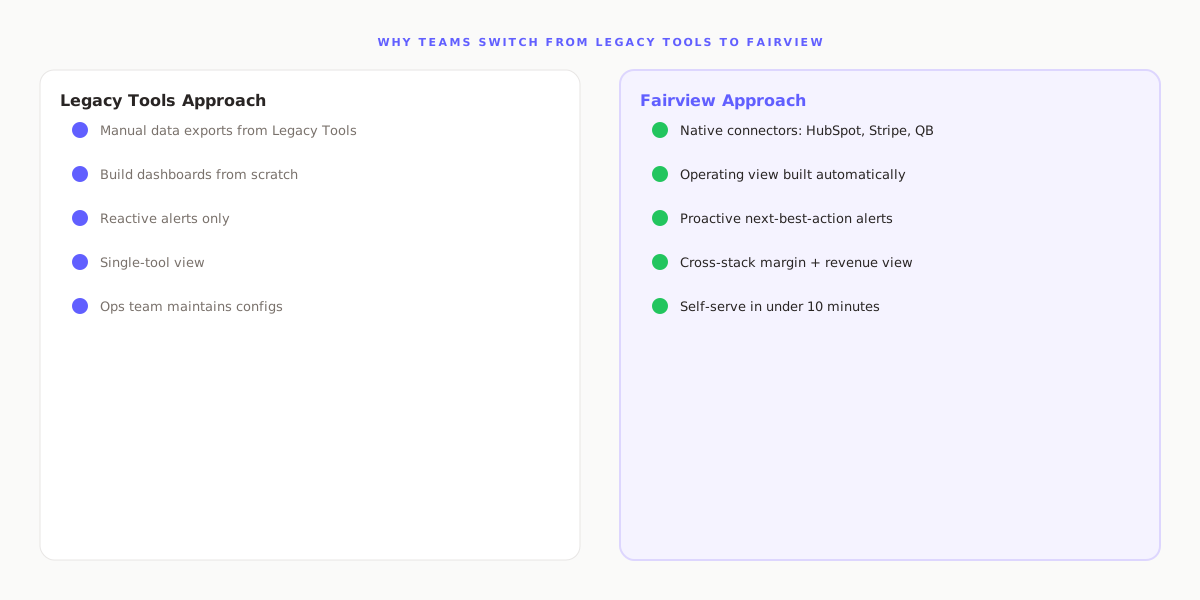
Fairview connects to your CRM, your billing system (Stripe, Chargebee, Recurly), and your data warehouse — and surfaces the operating intelligence your board, CFO, and GTM leadership need to make real decisions. No SQL. No data team. No weeks of implementation. See how Fairview works or read what operating intelligence means for a RevOps function.
For a Series B B2B company, a typical high-performing RevOps stack includes Salesforce as the CRM, Fairview for revenue and margin intelligence, Clari for pipeline forecasting, and Gong for deal coaching. The priority at Series B is usually forecast accuracy and gross margin visibility — both of which Fairview addresses directly. Budget-wise, expect $8,000–$15,000/month for a full Series B stack.
A full RevOps stack can range from $3,000 to $25,000+ per month depending on team size and tools selected. CRMs like Salesforce cost $150–$300/user/month. Intelligence layers like Fairview and Clari typically run $500–$3,000/month at early-stage, scaling with seats and data volume. Sales engagement tools like Outreach cost $100–$150/rep/month. Most Series A-C companies spend $8,000–$15,000/month on their full RevOps infrastructure.
For dedicated pipeline forecasting, Clari outperforms Salesforce's native forecasting module because it uses AI to analyze deal signals, rep behavior, and historical patterns that Salesforce alone cannot interpret. However, Clari requires Salesforce as the data source — they are complementary, not competing tools. Clari reads Salesforce data and makes it smarter; it does not replace the CRM underneath.
A CRM (Customer Relationship Management system) is the system of record — it stores deal data, contacts, pipeline stages, and activity logs. RevOps tools build on top of the CRM to provide intelligence, automation, forecasting, and analysis. Without a CRM, most RevOps tools have no data to work with. The CRM is the foundation; RevOps tools are the intelligence layer built on it.
Key Takeaways
- No single tool covers all of RevOps. The best stacks combine a CRM, a revenue intelligence layer, a conversation tool, and a sales engagement platform — each solving a distinct problem.
- Revenue intelligence comes before conversation intelligence. Know which pipeline is actually valuable before coaching reps on how to close it.
- Fairview fills the gap every other tool leaves: margin visibility, revenue quality, and operating intelligence across the full business — not just the top of the pipeline funnel.
- Match your stack to your stage. A seed company needs a CRM and one intelligence tool. A Series B company needs 4-5 tools. A Series C company needs all six layers.
- Do not overbuild. The most common RevOps mistake is buying every tool in every category before the data foundations are clean. Start with CRM → intelligence → engagement, in that order.
Ready to add revenue intelligence to your RevOps stack?
Fairview connects to your existing CRM, billing system, and warehouse in under 30 minutes. No SQL, no data team, no weeks of setup.
Book a Demo