.svg)
TL;DR
- A revenue attribution model is a rule for distributing credit for a closed deal across the marketing and sales touches that produced it.
- The seven models operators actually use: first-touch, last-touch, last-non-direct, linear, time-decay, U-shaped, W-shaped, and data-driven.
- Single-touch models lie about long sales cycles. Multi-touch models get gamed without strict touch definitions. Pick the model that fits your cycle length and volume.
- Rule of thumb: under 30-day cycles → last-non-direct. 30–180 days → W-shaped. 180+ days or 300+ monthly conversions → data-driven. Everyone else → linear, revisited quarterly.
- Fairview runs two models in parallel once your CRM, ad, and finance data are connected — so marketing and sales see the same revenue picture without rebuilding it each week.
A revenue attribution model is the rule your business uses to assign credit for a closed deal across the marketing and sales touches that produced it. The model you pick decides which channels get budget next quarter, which reps get credit this month, and whether your weekly revenue review turns into a fight about who did what.
Pick the wrong model and you will quietly starve the channels that actually drive pipeline. A B2B SaaS company running last-touch attribution will look at their dashboard, see that direct and organic closed every deal, and cut the content and paid-brand budget that fed the pipeline twelve months earlier. By the time pipeline coverage drops, the decision is already two quarters old.
This guide covers the seven models operators actually deploy, the shortlist by business type, and the implementation decisions that matter more than the model itself. It pairs with the RevOps pillar guide, RevOps KPIs, and marketing channel ROI.
What is a revenue attribution model?
Definition
Revenue attribution model: the rule a business uses to distribute credit for closed revenue across the marketing and sales touches that preceded the close. It decides which channel gets a 100% of the deal, a fraction of it, or zero — and therefore which channels look efficient on the dashboard.
Every closed deal has a history. A prospect saw an ad, read a blog post, downloaded a report, got an outbound email, booked a demo, sat through a pricing conversation, and eventually signed. That is between three and fifteen touchpoints for most B2B deals and two to five for most D2C ones. Attribution is the math that turns that list into budget decisions.
There is no correct model. Every model simplifies reality in exchange for a usable number. The right question is not "which is true" but "which distortion are we willing to live with?"
The seven attribution models, compared
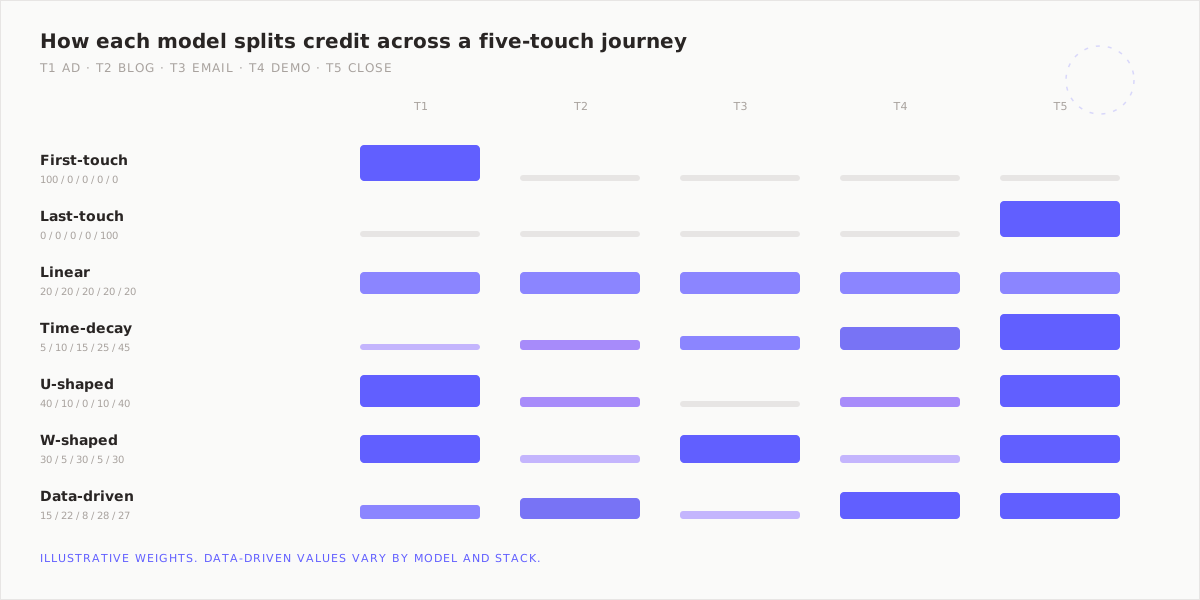
The models cluster into three families: single-touch (fast, lossy), rule-based multi-touch (balanced, arbitrary), and algorithmic (accurate, data-hungry).
| Model | How credit is split | Best for |
|---|---|---|
| First-touch | 100% to the channel that brought them in | Brand / top-of-funnel diagnosis |
| Last-touch | 100% to the channel that closed them | D2C short cycles, simple reporting |
| Last-non-direct | 100% to the last channel that is not direct traffic | D2C default in GA4 |
| Linear | Equal credit to every touch | Starting point for multi-touch |
| Time-decay | More credit to touches near the close | Cycles where late touches matter most |
| U-shaped (position-based) | 40% first, 40% last, 20% spread across middle | B2B with clear lead and opp creation |
| W-shaped | 30% first, 30% lead creation, 30% opp creation, 10% middle | B2B SaaS with MQL/SQL funnel |
| Data-driven | Credit assigned by a model trained on historical wins/losses | 300+ conversions/mo, mature stack |
Single-touch models: first-touch and last-touch
Single-touch models assign 100% of the deal to one channel. They are fast to implement, easy to explain, and wrong in a predictable direction.
First-touch credits the source that introduced the prospect. It favors content, paid brand, and earned media. Marketers love it for exactly that reason. Use it to answer the question "what is feeding the top of our funnel?" — not "what is closing deals?"
Last-touch credits the channel that closed the deal. In GA4 and most ad platforms, that is last-non-direct. Sales leaders prefer it because direct traffic and branded search disproportionately show up at the close. It will systematically starve top-of-funnel channels that created the demand in the first place.
Key insight
Single-touch models are fine for cycles under 30 days with one dominant channel. Anywhere else, they are a political weapon for whichever team writes the report.
Multi-touch models: linear, time-decay, U-shaped, W-shaped
Multi-touch models distribute credit across the journey. They correct the single-touch distortion but introduce a new one: the weights are arbitrary. Nobody can defend why 40/40/20 is the right U-shape split — it just beats 100/0/0 in most cases.
Linear gives equal credit to every touch. It is the least biased starting point for a team new to multi-touch. Its weakness: a five-touch deal gives the same weight to a 30-second ad impression as to a 45-minute demo call.
Time-decay weights touches closer to the close more heavily (usually with a 7-day half-life). Useful when late-funnel content, sales touches, or remarketing do most of the persuasion. It still under-credits the first touch.
U-shaped (position-based) gives 40% to the first touch, 40% to the last touch, and 20% split across everything in between. The cleanest choice for B2B teams that can identify lead creation clearly but do not have a mature opp-creation stage.
W-shaped anchors on three moments: first touch, lead creation (MQL), and opportunity creation (SQL). Each gets 30%, with 10% spread across the middle touches. This is the default for B2B SaaS with a defined funnel. It rewards the content that creates awareness, the CTA that captures the lead, and the sales play that qualifies the opportunity.
Data-driven attribution
Data-driven attribution (DDA) uses a statistical model — usually a variant of Shapley-value game theory or a Markov chain — to assign credit based on how much each channel actually lifts conversion probability. Google Ads and Meta offer it natively; tools like HubSpot Enterprise and Bizible run it across the full journey.
DDA is the most defensible model when you have the data to feed it. Google requires 300+ conversions and 3,000+ ad interactions in the past 30 days to enable it inside Ads, which rules out most companies under roughly $5M ARR.
Below that threshold DDA produces noisy credit allocations that drift week to week. W-shaped with explicit rules will outperform a data-driven model trained on 40 conversions every time.
Which model fits your business?
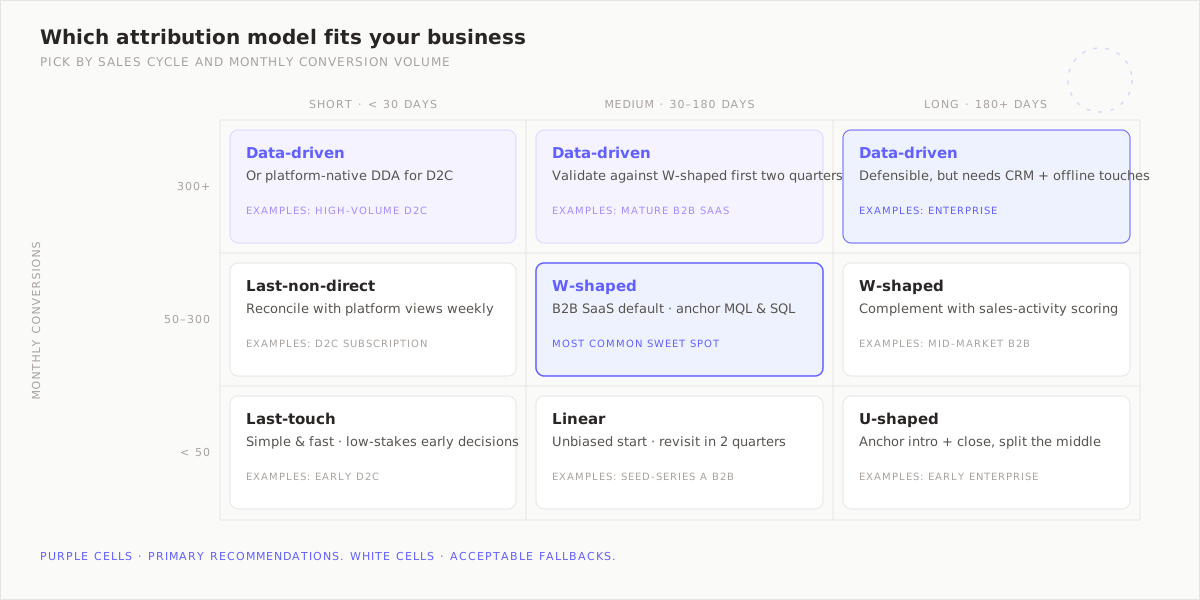
Match the model to two variables: sales cycle length (how many touches fit in a typical journey) and conversion volume (whether you have enough data to train an algorithm).
- D2C e-commerce, sub-30-day cycle. Last-non-direct. Complement with a platform-level view (Meta + Google) and reconcile weekly.
- B2B, 30–90-day cycle, under $5M ARR. Linear or U-shaped. Start with linear for six months, then move to U-shaped once you trust lead-creation timestamps.
- B2B SaaS, 60–180-day cycle, defined MQL/SQL funnel. W-shaped. Report both W-shaped and last-touch in your weekly review so marketing and sales see the distribution gap.
- Enterprise B2B, 180+ day cycle, 300+ conversions/month. Data-driven. Validate against a W-shaped control for the first two quarters.
- Any business with no attribution today. Linear. It is the fastest to implement, the hardest to argue with, and buys you two quarters to decide on the next step.
Quote-ready
The right attribution model is the one your marketing lead, sales lead, and CFO can look at without arguing. That is almost never the most sophisticated one.
What matters more than the model
The model is maybe 20% of the problem. The rest lives in the implementation.
- Touch definition. Does an ad impression count as a touch, or only a click? Does an email open count? Most teams find that standardising “what counts as a touch” changes the numbers more than switching models.
- Lookback window. A 30-day window hides anything that happens further back. A 180-day window captures more but drags in noise. Match the window to your median cycle length, not to the platform default.
- UTM discipline. Attribution is only as clean as your UTM taxonomy. Campaigns tagged inconsistently will collapse into “other” and quietly inflate the direct bucket.
- Offline touches. Sales calls, events, and webinars are invisible to most tools unless someone logs them in the CRM. W-shaped and DDA both collapse without opp-creation timestamps.
- Report cadence. A model that changes the reported number every week is not a model, it is noise. Lock the model quarterly.
How Fairview runs attribution across your stack
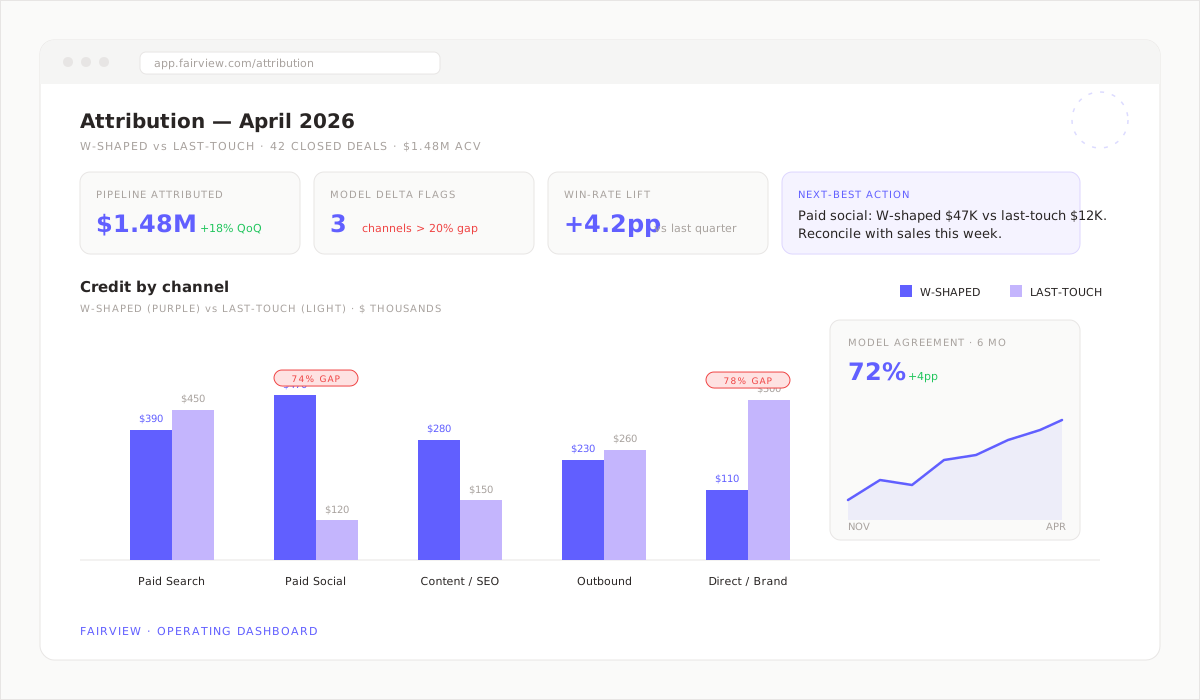
Fairview connects to HubSpot, Salesforce, Pipedrive, Stripe, QuickBooks, Xero, Shopify, Google Ads, Meta Ads, and HubSpot Marketing Hub via native OAuth. Once connected, the Operating Dashboard reconstructs the full touch journey for every closed deal using CRM activity, ad click data, and form-fill timestamps.
The Margin Intelligence layer runs two attribution models in parallel — typically W-shaped and last-touch — and shows the delta per channel. When the two disagree by more than 20%, Fairview writes a named next-best action: "Paid social receives $47K of credit under W-shaped but $12K under last-touch. Marketing is over-defending, sales is under-crediting. Reconcile weekly attribution review."
See pricing and tiers for the plan that fits your stack.
2 models
Run side-by-side, no rebuild
Daily
Refresh across channels
10
Native integrations live today
Key takeaways
- No attribution model is correct. Every one is a distortion with known trade-offs.
- Single-touch for short cycles. Multi-touch for anything over 60 days.
- W-shaped is the B2B default. Last-non-direct is the D2C default.
- Data-driven needs 300+ monthly conversions to be stable.
- Touch definitions, lookback windows, and UTM discipline matter more than the model choice itself.
Run two attribution models on the same pipeline.
Connect HubSpot or Salesforce, the ad platforms, and Stripe or Shopify. Fairview returns your first reconciled attribution view on day one. 14-day trial, no card required.
Frequently asked questions
A revenue attribution model is a rule for distributing credit for a closed deal across the marketing and sales touches that produced it. Different models weight the first touch, last touch, or all touches in between differently. The choice determines which channels look efficient and which look wasteful, so it directly shapes next quarter's budget.
No model is strictly accurate. Data-driven attribution is the most statistically defensible when you have 300 or more conversions per month. For smaller pipelines, W-shaped attribution for multi-stage B2B and last-non-direct for short-cycle D2C are the most honest defaults. Accuracy matters less than consistency — a stable rule-based model used the same way every month beats a sophisticated model that swings week to week.
First-touch credits the channel that brought the prospect in. Last-touch credits the channel that closed them. First-touch favors top-of-funnel sources like content and paid brand, and under-credits the sales plays and remarketing that finish the deal. Last-touch does the opposite. Reporting both side-by-side is the fastest way to see which channels are demand-creators versus demand-capturers.
Multi-touch. B2B sales cycles average six to nine months and involve five to ten touches across multiple stakeholders. A single-touch model will systematically over-credit whichever channel happens to sit at the close and starve the top-of-funnel budget that fed the pipeline two quarters earlier. W-shaped is the cleanest starting point for B2B SaaS.
Match the model to your sales cycle length and data volume. Short cycles under 30 days can tolerate last-non-direct. Cycles over 60 days need multi-touch. Teams with 300 or more monthly conversions can run data-driven. Smaller teams should run W-shaped or linear and revisit quarterly rather than chasing a model their data can't support.
Because they typically use different models. Marketing reports first-touch or multi-touch to defend top-of-funnel spend; sales reports last-touch to credit the closer. Both numbers are technically right under their own model. The fix is a single, shared model agreed at the leadership level, with the disagreements surfaced as a delta rather than argued about in the weekly review.