.svg)
TL;DR
- Marketing channel ROI = (contribution margin from the channel − fully loaded channel cost) ÷ fully loaded channel cost.
- Use contribution margin, not revenue. Revenue-based ROI is the same mistake as calling ROAS profitability.
- Fully loaded cost includes ad spend plus salaries, tooling, creative, and agency fees — often 40 to 80% on top of platform spend.
- Attribution is never clean. Reconcile platform last-click with post-purchase survey and directional media mix modeling.
- Fairview calculates channel ROI weekly once your ad platforms, CRM, and finance data are connected.
Most marketing channel ROI calculations lie by roughly 50%. They use revenue instead of contribution margin, platform-reported spend instead of fully loaded cost, and in-platform attribution instead of reconciled truth. The number looks great until the board asks why cash is still shrinking.
A correctly calculated marketing channel ROI tells the operator exactly two things: which channel to pour more money into next quarter, and which channel to cut before it drags the whole P&L down another two margin points.
This spoke gives you the formula that survives a finance review, the four cost categories that almost always get missed, a worked example across four channels, and the weekly rhythm that turns ROI from a slide-deck number into an operating decision. Read it alongside contribution margin by channel, true ROAS, and CAC payback period.
What is marketing channel ROI?
Definition
Marketing channel ROI: the contribution margin generated by a channel minus the fully loaded cost of running that channel, divided by the fully loaded cost. Expressed as a percentage. It answers the question "for every dollar we spent on this channel, how many cents came back as actual profit?"
ROI is the right denominator for budget decisions. ROAS answers a simpler question (revenue per ad dollar) and ignores every cost that happens between the click and the deposit in the bank account. Operators who confuse the two end up scaling a 4.5x ROAS Meta account that is returning −12% on contribution.
Every dollar of marketing cost has an opportunity cost. A channel that clears 80% ROI is fine; a channel that clears 240% means the same dollar was almost worth three times as much somewhere else. The point of measuring per channel is to allocate toward the best marginal dollar, not the best average dollar.
The marketing channel ROI formula
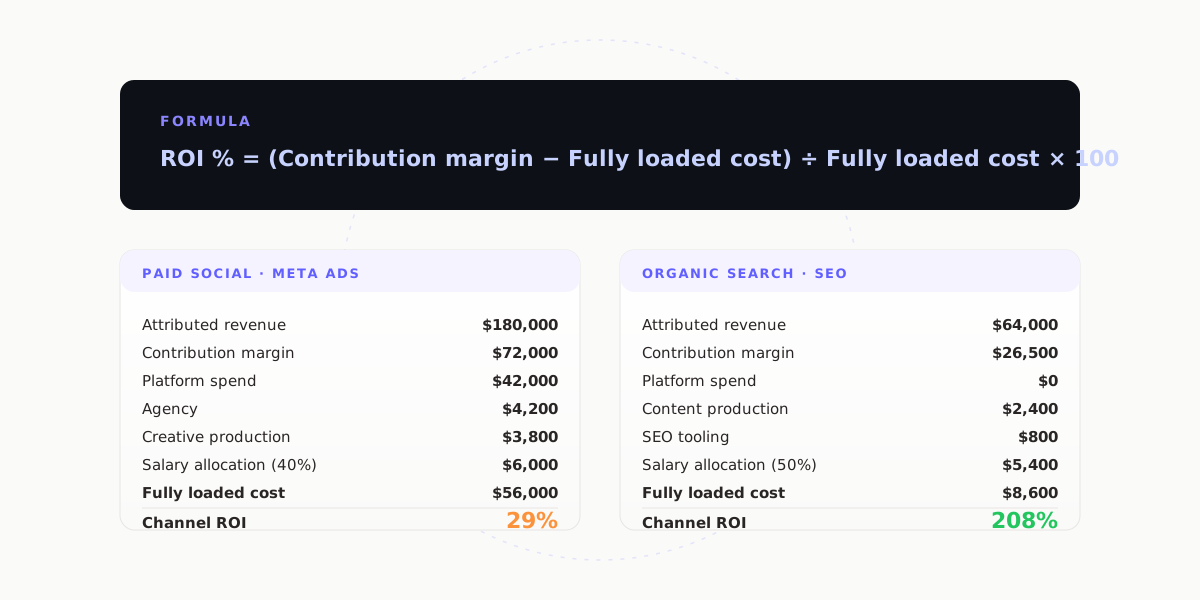
Formula:
Paid social worked example. Meta Ads drove $180,000 of attributed revenue last quarter. Contribution margin on that revenue (after COGS, shipping, fees, variable support): $72,000. Platform spend: $42,000. Agency management: $4,200. Creative production: $3,800. One growth marketer allocated 40% to Meta = $6,000. Total channel cost: $56,000. ROI = ($72,000 − $56,000) ÷ $56,000 = 29%. Survivable; not great.
Organic search worked example. SEO drove $64,000 attributed revenue. Contribution margin: $26,500. Content production + tools: $3,200. One writer allocated 50% = $5,400. Total cost: $8,600. ROI = ($26,500 − $8,600) ÷ $8,600 = 208%. Healthy.
Key insight
If you change only one thing, change the numerator. Swapping revenue for contribution margin cuts most channel ROIs in half — and exposes every channel that was quietly unprofitable.
The four costs that almost always get missed
Fully loaded channel cost is where most operators quietly inflate ROI. Platform spend is visible in the dashboard; the rest sits in payroll, SaaS bills, and agency invoices. Four categories to add explicitly:
- Salary allocation. If a growth marketer spends 40% of their time on Meta and 60% on lifecycle, 40% of their fully loaded salary belongs in the Meta line. Typical gap: 20 to 50% of true channel cost.
- Creative and production. Paid channels are creative-hungry. A single UGC batch can cost $4,000 to $12,000 and serves one channel for 30 to 60 days. Capitalize it across the period it runs.
- Agency and contractor fees. Even retainer-free agencies bill by percent-of-spend. Add them to the channel, not to a generic "marketing overhead" bucket.
- Tooling allocated to the channel. Motion design, ad preview, attribution, SEO crawlers. A channel that needs its own tools should absorb the proportional cost.
Channel ROI benchmarks
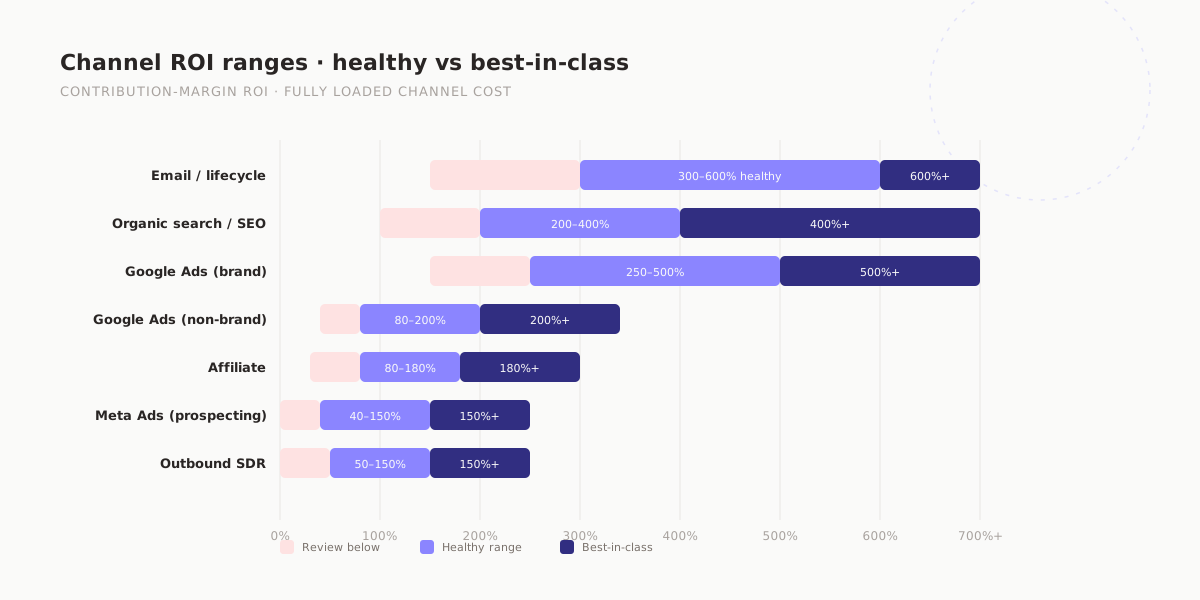
| Channel | Healthy ROI | Best-in-class | Review below |
|---|---|---|---|
| Organic search / SEO | 200–400% | > 400% | < 100% |
| Email / lifecycle | 300–600% | > 600% | < 150% |
| Google Ads (brand) | 250–500% | > 500% | < 150% |
| Google Ads (non-brand) | 80–200% | > 200% | < 40% |
| Meta Ads (prospecting) | 40–150% | > 150% | < 0% |
| Affiliate | 80–180% | > 180% | < 30% |
| Outbound SDR | 50–150% | > 150% | < 0% |
Paid channels run at lower ROI because the cost stack is heavier — platform spend, creative, and attribution layers all absorb margin. Organic and email look better per-dollar but carry hard capacity limits. The operating question is not which channel has the highest ROI; it is which channel can absorb the next $50,000 without the ROI collapsing.
Attribution: pick a method, then triangulate
Every attribution model is wrong about something. Last-click undercounts upper-funnel; first-click ignores conversion. Multi-touch weighted by a fixed curve invents precision that does not exist. The honest approach is to pick one primary model, accept its bias, and triangulate with two imperfect checks.
- Primary: platform last-click inside each platform's own reporting. Imperfect but consistent.
- Check 1: post-purchase survey with "how did you hear about us?" — catches dark social and word of mouth that no platform reports.
- Check 2: directional media mix modeling (MMM). Even a simple weekly regression on spend vs new customers reveals which channels have lift that platform reporting missed.
When platform ROI, survey ROI, and MMM ROI disagree, the truth is usually near the average. When they agree, the channel is behaving honestly.
A weekly rhythm for channel ROI
ROI that sits in a monthly deck gets spent before anyone notices the drift. The channels that move fastest need the fastest feedback loop.
Cadence
- Weekly: paid channels (Meta, Google non-brand). Contribution-margin ROI per campaign.
- Monthly: organic, content, email, affiliate. Slower to move, monthly is enough.
- Quarterly: cohort-based channel ROI, full MMM refresh, salary reallocation audit.
Quote-ready
The purpose of channel ROI is not to grade last month. It is to tell you where to put next month's first marginal dollar.
How Fairview calculates channel ROI automatically
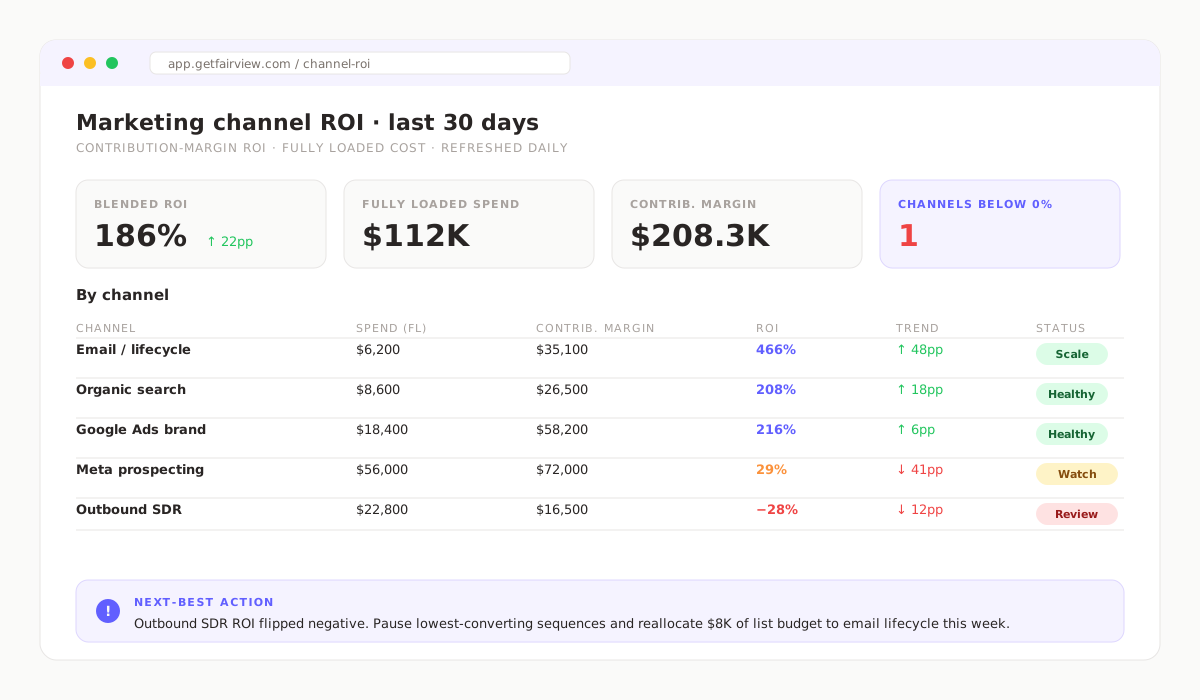
Fairview connects to Google Ads, Meta Ads, HubSpot, Salesforce, Pipedrive, Stripe, Shopify, QuickBooks, and Xero via native OAuth. Once connected, the operating view pulls platform spend, calculates contribution margin on attributed revenue, adds allocated salaries and tooling costs, and publishes a per-channel ROI every day.
When a channel's ROI drops below your threshold, Fairview writes a named next-best action: "Meta Prospecting ROI dropped from 78% to 12% over the last 14 days. Creative fatigue on top 3 ads, contribution margin per order down $4. Pause lowest-ROAS ad sets and test two new creative variants."
See pricing and tiers for the plan that fits your ad spend and integration needs.
Per channel
ROI with fully loaded cost
Daily
Refresh across ad platforms
10
Native integrations live today
Key takeaways
- Channel ROI = (contribution margin − fully loaded channel cost) ÷ fully loaded channel cost.
- Never use revenue in the numerator. That is ROAS, not ROI.
- Fully loaded cost includes salaries, tooling, creative, and agency — platform spend is usually 60 to 75% of it.
- Attribution is always wrong at the edges. Triangulate platform, survey, and MMM.
- Review paid channels weekly. Organic and email monthly. Everything quarterly by cohort.
See contribution-margin ROI per channel.
Connect Google Ads, Meta, Stripe or Shopify, and your CRM. Fairview returns your first per-channel ROI breakdown on day one. 14-day trial, no card required.
Frequently asked questions
Take the contribution margin generated by the channel, subtract the fully loaded channel cost, divide by that same cost, and multiply by 100 for a percentage. Contribution margin means revenue minus COGS, shipping, fees, and variable support. Fully loaded cost includes ad spend plus salaries, tooling, creative, and agency fees allocated to that channel.
The floor is roughly 100% — a two-to-one return on fully loaded cost — otherwise the channel is not clearing the opportunity cost of capital. Healthy ranges depend on channel type: organic search and email often clear 200 to 600%; paid social prospecting usually sits at 40 to 150%. A channel below 0% on contribution margin is losing money on every dollar spent.
No. ROAS divides attributed revenue by ad spend and ignores COGS, fulfillment, payment fees, and any cost that is not a platform bill. ROI subtracts all those costs first, then divides contribution margin by fully loaded channel cost. A 4x ROAS can easily be a negative ROI after COGS and fully loaded cost land.
Pick one primary model and triangulate. Platform last-click is the most operationally consistent. Reconcile against post-purchase survey data to catch word of mouth and dark social, and run a directional media mix model weekly to spot lift that platform reporting missed. No single attribution model is correct; three imperfect ones together are usually close enough to act on.
Paid channels weekly, organic and email monthly, cohort-based views quarterly. Paid channels move fast enough that a two-week feedback lag can burn $30,000 on a creative fatigue problem. Organic and email shift slowly and do not need the same cadence. A quarterly cohort view catches drift that weekly and monthly views miss.
Platform spend is the visible piece. Add salaries for anyone spending meaningful time on the channel, creative production (UGC, design, video), agency or contractor fees, channel-specific tooling, and any attribution or analytics subscriptions the channel needs to operate. Excluding any of these inflates ROI and corrupts the comparison between channels.