.svg)

TL;DR
- Revenue operations (RevOps) aligns marketing, sales, and customer success under one process, data, technology, and analytics layer.
- Four pillars: Process, Data, Technology, Analytics. A RevOps function is weak if any pillar is missing.
- Most B2B companies benefit from a dedicated RevOps owner between $5M–$15M ARR or ~20 go-to-market headcount.
- Core metrics: pipeline coverage, win rate, sales cycle, CAC payback, NRR, forecast accuracy.
- Fairview gives RevOps teams one connected operating view across CRM, billing, and ads without a data team.
Revenue operations is the function that treats the revenue engine as one system instead of three departments arguing over the same spreadsheet. It is less about tools, more about giving marketing, sales, and customer success a single version of the truth so the company can grow predictably.
Most B2B operators have lived through the alternative. Marketing celebrates a record quarter of leads. Sales says those leads were unqualified. Customer success says half of last quarter's wins are already at risk. Finance cannot reconcile any of it with the GL. The revenue number on the board deck turns out to be optimistic by 18%. A mature RevOps function is how that stops happening.
This pillar covers the full picture: what RevOps is, why it emerged, the four pillars, team structure, the maturity model, the metrics that matter, and how to start. It links to supporting posts on CAC payback, contribution margin by channel, true ROAS, and profit leak detection.
What is revenue operations?
Definition
Revenue operations (RevOps): the function that aligns marketing, sales, and customer success under a single process, data, technology, and analytics layer so the full revenue engine operates as one system. Its mandate is predictable, efficient, and scalable revenue growth across the lead-to-cash lifecycle.
The simplest framing: RevOps is the air traffic control tower for revenue. It does not fly the planes. It makes sure the planes do not collide, land at the right gate, and share one weather report. Marketing launches campaigns, sales closes deals, customer success expands accounts — RevOps makes sure those three teams read from one rulebook.
The category emerged because the old split was broken. SalesOps supported reps, MarketingOps supported campaigns, and CustomerOps (if it existed) supported renewals. Each sub-function optimized its own metric, and the handoffs between them leaked. RevOps collapses the silos into one function that owns the entire journey.
The four pillars of RevOps
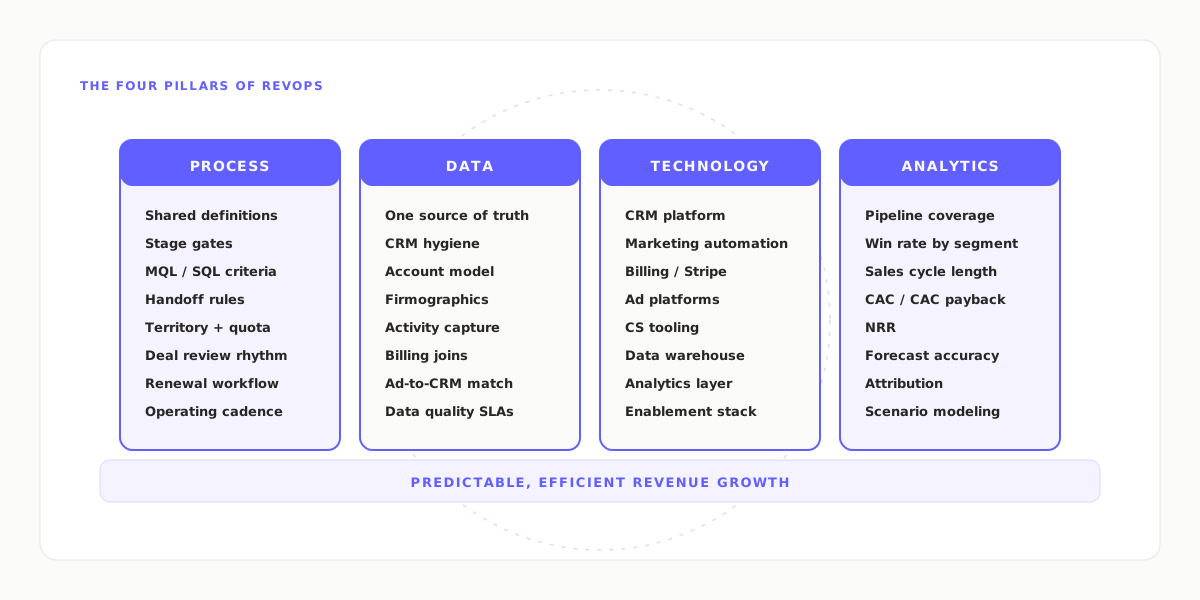
Every strong RevOps function covers four things. Miss any one and the other three start compensating until something breaks.
1. Process
Shared definitions and standardized workflows across the revenue cycle. What qualifies as a marketing-qualified lead. When a lead becomes an opportunity. What counts as Stage 3. Who owns handoff from sales to onboarding. Process is unglamorous and the most common place RevOps initiatives fail when skipped.
2. Data
One source of truth for pipeline and revenue. A single account record that marketing, sales, and CS can all trust. Clean firmographics, clean activity data, clean billing joins. Most RevOps teams spend their first 12 months fixing data before they can do anything else useful.
3. Technology
The connected tech stack: CRM (HubSpot, Salesforce, Pipedrive), marketing automation, billing (Stripe, Chargebee), customer success tooling, and an analytics layer that unifies them. Tooling should reflect the process, not the other way around.
4. Analytics
Metrics, forecasting, and insights that drive decisions. Pipeline coverage, win rate, CAC, NRR, forecast accuracy. Analytics is the pillar that converts the other three into revenue outcomes — without it, process and data just document what already happened.
Key insight
A RevOps team that can not trust its own data will eventually be asked to produce a forecast it can not defend. Data quality is the hidden floor under every other pillar.
Why RevOps matters now
Two shifts made this function non-optional. First, B2B buying is harder. The average SaaS buying group is 6–10 people (Gartner, 2023), the cycle has lengthened, and buyers spend the majority of the journey invisible to vendors. You cannot guess your way through that with siloed tooling. Second, investor scrutiny has moved from growth-at-all-costs to efficient growth — CAC payback, NRR, and gross retention are now the stories that raise a round.
Companies with mature RevOps functions see ~10–20% higher sales productivity and 100–200 basis points of forecast accuracy lift over peers (Boston Consulting Group, 2020). The number you care about is simpler: a board that can believe the pipeline number and an ops team that can explain every variance.
RevOps team structure
| Stage | Typical ARR | RevOps shape |
|---|---|---|
| Pre-scale | < $5M | Founder + fractional or first Ops hire |
| Scale | $5–$15M | First full-time RevOps leader + analyst |
| Growth | $15–$50M | RevOps team of 3–6: leader, analytics, systems, enablement |
| Scale-up | $50M+ | VP RevOps with function leads by pillar |
Before $5M ARR, a founder or a strong Head of Operations can cover RevOps with help from a fractional specialist. Between $5M and $15M ARR is the most common hiring moment — the go-to-market team crosses 20 people and ad-hoc spreadsheets stop scaling. Beyond $50M, RevOps usually splits into specialized pillars reporting to a VP.
Where RevOps reports
Three structures dominate. RevOps reporting to the CRO is the most common and keeps the function close to pipeline. RevOps reporting to the COO is stronger for companies with a heavy operations culture and cross-functional charter. RevOps reporting to the CFO is rare but works when forecast accuracy and board reporting dominate the agenda. There is no single right answer; the worst setup is unclear ownership.
The RevOps maturity model
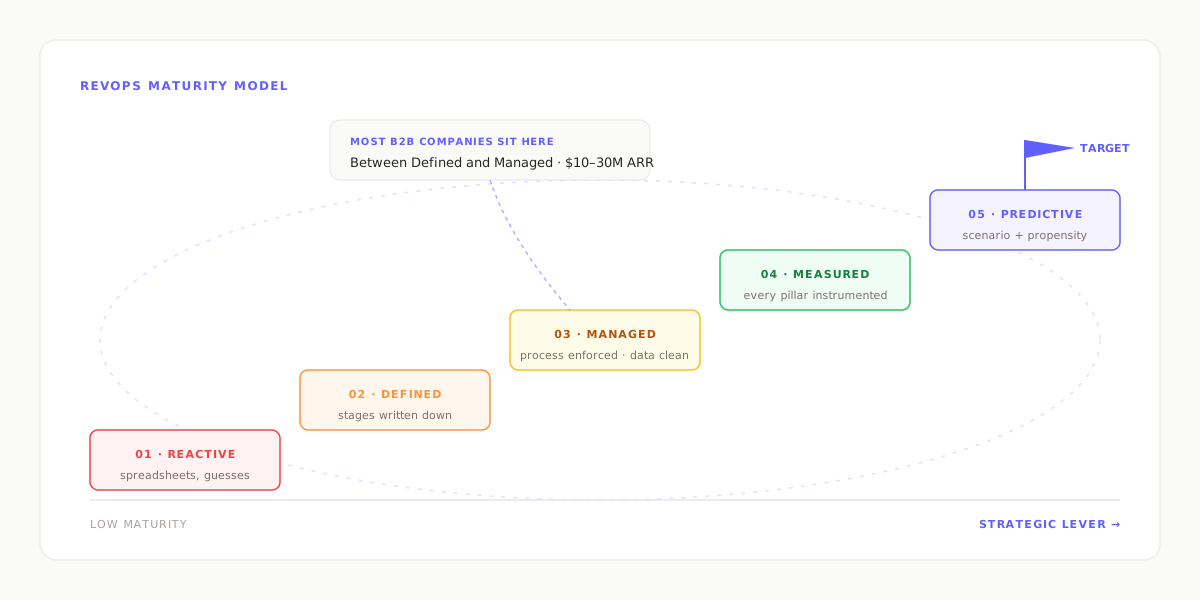
The clearest way to benchmark a RevOps function is against a maturity model. Adapted from the CMMI framework, the five stages are:
- Reactive. No shared definitions. Pipeline reviewed from spreadsheets. Forecast is a guess.
- Defined. Stage definitions and MQL/SQL criteria written down. CRM hygiene acceptable. Forecast accuracy starts to firm up.
- Managed. Process is enforced. Data is clean across CRM, billing, and ad platforms. One source of truth exists.
- Measured. Every pillar has instrumented metrics. Forecast accuracy tracked by segment. Anomalies surface automatically.
- Predictive. Scenario modeling, propensity scoring, and lead-to-cash optimization continuously. RevOps is a strategic lever, not a reporting function.
Be honest about where you sit. Most $10–$30M ARR B2B companies hover at Defined or Managed; Measured is where the investment in RevOps starts paying back in forecast credibility and sales productivity.
Metrics every RevOps team owns
Quote-ready
If a metric cannot be traced back to a single source of truth, it is an opinion, not a KPI.
- Pipeline coverage. Open pipeline value divided by target. 3x is the common rule of thumb; the correct number depends on historical win rate.
- Win rate. Deals won divided by deals closed. Track by segment, source, and stage-entered.
- Sales cycle length. Median days from opportunity creation to close. Watch both the median and the long tail.
- CAC and CAC payback. What each customer costs and how fast contribution margin recovers it. See the CAC payback post for the formula.
- Net revenue retention (NRR). Revenue from existing customers this period versus the same cohort a year ago, including expansion and churn. 110%+ is strong for SMB SaaS; 120%+ for enterprise.
- Forecast accuracy. Predicted closed-won versus actual closed-won. Target +/- 5% at the segment level.
- Lead-to-opportunity conversion. Volume signal for marketing quality and SDR effectiveness.
How to start RevOps in 90 days
The first 90 days of any RevOps function should build foundation, not ship dashboards. A working order that has held up across companies:
- Days 1–30: audit. Document existing stages, definitions, data flows, and tools. Interview the leaders of marketing, sales, and CS. Pull the last 4 quarters of forecast versus actual. Write up the top 10 process and data gaps.
- Days 31–60: align. Land shared definitions (MQL, SQL, opportunity, stage gates, handoff criteria). Put them in writing. Get leadership sign-off. This is a political exercise as much as an ops one.
- Days 61–90: instrument. Connect the CRM, billing, marketing automation, and ad platforms to one analytics layer. Stand up a weekly operating review with the same five metrics every time.
- Day 90+: iterate. Now you have a foundation. Every quarter, pick the weakest pillar and strengthen it.
How Fairview powers RevOps analytics
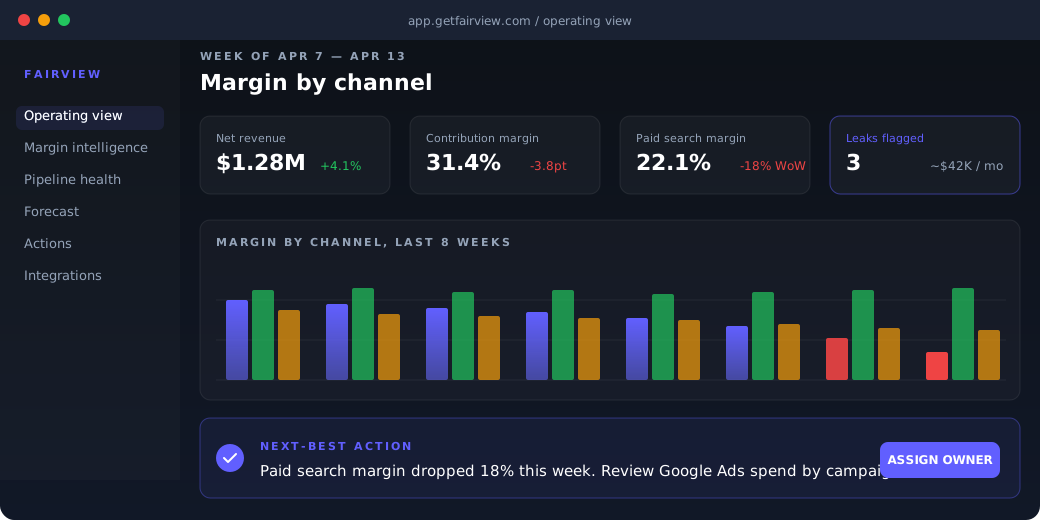
The Analytics pillar is where most RevOps teams stall. Building one reliable source of truth across HubSpot or Salesforce, Stripe, QuickBooks or Xero, and the ad platforms usually requires a data team a scale-stage company does not have. Fairview is the alternative path.
Fairview connects natively to HubSpot, Salesforce, Pipedrive, Stripe, Shopify, QuickBooks, Xero, Google Ads, Meta Ads, and HubSpot Marketing Hub. Once connected, the operating view reconstructs pipeline, margin, forecast, and CAC metrics without SQL. The Forecast Confidence Engine flags where the commit is optimistic; the Margin Intelligence view reconciles pipeline with contribution margin weekly.
See pricing for the plan that fits your revenue stack.
10
Native integrations live today
No SQL
One operating view, no data team
Weekly
Operating report, auto-generated
Key takeaways
- RevOps aligns marketing, sales, and CS under one process, data, tech, and analytics layer.
- The four pillars are non-negotiable. A missing pillar shows up as a broken forecast.
- Hire a dedicated RevOps owner between $5M and $15M ARR, or ~20 go-to-market headcount.
- Benchmark with a 5-stage maturity model. Most B2B companies live between Defined and Managed.
- Forecast accuracy and pipeline coverage are the two metrics no RevOps function gets to skip.
Give your RevOps team one operating view.
Connect your CRM, billing, and ad platforms. Fairview returns pipeline health, margin, and forecast confidence in a single view. 14-day trial, no card required.
Frequently asked questions
Revenue operations (RevOps) is the function that aligns marketing, sales, and customer success under a single process, data, and technology layer so the full revenue engine operates as one system rather than three siloed teams. Its mandate is predictable, efficient, and scalable revenue growth across the lead-to-cash lifecycle.
Process (shared definitions, stages, and handoffs), Data (one source of truth for pipeline and revenue), Technology (a connected CRM, marketing automation, billing, and analytics stack), and Analytics (the metrics, forecasting, and insights that drive decisions). A function is weak if any pillar is missing.
RevOps owns lead-to-cash process design, data quality across the revenue stack, tooling decisions, forecasting, territory and quota planning, pipeline analytics, and cross-functional reporting. It operates as the connective tissue between marketing, sales, finance, and customer success.
SalesOps supports the sales team only. RevOps spans the full revenue lifecycle across marketing, sales, and customer success. In most modern B2B structures, SalesOps is a subset of RevOps rather than a parallel function.
Most B2B companies benefit from a dedicated RevOps leader between $5M and $15M ARR, or when the go-to-market team crosses 20 to 30 people. Before that, a fractional RevOps owner or an operations-minded founder can cover the function without a full-time hire.
Pipeline coverage, win rate, sales cycle length, CAC, CAC payback, LTV:CAC, net revenue retention, forecast accuracy, and lead-to-opportunity conversion. The exact list varies by stage and business model, but forecast accuracy and pipeline coverage are universal across every RevOps function.