.svg)
TL;DR
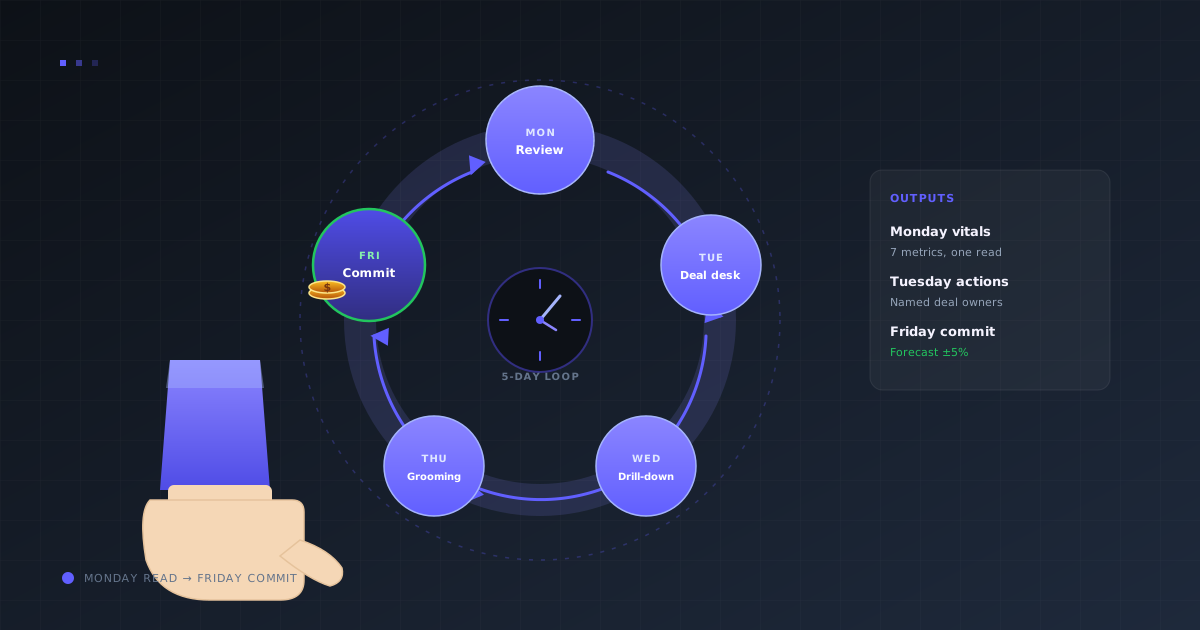
- A weekly revenue cadence is a five-day rhythm: Monday review, Tuesday deal desk, Wednesday stage drill-down, Thursday pipeline grooming, Friday commit call.
- Total time cost is under three hours a week. Most teams already spend more rebuilding a month-end report from scratch.
- Each meeting has one named output and one accountable owner — not a status update, a decision.
- Teams that run the weekly rhythm typically lift forecast accuracy from 60–70% to 90%+ within 90 days.
- The cadence only works if the data is clean by Monday 9am. That is why the operating intelligence layer (not the CRM) owns the kickoff.
A weekly revenue cadence is the five-meeting rhythm that turns a monthly-reactive revenue org into a weekly-prescriptive one. Monday reads the vitals. Friday commits the number. The three days in between are where behavior actually changes.
Most teams try to build this on calendar invites alone. It falls apart inside six weeks because the data is never ready on Monday morning, the agendas drift, and the Friday commit becomes a recycled version of last Friday’s. The cadence looks lightweight — five meetings, three hours — but holding it requires one thing most teams underinvest in: a clean, unified operating view that loads at 9am Monday without a human rebuilding it.
This guide covers the five meetings, their owners, durations, outputs, the data each one needs, and the forecast-accuracy curve you can expect. Pair it with pipeline health metrics for the numbers the Monday review reads.
What is a weekly revenue cadence?
Definition
Weekly revenue cadence: a five-day operating rhythm in which a RevOps team runs a Monday revenue review, a Tuesday deal desk, a Wednesday stage drill-down, a Thursday pipeline grooming session, and a Friday commit call. Each meeting has a fixed owner, duration, and named output.
The defining feature is not which meetings happen. It is the decision-per-meeting rule: every session ends with a named owner and a named action. A review without a decision is a status update, and status updates do not move the forecast.
Top-quartile public SaaS companies tracked in the Scale Venture Partners SaaS benchmark hit forecast accuracy inside ±5% on a two-week horizon. That accuracy is downstream of a tight weekly cadence, not an AI forecasting model.
The five-day rhythm, meeting by meeting
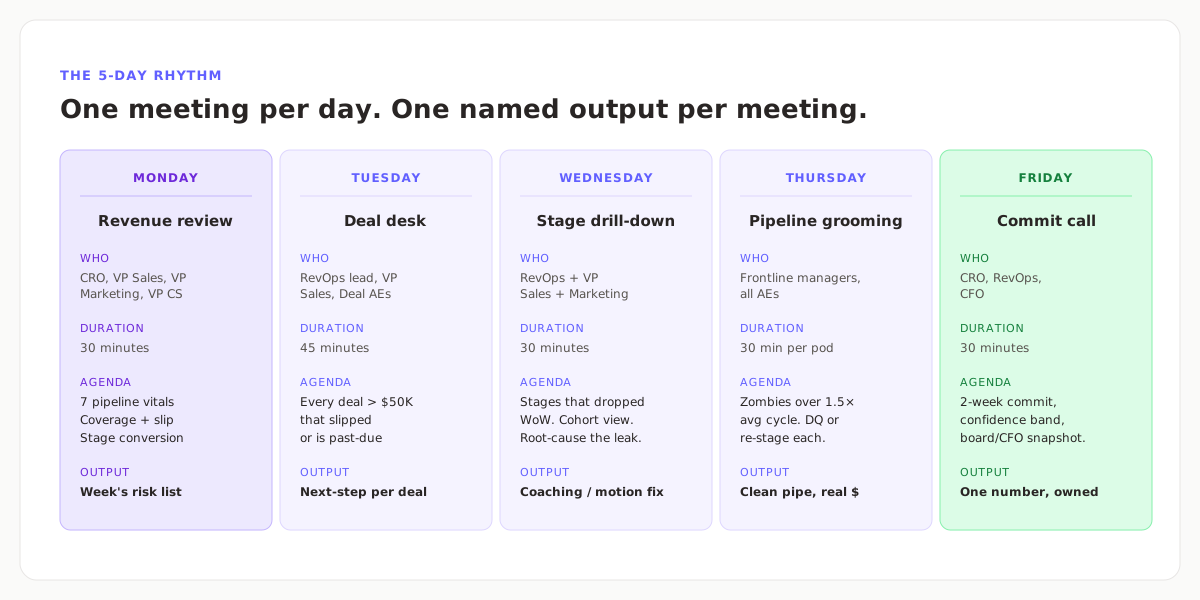
Monday 9:00 — Revenue review (30 min)
Who: CRO, VP Sales, VP Marketing, VP CS, RevOps lead. Input: the seven pipeline health metrics in one dashboard. Output: the week’s risk list — three to five specific issues that need decisions by Friday.
The hardest part is not the meeting. It is having clean numbers by 9am. If Monday starts with “let me pull the latest export,” the cadence is already broken. Data readiness on Monday morning is the single biggest predictor of whether the rhythm survives a quarter.
Tuesday 10:30 — Deal desk (45 min)
Who: RevOps lead, VP Sales, AEs whose deals are under review. Input: every deal above a dollar threshold that slipped last week or is past due. Output: a named next step per deal, owner, and a two-week commit-or-kill call.
Rule: no status updates. “Customer is thinking about it” is not a next step. “Procurement review scheduled Thursday with X, MSA sent by Tuesday” is. Deal desk is where AE coaching happens in real time rather than at month-end QBRs.
Wednesday 14:00 — Stage drill-down (30 min)
Who: RevOps, VP Sales, VP Marketing. Input: any stage-conversion rate that dropped week-over-week. Output: a hypothesis (pricing pushback, missing economic buyer, legal friction) and an owner for fixing it.
This is the root-cause meeting. A drop from 55% to 42% at Proposal is rarely a coaching problem — it is usually a motion problem, a pricing problem, or a qualification problem. The drill-down is what tells the difference.
Thursday 11:00 — Pipeline grooming (30 min per pod)
Who: Frontline managers with their AEs, by pod. Input: every deal open longer than 1.5× the average cycle. Output: each zombie is either disqualified, re-staged, or given a concrete two-week plan.
Without Thursday, coverage numbers inflate quietly over a quarter as stuck deals accumulate. HBR research on sales enablement shows the best teams archive stalled deals aggressively rather than letting them sit.
Friday 16:00 — Commit call (30 min)
Who: CRO, RevOps lead, CFO. Input: the week’s movement, forecast-accuracy band, what changed in the risk list. Output: a two-week-out commit number, a confidence band, and a board/CFO-ready snapshot.
This is where forecast accuracy gets earned. By Friday, the Monday risk list has been worked, the deals have clarity, and the commit reflects reality rather than optimism.
Monthly cadence vs weekly cadence
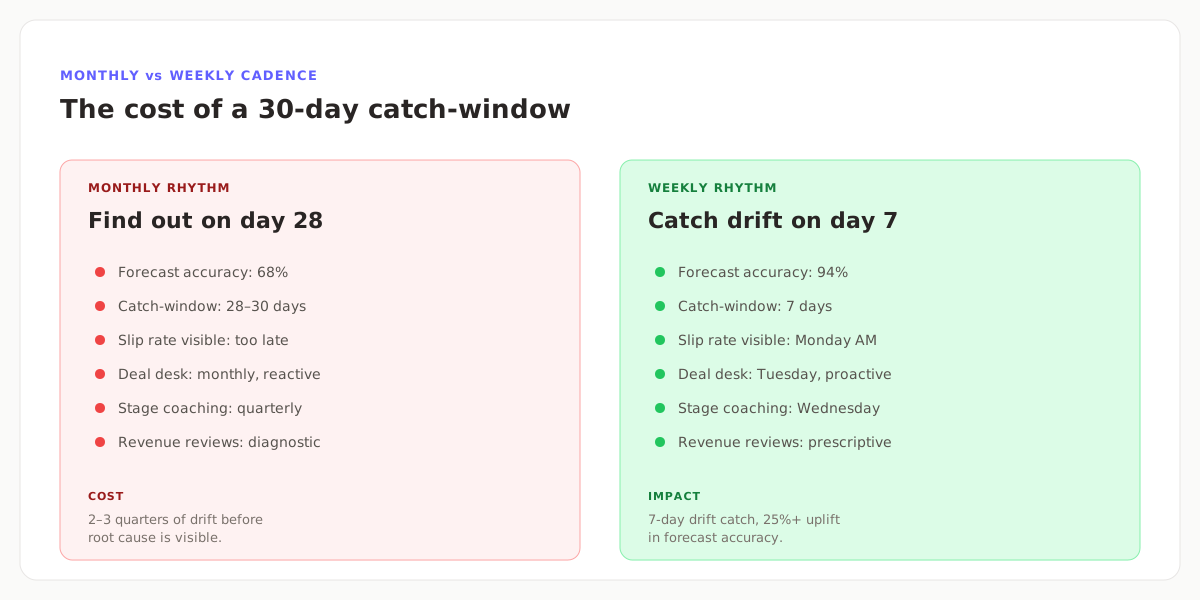
The quiet cost of monthly-only cadence is invisible to most CROs until the second quarter miss. When a slip rate crossed 20% in week two, month-end reviews still booked the forecast as on track. Four weeks later, the deals were gone — and so was the credibility of the forecast.
Teams that move from monthly to weekly typically see forecast accuracy rise from 60–70% to 90%+ inside a quarter. The mechanism is not magic: weekly deal desks force reps to commit or kill deals every seven days, which tightens stage hygiene, which cleans the forecast inputs.
Key insight
The weekly cadence does not forecast better — it forces cleaner inputs to the forecast every seven days. The accuracy is downstream.
How to roll out the cadence in 30 days
- Week 1 — name the owner. The RevOps lead owns cadence design. The CRO owns Monday and Friday attendance. If either is absent, the cadence does not survive month one.
- Week 1 — lock the data pipeline. Pick the operating intelligence view that loads by 8:45am Monday. If data takes three hours to pull, the 9am meeting cannot start on time, and the rhythm breaks.
- Week 2 — run Monday and Friday only. Start with the two anchors. Hold the rhythm for two weeks before adding Tuesday and Wednesday.
- Week 3 — add Tuesday deal desk and Thursday grooming. Managers lead these by pod. Keep them under 45 minutes.
- Week 4 — add Wednesday drill-down. Only when the other four are stable. Run monthly at first; move to weekly once stage-conversion data is clean enough to drill on.
Five reasons weekly cadences fall apart
- Data is not ready by 9am Monday. The most common failure. If Monday starts with “let me refresh,” the meeting turns into a status update.
- Meetings do not end with named owners. Decisions without names are unowned. Every output needs a human.
- The CRO attends inconsistently. When the CRO skips, everyone else does too. Block the calendar at a director level.
- Agendas drift. After six weeks the agenda becomes open discussion. Re-anchor the five named meetings each month.
- Tuesday becomes status reporting. Deal desk loses its edge when it turns into a round-robin. Ruthlessly cut any deal that does not fit a specific pattern.
How Fairview runs the Monday read automatically
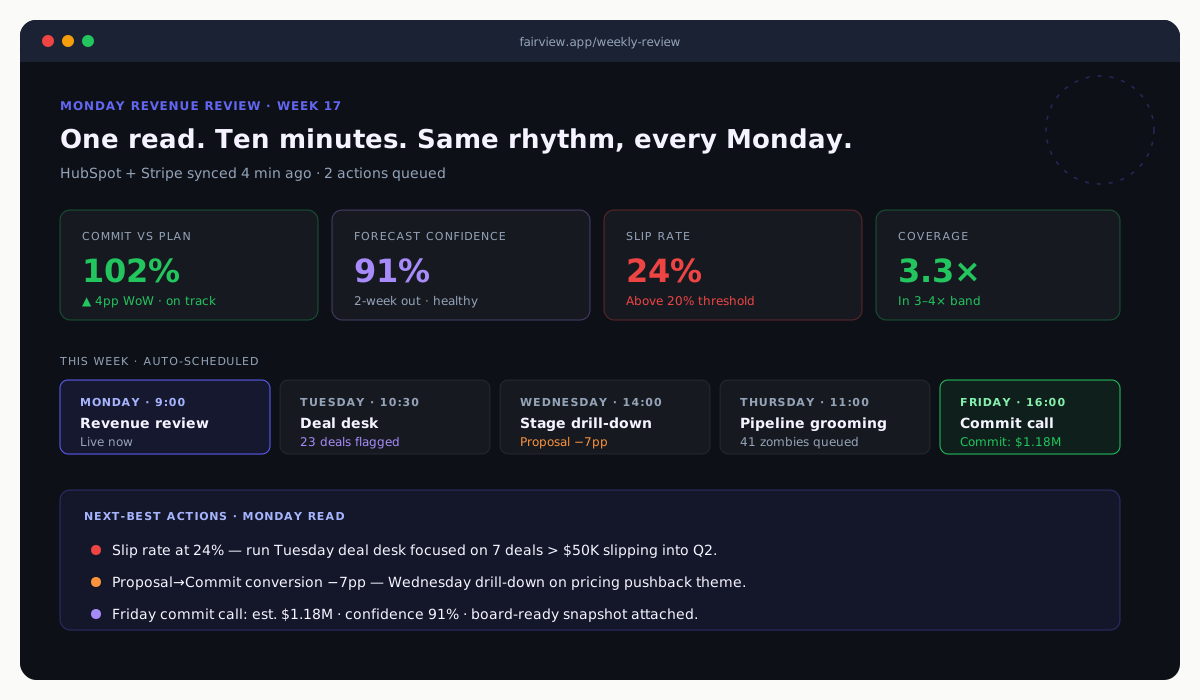
Fairview connects to HubSpot or Salesforce plus Stripe and QuickBooks, computes the seven vitals overnight, and publishes the Monday dashboard at 9am with the week’s risk list already identified. What used to take a RevOps analyst three hours every Monday is an eight-minute read.
When a vital drifts outside its healthy band, Fairview writes a named next-best action into the week’s agenda — the slipped deals for Tuesday’s desk, the stage drops for Wednesday, the zombies for Thursday. The same pattern used in the profit leak detection framework.
See pricing and tiers or the product overview for how the Monday read looks in practice.
<3 hrs
Total weekly time cost
7 days
Drift catch-window
+25pp
Typical forecast accuracy lift in 90 days
Key takeaways
- A weekly revenue cadence is five meetings, one per day, under three hours total.
- Every meeting ends with a named owner and a named action. Status updates do not count.
- Monday data readiness is the make-or-break input. No clean data by 9am, no cadence.
- Weekly rhythms catch drift in seven days; monthly rhythms catch it on day 28, two days too late.
- Forecast accuracy gains of 20–25 points inside 90 days are normal once the rhythm holds.
Start your Monday revenue review on time this week.
Connect HubSpot or Salesforce plus Stripe. Fairview publishes the Monday dashboard at 9am with the week’s risk list pre-built. 14-day trial, no card required.
Frequently asked questions
A weekly revenue cadence is a five-day operating rhythm in which a RevOps team runs a Monday revenue review, a Tuesday deal desk, a Wednesday stage drill-down, a Thursday pipeline grooming session, and a Friday commit call. Each meeting has one named output and one accountable owner.
A weekly rhythm catches pipeline drift within seven days. A monthly review catches it on day 28 — two days before month-end, when nothing can be done. Teams that run weekly typically lift forecast accuracy from 60–70% to 90%+ within a quarter because the forecast inputs get cleaned every Monday rather than every four weeks.
The RevOps lead owns the cadence itself — scheduling, agendas, and outputs. The CRO owns the Monday review and Friday commit call. Frontline managers own Tuesday deal desk and Thursday pipeline grooming. Marketing Ops and CS Ops participate in Wednesday stage drill-down. Without CRO attendance at Monday and Friday, the cadence does not survive the first month.
Thirty minutes for the Monday revenue review and Friday commit call. Forty-five minutes for Tuesday deal desk. Thirty minutes each for Wednesday stage drill-down and Thursday pipeline grooming. Total time cost is under three hours a week — less than most teams already spend rebuilding a month-end report from scratch.
A clean CRM (Salesforce or HubSpot), billing data (Stripe, QuickBooks, or Xero), and an operating intelligence layer that unifies them into one Monday-morning view. Without the operating intelligence layer, Monday becomes a three-hour spreadsheet rebuild, and the 9am meeting never starts on time. See the RevOps tech stack guide for the layer that makes cadence possible.
Most teams see forecast accuracy improve within 60 to 90 days and end-of-quarter slip rate drop within one full quarter. The biggest gain is usually in the 60 to 90 day window as reps adapt to weekly deal-desk reviews rather than month-end scrambles. A 20–25 percentage-point lift in forecast accuracy inside a quarter is normal once the rhythm holds.