.svg)
TL;DR
- Predictive lead scoring uses a supervised ML model trained on closed-won outcomes to estimate each lead’s conversion probability.
- It typically lifts lead-to-opp conversion by 25–40% over rules-based scoring once volume is high enough to train the model.
- Minimum training data: 500 closed-won and 5,000 closed-lost or unqualified records from the last 18 months.
- Feed the model three layers: firmographic, behavioral, and intent. Skipping one drops accuracy materially.
- Retrain quarterly, monitor tier-by-tier conversion as the drift signal, and hold the model to a tangible lift goal or turn it off.
Every growth-stage RevOps team I talk to goes through the same scoring arc. Start with rules — title gets 20, company size gets 15, page views get 10 — it works for a while. Somewhere between 500 and 2,000 monthly leads the rules stop paying off. Reps stop trusting the tiers, MQL-to-SQL conversion plateaus, and marketing and sales argue about whether a 78 means anything.
Predictive lead scoring is the fix, but only when the data is ready for it. This guide walks through what predictive scoring actually does under the hood, when to deploy it, the data prerequisites, a month-by-month rollout, and the metrics that tell you if the model is earning its keep. It is a companion to the Cluster 4 pillar on AI revenue operations and the MOFU piece on closed-won analysis, which provides the training data a scoring model depends on.
What is predictive lead scoring?
Definition
Predictive lead scoring: a supervised machine-learning model that takes a lead’s firmographic, behavioral, and intent signals and outputs a probability of converting to an opportunity or closed-won deal. The model is trained on historical outcomes so the weights are learned, not hand-coded.
The easiest way to see the difference is at the weight-setting step. Rules-based scoring asks a human to decide that a director-level title is worth 20 points. Predictive scoring learns from the data that director-level titles who viewed the pricing page twice and came from a partner source convert at 34% — and it encodes that interaction without anyone writing it down.
The output looks the same: a score, a tier, a row in the CRM. The mechanics underneath are different, and the operational implications matter. You govern a predictive model instead of editing rule tables.
Predictive vs rules-based scoring
| Dimension | Rules-Based | Predictive |
|---|---|---|
| Weights | Hand-coded | Learned from closed-won |
| Captures interactions | Rarely | Native |
| Works at low volume | Yes (< 500/mo) | Needs 500+ wins to train |
| Lift over baseline | Baseline | 25–40% typical |
| Main failure mode | Stale, humans forget to update | Drift, garbage-in amplification |
Rules work longer than most vendors want to admit. If your pipeline is 200 leads a month and the sales team reviews everything anyway, predictive scoring is a solution looking for a problem. Stick with rules. The switch becomes worth it around the point where reps stop reading every inbound lead.
The data a predictive model actually needs
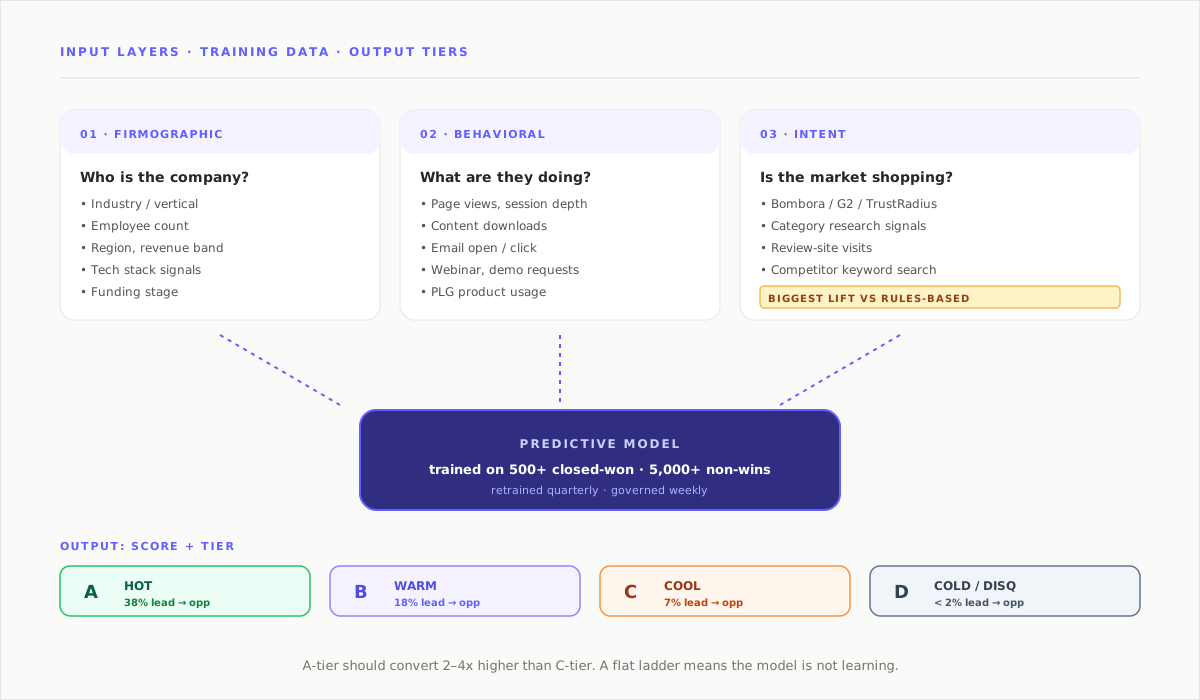
A predictive model is only as good as the signals it sees. Three layers matter, and all three are required:
- Firmographic. Industry, sub-vertical, employee count, revenue band, region, funding stage, tech stack signals. Sourced from enrichment providers (ZoomInfo, Clearbit, Apollo) or public data.
- Behavioral. Page views, content downloads, email opens and clicks, webinar attendance, and — for PLG motions — product usage signals like workspace creation, invites sent, or key-feature adoption.
- Intent. Third-party intent signals from Bombora, G2, TrustRadius; review-site visits; category research behavior. Intent is where predictive scoring materially pulls ahead of rules, because it is too noisy to score with hand-coded weights.
The closed-won training set sits on top of these three layers. The minimum viable training set: 500 closed-won deals in the last 18 months, 5,000 closed-lost or disqualified records, and 12+ months of behavioral history on both. Below that, the model overfits to noise.
Key insight
The training data is the model. A clean closed-won history with firmographic enrichment predicts better than any vendor choice.
When predictive scoring pays off (and when it does not)
Predictive scoring earns its place when three things are true:
- Inbound volume exceeds roughly 1,500 leads per month, so reps cannot manually review everything.
- At least 500 closed-won deals exist in the last 18 months, with enrichment and behavioral history attached.
- MQL-to-SQL conversion has plateaued under rules-based scoring, suggesting the rules have stopped learning.
It does not pay off when closed-won data is thin, when the sales motion is enterprise with 6–12 deals per quarter total, or when the CRM is still dirty enough that basic fields are missing from most records. Fix those first. Everything else is premature.
A practical rollout (month by month)
- Month 0 — audit. Count closed-won in the last 18 months. Check enrichment completeness on the won and lost set. If either fails the minimum, pause and fix before proceeding.
- Month 1 — train. Train the model on the closed-won/lost history plus at least two quarters of behavioral signal. Most modern tools (HubSpot Breeze, Salesforce Einstein, MadKudu) handle the math; the RevOps team curates features and labels.
- Month 2 — shadow run. Deploy the predictive score alongside the existing rules-based one. Reps see both. Track how predictive tiers would have reordered routing if they had been live.
- Month 3 — cut over in one segment. Switch routing to predictive scoring in one well-defined segment (inbound SMB is usually the safest). Keep rules-based live elsewhere. Measure lead-to-opp conversion by tier.
- Month 4–5 — expand. If the A tier converts at least 2x the C tier and MQL-to-SQL lifts 20%+, expand to the rest of the motion. If not, investigate data quality before expanding.
- Month 6+ — govern. Retrain quarterly. Monitor tier-by-tier conversion for drift. Hold the model to a tangible lift goal; if it stops beating rules-based by 15%+, retire it.
How to know the model is working
Four metrics define whether predictive lead scoring is earning its place:
- Tier ladder. A-tier should convert 2–4x higher than C-tier to opportunity. A flat ladder means the model is not learning.
- Lift over rules-based. Predictive should deliver a 25–40% lift in lead-to-opp conversion. Below 15% and the investment is not paying for itself.
- SLA discipline. Time from inbound lead to first rep touch should drop in A-tier because reps know it is worth their time immediately.
- Rep trust. An informal but real signal: ask AEs if they skip the score. If they do, the tier definitions are not trustworthy. Retrain and recalibrate.
Quote-ready
A predictive scoring model that reps route around is a rules-based model with extra steps.
The three mistakes that kill predictive scoring rollouts
- Training on dirty data. If 30% of closed-won records are missing company size or the source field, the model learns noise. Close the CRM gap before training.
- Skipping the shadow month. Switching routing to predictive scoring on day one guarantees blame when a slow week shows up. The shadow run gives you evidence the new model would have done better.
- Retraining never. Markets shift, ICP drifts, and yesterday’s winning pattern becomes today’s fading one. Quarterly retraining is the minimum; some teams retrain monthly. Never-retrained models go stale in six months.
How Fairview supports predictive lead scoring
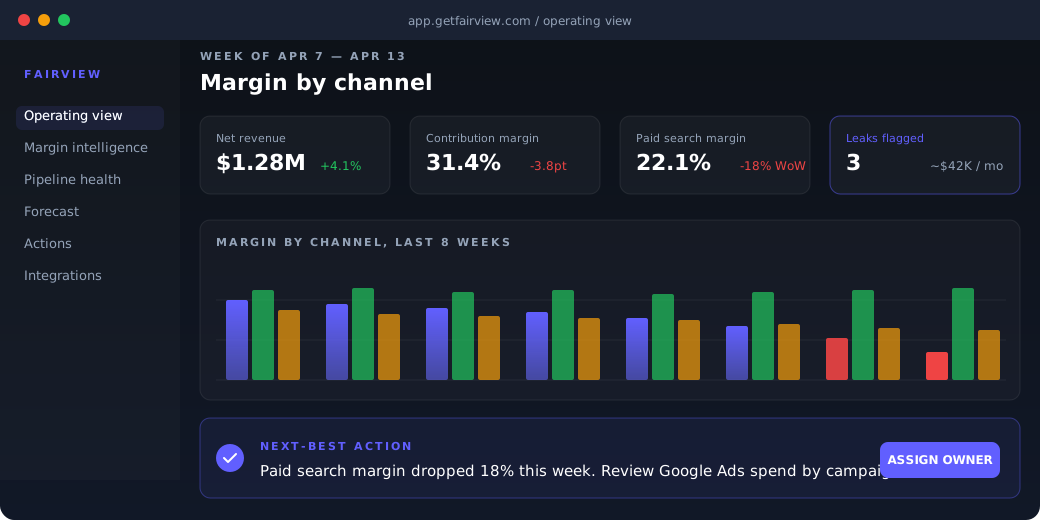
Fairview connects to HubSpot, Salesforce, Pipedrive, Stripe, QuickBooks, Xero, Shopify, Google Ads, Meta Ads, and HubSpot Marketing Hub via native OAuth. Once connected, the operating view joins closed-won history with enrichment and behavioral signals, then exposes the four scoring governance metrics: tier ladder, lift, SLA discipline, and drift over time.
When A-tier conversion drifts below target, Fairview writes a named next-best action: "A-tier lead-to-opp dropped from 28% to 19% this month. Driver: enrichment completeness fell on leads from inbound chat source. Recommendation: check enrichment provider webhook before retraining." The RevOps team fixes the data, not the model.
See pricing and tiers for the plan that fits your stack.
25–40%
Typical lift over rules-based
Quarterly
Retraining cadence
500+
Closed-won minimum to train
Key takeaways
- Predictive lead scoring learns weights from closed-won data instead of hand-coding them.
- Typical lift over rules-based scoring: 25–40%, once volume and training data are adequate.
- Three input layers required: firmographic, behavioral, intent. Training data: 500+ wins, 5,000+ non-wins.
- Rollout in shadow first. Cut over in one segment. Expand only if the tier ladder and lift hold up.
- Retrain quarterly. Govern the model against tier ladder, lift, SLA, and rep trust.
Put a governed scoring model on your pipeline.
Connect HubSpot or Salesforce, your enrichment provider, and Stripe. Fairview joins closed-won history with signals and surfaces lift over baseline on day one. 14-day trial, no card required.
Frequently asked questions
Predictive lead scoring is a supervised machine-learning model that estimates each lead’s likelihood of converting to an opportunity or closed-won deal. It is trained on historical closed-won outcomes and takes firmographic, behavioral, and intent signals as inputs. The output is usually a score 0–100 or a tier A/B/C/D that drives routing and prioritization.
Rules-based scoring assigns points manually for each signal. A director title gets 20, a pricing page view gets 10, a demo request gets 30. Predictive scoring learns those weights from closed-won outcomes and, more importantly, captures interactions between signals that humans would never hand-code. The two look similar in the CRM; the math underneath is different.
A 25 to 40 percent lift in lead-to-opportunity conversion over rules-based scoring is typical in B2B SaaS with at least 500 wins of training data. The lift comes from re-prioritization, not from creating more leads. If the lift is under 15 percent after a quarter, the model probably needs better data rather than more tuning.
A practical minimum is 500 closed-won deals in the last 18 months, plus at least 5,000 closed-lost or unqualified records so the model learns what does not convert. Below that, rules-based scoring is usually the better choice until the dataset grows. Enterprise motions with small deal counts need a different approach entirely.
Three input layers. Firmographic from an enrichment provider: industry, size, region, tech stack. Behavioral from the CRM and MAP: page views, downloads, email engagement, product usage. Intent from third-party providers: Bombora, G2, TrustRadius. Missing the intent layer costs the most accuracy because predictive models can use that signal in ways rule tables cannot.
Quarterly is the minimum. Markets shift, product-market fit evolves, and the closed-won pattern drifts. A model trained on 2024 wins is already misaligned for 2026 buying behavior. Teams running high-volume motions often retrain monthly. Never-retrained models become stale within six months and start producing flat tier ladders.