.svg)
TL;DR
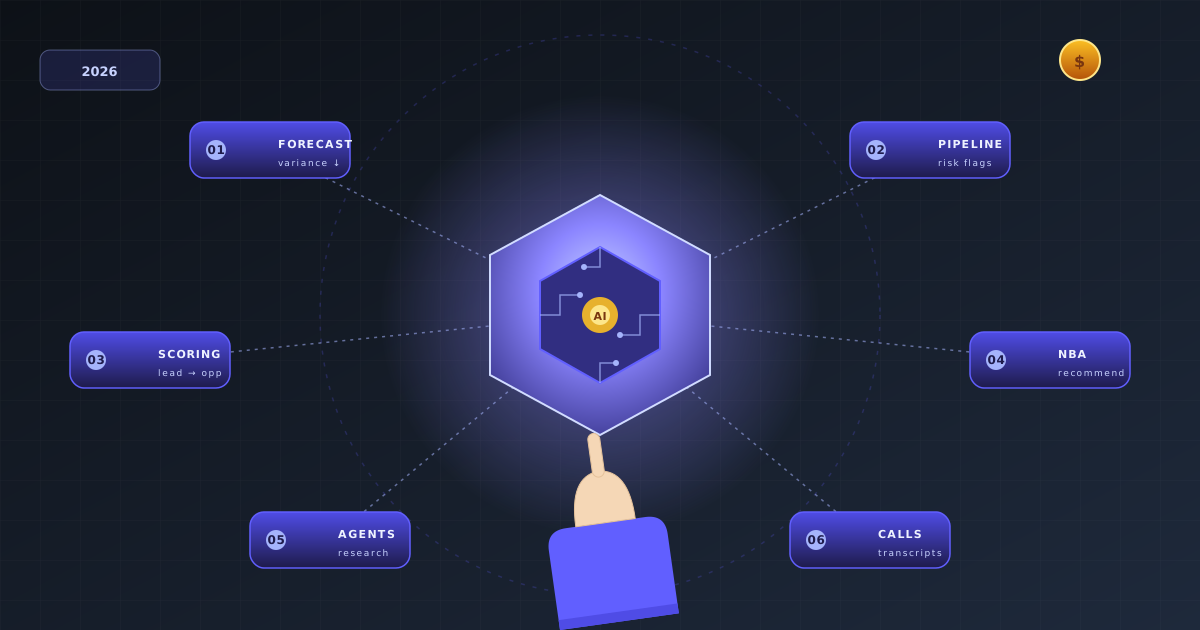
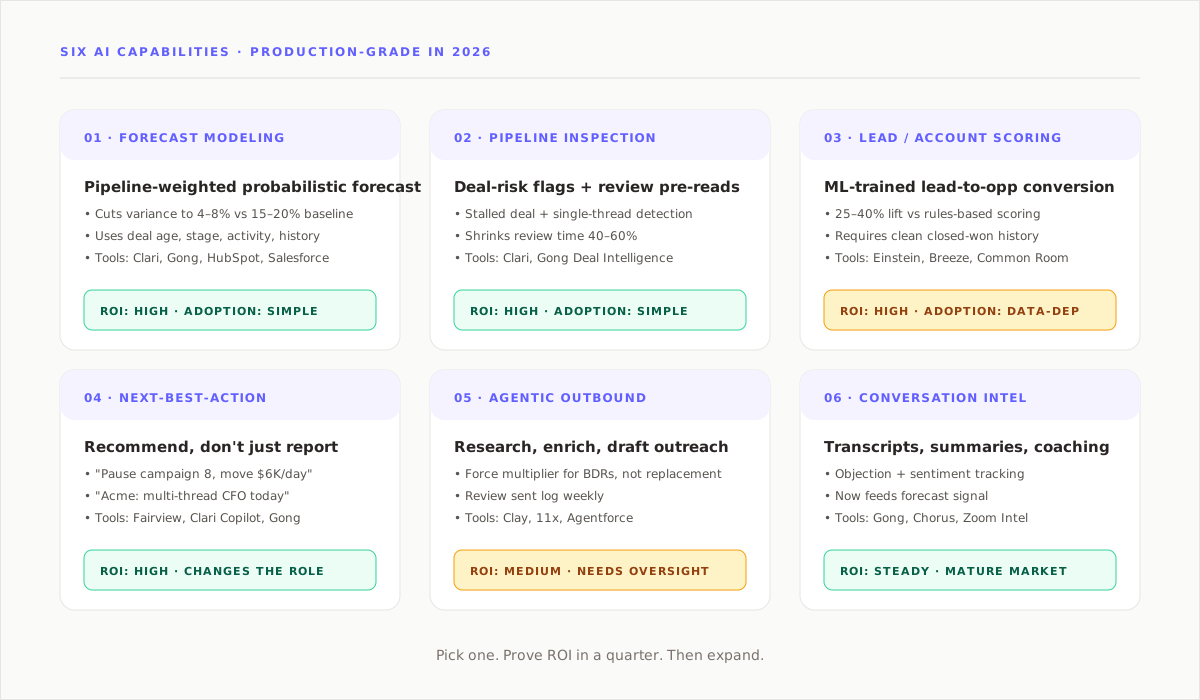
- AI in revenue operations is past the hype cycle. Six capabilities are production-grade in 2026: forecast modeling, pipeline inspection, lead scoring, next-best-action, agentic outbound, and conversation intelligence.
- The job of RevOps is shifting from reporting on last week to recommending this week’s actions. AI does the extraction; humans do the governance.
- Three myths still burn teams: AI fixes bad data, AI replaces pipeline reviews, and agents can run outbound unsupervised. All three are false.
- Start with one capability that has clean data already. Prove ROI in a quarter. Expand. Avoid rolling out five capabilities at once.
- Fairview sits at the operating layer: it joins CRM, billing, and ad data, and applies AI to surface pipeline risk and next-best actions that a rep or operator can execute on directly.
Two years ago every RevOps vendor promised AI. Most of it was a chat window bolted onto a dashboard. In 2026 the picture has sharpened: a smaller set of capabilities actually works in production, the ROI is measurable, and the teams that have adopted them have noticeably shifted what RevOps spends its week doing.
This is the operator’s view, not the vendor pitch. I have spent the last year watching growth-stage B2B and D2C teams deploy AI in revenue operations at different maturities. Some of it works astonishingly well. Some of it is a $40K annual subscription producing slides. The gap is almost always in where the AI is applied and how much CRM hygiene sits underneath it.
This pillar walks through the six AI capabilities that now belong in a serious RevOps stack, the three myths still burning teams, what the role of the RevOps analyst actually looks like in 2026, and a practical adoption roadmap. It anchors the Cluster 4 AI & RevOps hub on getfairview.com, with spokes on RevOps vs Sales Ops, forecasting methods, and closed-won analysis.
What “AI revenue operations” actually means
Definition
AI revenue operations: the application of machine learning, LLMs, and agentic systems to the full revenue engine — pipeline, forecast, scoring, retention, and GTM execution — with the goal of shifting RevOps from retrospective reporting to prospective recommendation.
The definition matters because the term gets used in two incompatible ways. One camp means “we bolted a summarizer onto Salesforce.” The other means “we rebuilt forecast and next-best-action around probabilistic models.” Only the second one actually changes how a company operates.
Real AI RevOps sits at the operating layer. It reads pipeline, retention, spend, and usage data across systems. It produces a recommendation. A human approves or adjusts. The CRM or billing system executes. Loop closed, measurable, governable.
The six capabilities that are production-grade in 2026
1. Forecast modeling
The most mature use case. Probabilistic forecast models take pipeline stage, deal age, activity signals, and historical close rates and output a forecast with a confidence interval. Best-in-class B2B SaaS teams using these tools have cut forecast variance from roughly 15–20% to 4–8% against commit (see Gong’s 2024 forecasting benchmarks). The math is not new; the accessibility is. What required a data science team in 2021 is a native feature in Clari, Gong Forecast, and HubSpot in 2026.
2. Pipeline inspection and deal risk
AI flags stalled deals, single-threaded accounts, missing meetings, and deals with probability/stage mismatches. A pipeline review that used to take four hours of VP Sales time now starts with a pre-read that highlights the 12 deals worth talking about. The ROI is not in the flags themselves but in where the conversation starts.
3. Lead and account scoring
Supervised ML scoring models trained on closed-won outcomes outperform rules-based scoring by 25–40% in most benchmarks (HubSpot, Salesforce Einstein public case studies). The gain comes from letting the model learn interactions between firmographic and behavioral signals that humans would not encode by hand. The prerequisite is a clean closed-won history — which is where most teams hit their first wall.
4. Next-best-action (NBA) recommendations
The shift from a dashboard to a recommendation. Instead of showing that contribution margin fell 4 points this week, the system writes: "Meta Prospecting contribution margin dropped 4 points this week. Driver: CPA up $14 on Campaign 8. Recommendation: pause Campaign 8, reallocate $6K/day to Campaign 12." Rep-facing NBA does the same for deals: "Acme deal has not had a multi-thread in 18 days. Recommendation: send FAQ to CFO."
5. Agentic outbound research and enrichment
Tools like Clay, 11x, and the new Salesforce Agentforce stack have made account research, enrichment, and initial outreach a per-account automated workflow. The business case is clear on high-volume outbound SMB and mid-market motions. It gets shakier for enterprise, where the research an AE needs is deeper than any agent currently produces. Treat this as a force multiplier for BDRs, not a replacement.
6. Conversation intelligence
The oldest of the six. Call transcription, summary, objection tracking, and coaching flags from Gong, Chorus, and Zoom Intelligence. Mature, boring, valuable. Where it gets newer in 2026 is the integration with forecasting — a deal where the champion used the word “budget” three times on the discovery call is worth more than a deal where that word never appeared, and the forecast model knows it.
Key insight
The common thread across all six: AI takes over the extraction work. The human keeps governance, judgment, and the decision to act.
How the RevOps job actually changes
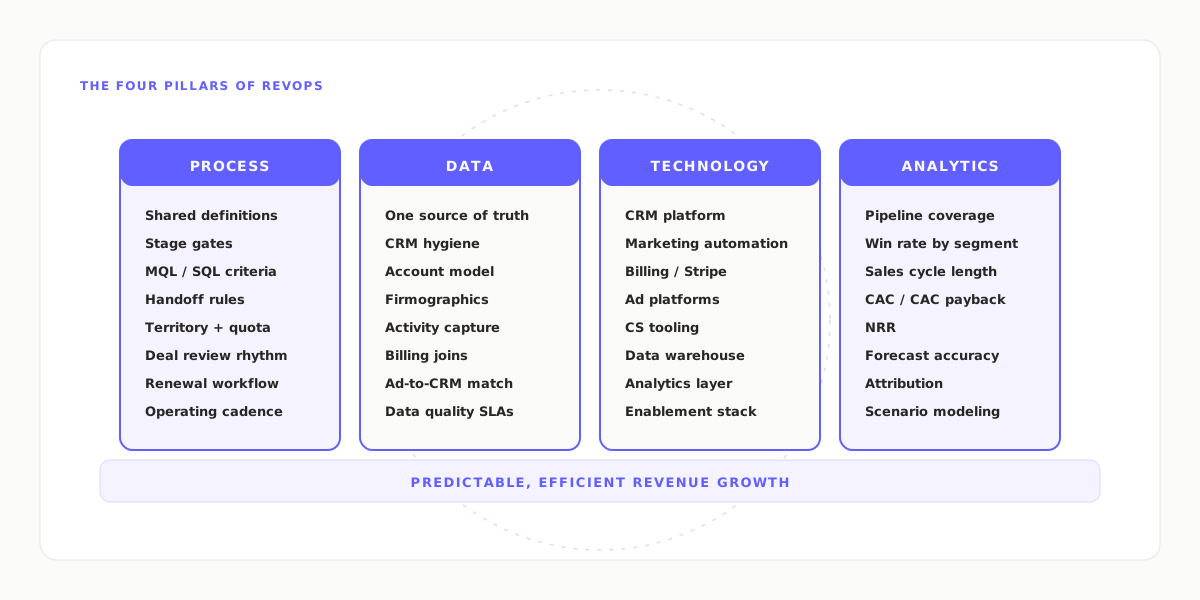
AI does not replace RevOps. It changes what RevOps spends its time on. Three shifts dominate:
- Less reporting, more decision architecture. Fewer hours on “build the weekly pipeline dashboard.” More hours on “define the thresholds that trigger a next-best-action.”
- Less data wrangling, more data governance. The model is only as good as the inputs. The RevOps team owns the schema, the definitions, and the audit trail for the signals an AI model consumes.
- Less retrospective, more prospective. “What happened last week” becomes the shortest meeting of the week. “What should we do this week” becomes the longest.
Teams that do not make this shift end up with a $40K Clari subscription that only the head of RevOps uses. Teams that do make it end up with weekly commit calls where the AE opens with the AI-surfaced risks instead of defending them.
The three myths still burning teams
- “AI will fix our CRM data.” It will not. Models amplify the data they are trained on. Dirty closed-won data produces dirty lead scores. Budget CRM hygiene before AI scoring, not after — see the Cluster 2 piece on RevOps vs Sales Ops for the function that owns it.
- “Forecast AI replaces pipeline reviews.” It does not. It changes where the review starts. The conversation shifts from “what is the number” to “which deals does the model disagree with us on, and why.” Skip the review and the model drifts.
- “Agents can run outbound unsupervised.” Maybe for SMB, for one quarter, before the lift-off delivery penalties kick in. Treat agentic outbound as a BDR tool, not a BDR replacement. Review the sent-email log weekly, minimum.
A practical adoption roadmap
The worst adoption pattern is “stand up five AI capabilities at once.” It guarantees none of them get governed properly and all of them get blamed when a quarter slips. A working sequence:
- Month 0–1: Audit the data. CRM hygiene, closed-won history, stage definitions. If closed-won is dirty, stop and fix that first.
- Month 1–3: Deploy one capability. Pick forecast or pipeline inspection — the two with the clearest ROI and the smallest data prerequisites. Run it alongside the human process for a full quarter.
- Month 3–6: Measure and govern. Compare the AI forecast to actuals. Compare AI-surfaced deal risk to closed-lost causes. Adjust thresholds. The RevOps team owns this review.
- Month 6–9: Add the second capability. Usually scoring or NBA, building on the first capability’s data foundation.
- Month 9–12: Extend to the rest of the engine. Agentic outbound, conversation intelligence, retention scoring — layered on now that the muscle exists.
Quote-ready
The teams that got AI RevOps right in 2026 all did the same boring thing first: they cleaned the CRM before they turned on the models.
What to measure to know it is working
- Forecast variance vs commit. Should drop by 5–10 points within two quarters of a forecast AI rollout.
- Pipeline review time. Should drop 40–60% as AI pre-reads surface the deals worth discussing.
- Lead-to-opp conversion by score band. Should show a clean ladder. A flat curve means the model is not learning.
- Rep time on admin. Should drop from ~30% of the week to ~15% for reps using conversation intelligence and NBA prompts.
- Time-to-first-action on deal risk flags. Should be under 48 hours. If it is not, the system is producing alerts nobody acts on.
How Fairview fits into AI revenue operations
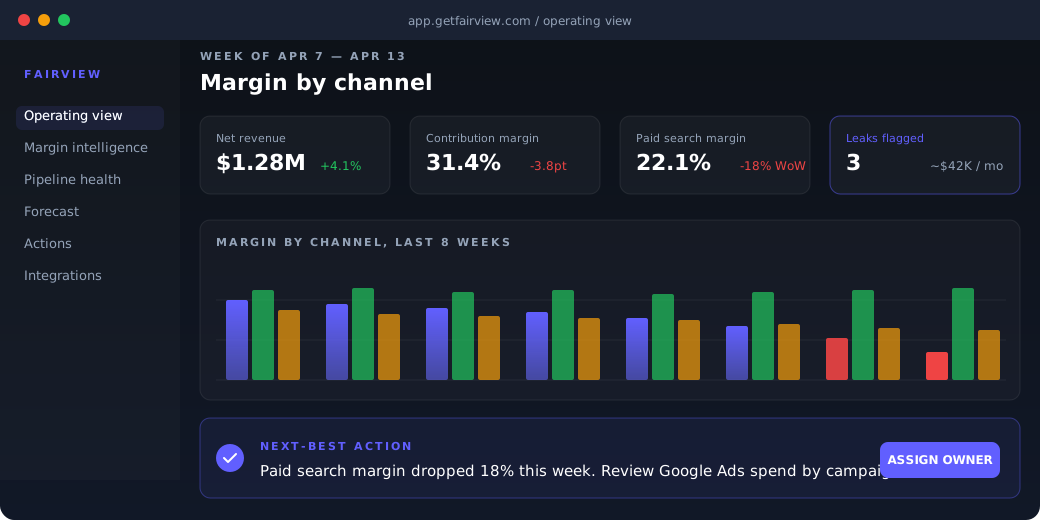
Fairview is not a forecast point solution or a conversation intelligence tool. It sits at the operating layer: it connects HubSpot, Salesforce, Pipedrive, Stripe, QuickBooks, Xero, Shopify, Google Ads, Meta Ads, and HubSpot Marketing Hub via native OAuth, joins the data, and applies AI to surface pipeline risk, margin leaks, and next-best actions. The operating view shows the connections and outputs in one place.
When a metric moves past a configured threshold, Fairview writes a named next-best action: "Mid-market bottom-up forecast gap widened to 17% this week. Driver: Stage 4 close rate dropped from 51% to 38%. Action: review discovery quality on the five deals flagged below." Rep-executable, operator-reviewable, model-governed.
See pricing and tiers for the plan that fits your stack.
6 capabilities
Production-grade in 2026
10 min
To connect source systems
10
Native integrations live today
Key takeaways
- AI revenue operations has six production-grade capabilities: forecast, pipeline inspection, scoring, NBA, agentic outbound, conversation intelligence.
- The RevOps job shifts from reporting to decision architecture and governance.
- Three myths still cost teams real money: AI fixes bad data, AI replaces reviews, agents run themselves.
- Adoption works best one capability at a time, starting with forecast or pipeline inspection.
- Measure forecast variance, pipeline review time, conversion ladder, and time-to-first-action on flags.
Put AI RevOps to work without a data-team project.
Connect HubSpot or Salesforce, Stripe, and the ad platforms. Fairview joins the data and surfaces next-best actions on day one. 14-day trial, no card required.
Frequently asked questions
AI is changing RevOps across six production-grade capabilities in 2026: forecast modeling, pipeline inspection, lead and account scoring, next-best-action recommendations, agentic outbound and research, and conversation intelligence. The common thread is a shift from retrospective reporting to prospective recommendation, with humans owning governance and execution decisions.
Not meaningfully. AI removes the hours a RevOps analyst spent wrangling CRM exports and rebuilding the weekly dashboard. The role shifts toward decision architecture, scoring governance, model evaluation, and system design. The headcount does not shrink; the work it does becomes more senior and more leveraged.
Forecast accuracy and pipeline risk detection tend to return the highest measurable ROI. Both cut forecast variance and shrink pipeline review time. Lead scoring and next-best-action recommendations follow close behind. Agentic outbound and conversation intelligence have real value but require more human oversight to deliver it safely.
Forecast platforms like Clari and Gong Forecast, pipeline and deal inspection tools, conversation intelligence from Gong and Chorus, agentic outbound research from Clay and 11x, Salesforce Einstein and Agentforce, and HubSpot’s Breeze AI. The embedded CRM features have caught up to the point that most growth-stage teams do not need best-of-breed on every capability.
Three. First, that AI will fix bad CRM data; it will amplify it. Second, that forecast AI replaces the pipeline review; it changes the starting point, not the need. Third, that agentic outbound can run unsupervised; the deliverability penalties and brand damage show up quickly. Budget CRM hygiene before models, and review agent-sent traffic weekly.
Start with one capability that already has clean data. Forecast AI or pipeline inspection are the usual first picks because the ROI is measurable inside one quarter. Run the AI alongside the human process, measure variance drop and review time drop, then expand to scoring or NBA. Rolling out five capabilities at once guarantees none get governed properly.