.svg)
TL;DR
- D2C unit economics are the per-customer metrics that decide whether a brand makes money on every order or just on the last one.
- The eight must-track metrics: CAC, AOV, contribution margin, CAC payback period, LTV, LTV:CAC ratio, repeat purchase rate, and the blended-vs-paid CAC gap.
- Use contribution margin, never gross margin. Gross margin ignores shipping, fees, and returns — the exact costs that kill D2C unit economics.
- Healthy benchmarks: LTV:CAC ≥ 3.0, CAC payback < 12 months, first-order contribution margin > 0, repeat rate > 35% at month 6.
- Fairview calculates contribution margin and CAC payback per channel and per cohort once your Shopify, Stripe, and ad platforms are connected — no spreadsheet rebuild required.
D2C unit economics are the per-customer and per-order metrics that tell a direct-to-consumer brand whether each unit sold makes money or quietly loses it. Get them right and growth compounds. Get them wrong and scale just amplifies the loss per order.
Half the D2C founders looking at a 3.2x ROAS on Meta every morning are losing money on every shipment. The dashboard looks healthy because ROAS ignores COGS, shipping, payment fees, returns, and fulfilment — a full 40–60% of order revenue in most categories. Unit economics are what reveal the gap between "the ad worked" and "the business worked."
This guide covers the eight unit-economic metrics every D2C operator must track, how to calculate each one without the usual shortcuts, benchmark ranges by category, and the diagnostic rubric for spotting a leak before it reaches the P&L. Pair it with profit-leak detection, contribution margin by channel, and CAC payback period.
What are D2C unit economics?
Definition
D2C unit economics: the per-customer and per-order financial metrics that reveal whether each unit a direct-to-consumer brand sells generates profit or consumes cash. The purpose is to know — before scaling spend — whether more volume helps or hurts the business.
Unit economics answer the only question that matters at scale: does the 10,000th order look better than the 1,000th? If contribution margin per order is positive and improves with scale, growth compounds. If it is negative or flat, every dollar of growth spend is funded by the previous one.
Most D2C founders can quote their ROAS to two decimals and cannot tell you their first-order contribution margin. That asymmetry is why so many seven-figure brands blow up on the scale-up.
The eight D2C unit economics to track
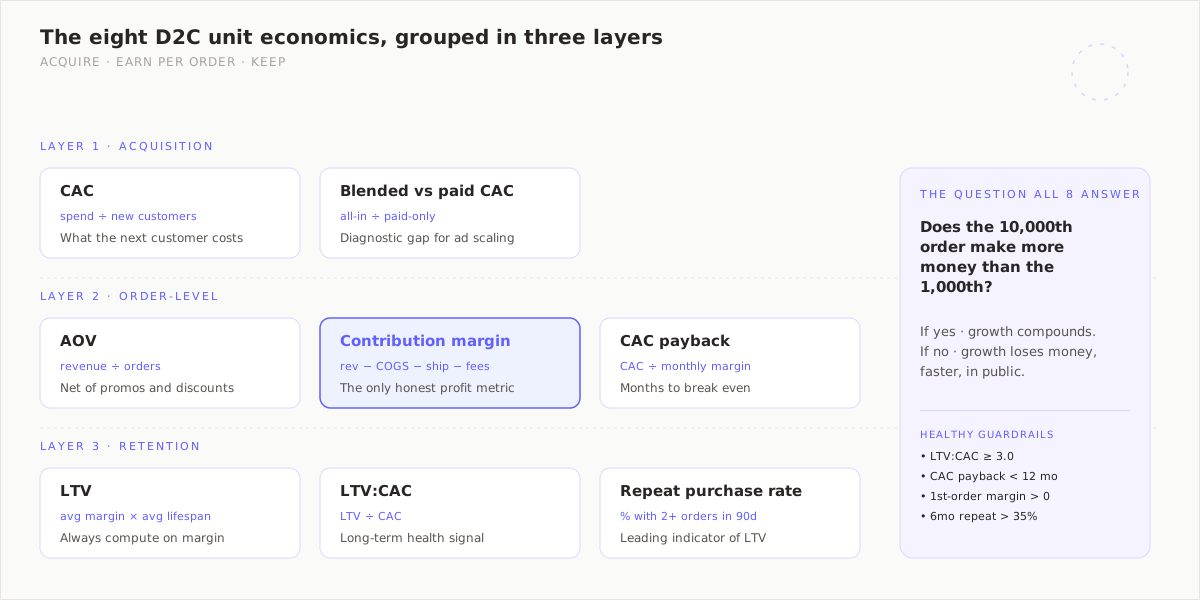
The eight metrics cluster into three layers. Acquisition metrics tell you what the next customer costs. Order-level metrics tell you how much profit each order delivers. Retention metrics tell you how many orders you earn from that customer over time.
| Metric | Formula | Layer |
|---|---|---|
| CAC | Acquisition spend ÷ new customers | Acquisition |
| Blended vs paid CAC | Total spend ÷ all new vs paid only | Acquisition |
| AOV | Revenue ÷ orders | Order-level |
| Contribution margin | Revenue − COGS − shipping − fees | Order-level |
| CAC payback | CAC ÷ monthly contribution margin | Order-level |
| LTV | Avg contribution margin per customer × avg lifespan | Retention |
| LTV:CAC ratio | LTV ÷ CAC | Retention |
| Repeat purchase rate | % of customers with 2+ orders in 90 days | Retention |
Acquisition metrics: CAC and the blended-vs-paid gap
CAC (customer acquisition cost) is total acquisition spend divided by new customers in the same window. Looks simple. The mistake brands make is deciding what goes in the numerator. Does it include creative production? Influencer fees? Affiliate commissions? Salaries of the growth team? Pick a definition, document it, do not change it mid-quarter.
Blended CAC divides total marketing spend by all new customers, including organic. Paid CAC uses paid spend divided by paid-acquired customers only. The gap between the two is a diagnostic in its own right: a brand with $45 blended CAC and $110 paid CAC is being carried by brand equity and organic referrals, not by the ad account.
Key insight
When paid CAC drifts 2x above blended CAC, you are no longer scaling on ads — you are paying Meta to take credit for customers the brand would have acquired anyway.
Order-level metrics: AOV, contribution margin, CAC payback
Average order value (AOV) is revenue per order. The honest version strips out discount codes, shipping charges, and taxes. Gross AOV is what the ad account optimises toward. Net AOV is what your margin actually depends on. The gap between them is the discount tax, and most brands forget to track it.
Contribution margin is the only order-level profitability metric that matters. Revenue minus COGS, shipping, payment processing, returns, and variable support. In most apparel and beauty D2C, contribution margin sits between 35% and 55% of gross revenue. In food and consumables, closer to 15–35%.
CAC payback period is CAC divided by monthly contribution margin per customer. It tells you how many months the business is floating each acquisition before it is profitable. Under 12 months is healthy for D2C subscription. Best-in-class is under 6. The pillar on CAC payback period covers the cohort view in detail.
Retention metrics: LTV, LTV:CAC, repeat rate
Lifetime value (LTV) is average contribution margin per customer multiplied by average customer lifespan. Do not use gross revenue. A customer who spent $400 gross but cost $260 to serve has $140 of LTV, not $400. Using gross revenue is the single most common unit-economic error in D2C decks.
LTV:CAC ratio is the long-term health signal. A 3:1 ratio means every dollar of acquisition spend produces three dollars of downstream contribution. Below 2:1, the business is subsidising growth. Above 6:1, the business is under-investing in acquisition and leaving demand on the table.
Repeat purchase rate at month 3, month 6, and month 12 is the leading indicator of LTV. If month-6 repeat rate drops from 38% to 28%, LTV is about to follow. Most brands notice the LTV drop two quarters too late because they only track it annually.
D2C unit economics benchmarks
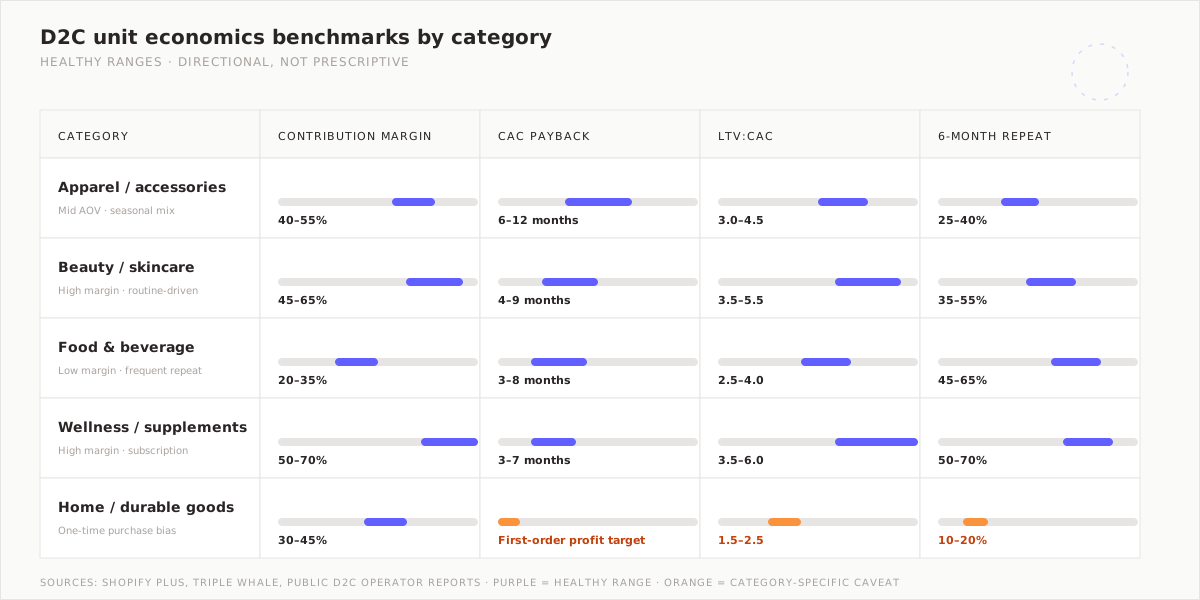
Benchmarks drawn from composite data published by Shopify Plus, Triple Whale, and public D2C operator reports. Treat the numbers as directional — category and brand positioning move them meaningfully.
| Category | Contribution margin | CAC payback | LTV:CAC | 6mo repeat |
|---|---|---|---|---|
| Apparel / accessories | 40–55% | 6–12 mo | 3.0–4.5 | 25–40% |
| Beauty / skincare | 45–65% | 4–9 mo | 3.5–5.5 | 35–55% |
| Food & beverage | 20–35% | 3–8 mo | 2.5–4.0 | 45–65% |
| Wellness / supplements | 50–70% | 3–7 mo | 3.5–6.0 | 50–70% |
| Home / durable goods | 30–45% | First-order | 1.5–2.5 | 10–20% |
Quote-ready
D2C unit economics should be tracked weekly, not quarterly. Most leaks hide in a two-week CPM swing that never makes it into the monthly board deck.
Five mistakes that wreck D2C unit economics
Almost every broken D2C P&L traces to one of these. None of them are difficult to fix — they are just rarely caught before the trend is deep.
- Using gross margin instead of contribution margin. Shipping, fees, and returns are 8–15% of revenue. Ignoring them overstates profitability.
- Quoting ROAS without contribution margin. A 3.2x ROAS on a product with 38% contribution margin is breakeven, not profitable. The spreadsheet lies.
- LTV calculated on gross revenue. Same mistake as above, scaled across the customer lifetime.
- Tracking blended CAC only. When paid scales faster than organic, blended CAC masks the real marginal cost of growth.
- Ignoring repeat rate until it has dropped. Repeat rate is the leading indicator. LTV is lagging. Wait for LTV and you are two quarters late.
How Fairview tracks D2C unit economics automatically
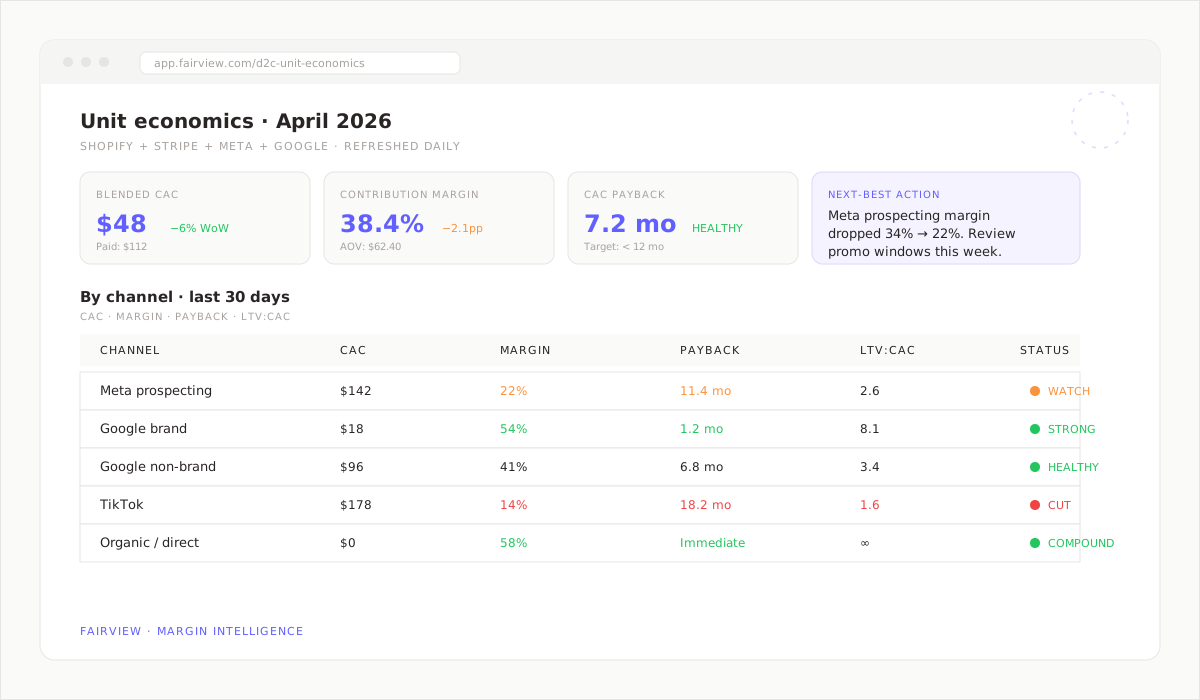
Fairview connects to Shopify, Stripe, QuickBooks, Xero, Google Ads, Meta Ads, and the rest of the D2C stack via native OAuth. Once connected, the Margin Intelligence layer pulls revenue from Shopify and Stripe, cost data from QuickBooks or Xero, and ad spend from the platforms — then attributes the spend to the orders to compute contribution margin per channel, per SKU, and per acquisition cohort.
When contribution margin on a channel drops week-over-week, Fairview writes a named next-best action: "Meta Prospecting contribution margin dropped from 34% to 22% this week. Driver: AOV fell from $62 to $49 after BFCM cohort landed. Review creative mix or promo windows."
See pricing and tiers for the plan that fits your stack.
Per SKU
Contribution margin, not just revenue
Per cohort
LTV and repeat rate by acquisition month
Daily
Refresh across every channel
Key takeaways
- Eight metrics, three layers: acquisition, order-level, retention.
- Contribution margin — not gross margin — is the only honest order-level metric for D2C.
- Track blended and paid CAC separately. The gap is a diagnostic.
- LTV:CAC 3:1 healthy, 4:1+ best-in-class. Below 2:1 is a growth subsidy.
- Repeat rate is leading, LTV is lagging. Watch repeat rate weekly.
See your D2C unit economics per channel, per cohort, every day.
Connect Shopify, Stripe, and the ad platforms. Fairview returns contribution margin, CAC payback, and LTV:CAC on day one. 14-day trial, no card required.
Frequently asked questions
D2C unit economics are the per-customer and per-order metrics that reveal whether each unit sold by a direct-to-consumer brand actually makes money. The core set is customer acquisition cost, average order value, contribution margin, CAC payback period, lifetime value, LTV:CAC ratio, repeat purchase rate, and the gap between blended and paid CAC.
Healthy LTV:CAC for D2C subscription brands is 3:1 or better. Best-in-class brands run at 4:1 or higher. Below 2:1 you are funding growth rather than compounding it. Above 6:1 usually signals under-investment in acquisition — there is demand at higher CAC that the brand is leaving unserved. Both LTV and CAC must be computed on contribution margin, not gross revenue.
Contribution margin, always. Gross margin subtracts only COGS and misses shipping, payment fees, returns, and variable support — collectively 8 to 15% of revenue in most D2C categories. Running CAC payback or LTV on gross margin overstates profitability by roughly 20–40%. Contribution margin is the only metric that matches what actually hits the bank account.
Blended CAC divides total marketing spend by all new customers acquired — organic and paid combined. Paid CAC divides paid spend by only the customers acquired through paid channels. Paid CAC is the honest answer for ad-scaling decisions because it reflects the marginal cost of buying the next customer. When paid CAC drifts more than 2x above blended CAC, the brand is paying Meta or Google to take credit for organic traffic that would have converted anyway.
Weekly at the channel and cohort level, monthly at the blended level, quarterly at the board level. D2C unit economics move fast — CPM swings, promo cycles, SKU mix shifts, and seasonality all change the numbers inside a week. Monthly-only reviews miss the trend before it becomes the problem. Channel-level contribution margin and weekly repeat-rate checks are the two non-negotiable weekly rituals.
From the first $50K of monthly revenue. Below that the sample is too small for any individual metric to be statistically stable, but the direction still matters — a brand losing money on the first order at $30K/month is going to lose more money at $300K/month. The earlier unit economics get tracked honestly, the fewer bad quarters follow the scale-up and the easier the Series A conversation becomes.