.svg)
TL;DR
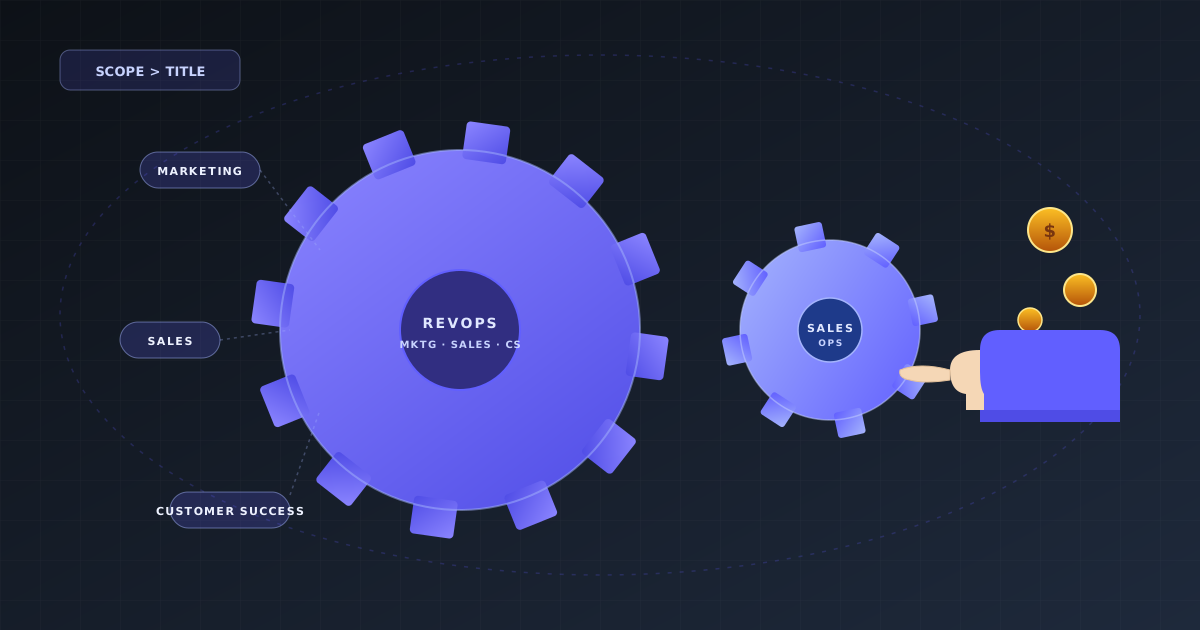
- Sales Operations supports one team — sales. Revenue Operations supports the full revenue engine: marketing, sales, and customer success.
- Sales Ops owns CRM hygiene, quotas, comp, and pipeline reporting. RevOps owns that plus marketing attribution, CS retention systems, and the joined forecast.
- Hire Sales Ops at roughly 5–10 reps. Move to a RevOps model when forecasts from marketing, sales, and CS start disagreeing in leadership meetings.
- RevOps does not replace Sales Ops — it absorbs it, along with marketing ops and CS ops, under a single revenue leader.
- The practical blocker to either function is usually data, not headcount. Fairview joins the source systems so whichever function exists can work from one truth.
Someone always asks it around Series A. The VP Sales wants a Sales Ops hire. The COO wants a Head of RevOps. The founder wants to know whether those are the same job. They are not, and hiring the wrong one burns six to nine months.
The short version: Sales Operations is a function inside Sales. Revenue Operations sits above Sales, Marketing, and Customer Success, and holds all three accountable to one joined view of the revenue funnel. The confusion comes from the middle years of a company, when one person is doing both jobs and the title has not caught up to the scope.
This guide walks through the four real differences — scope, ownership, metrics, and team fit — and gives a plain rule for which function a growing company actually needs. It is a companion to the Cluster 2 posts on CAC payback and the operator toolkit in finding profit leaks.
What is Sales Operations?
Definition
Sales Operations: the function that makes the sales team more productive. Owns CRM configuration, quota setting, compensation plans, territory design, pipeline reporting, and sales enablement tooling. Reports to the VP Sales or CRO.
Sales Ops is a sales-team function. Its customers are the AEs, BDRs, and sales managers. Its job is to remove every operational obstacle between a rep and a closed-won deal: stuck records in the CRM, unclear territory rules, comp plans that confuse the field, and pipeline dashboards that nobody trusts.
A good Sales Ops leader can tell you the win rate by segment, the average cycle time by product line, the coverage ratio heading into the quarter, and which stages of the funnel are leaking. That is already a lot of work. It stops at the sales team’s door.
What is Revenue Operations?
Definition
Revenue Operations (RevOps): the function that runs the full revenue engine end to end. Covers marketing operations, sales operations, and customer success operations as one team with one data model, one forecast, and one set of KPIs. Reports to a Chief Revenue Officer, COO, or CEO.
RevOps exists because growth-stage companies kept running three disconnected ops functions — one under the CMO, one under the VP Sales, one under the VP CS — and the numbers never reconciled. Marketing would report 400 MQLs. Sales would say 40 of those were real. Customer Success would notice half of the converted accounts churned in the first six months. Every function had its own dashboard and nobody had the picture.
RevOps stitches the picture back together. The mandate is simple: one revenue funnel, one forecast, one system of record for every customer-facing interaction. In practice that means joining marketing automation with the CRM with the CS platform with billing, and building KPIs on top that every GTM leader has to accept as ground truth.
Key insight
Sales Ops optimizes a single motion. RevOps owns the conversions between motions. That is the whole difference, and it is why the roles do not compete — they stack.
The four differences that actually matter
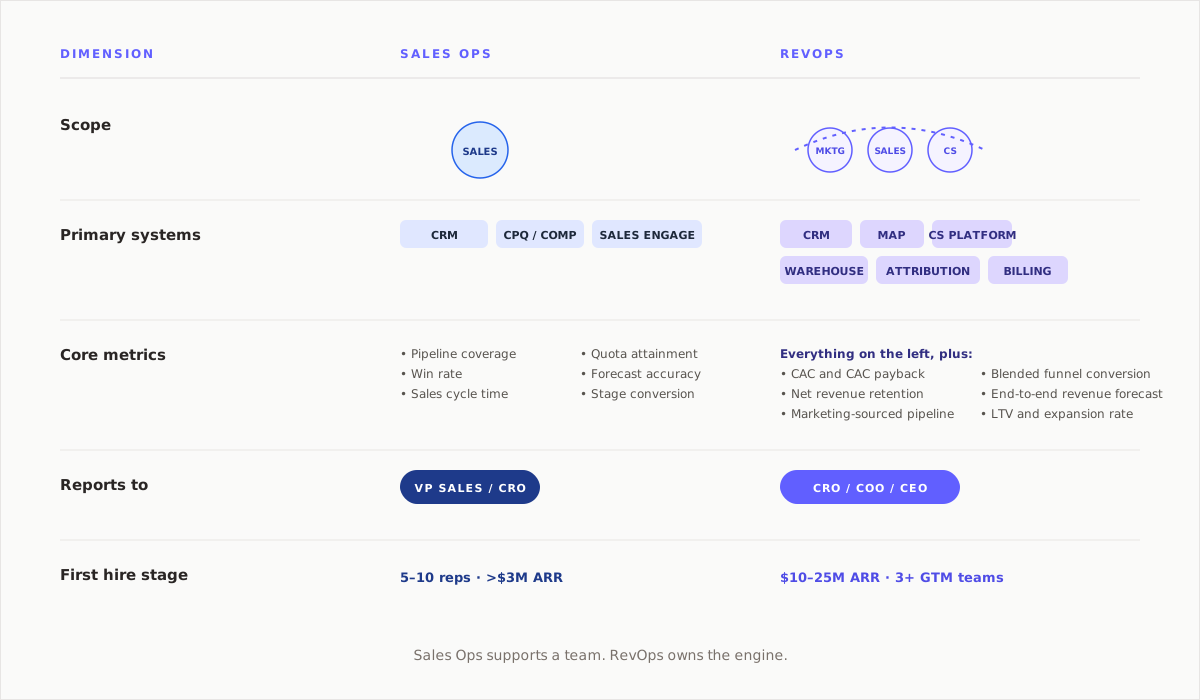
| Dimension | Sales Ops | RevOps |
|---|---|---|
| Scope | Sales team only | Marketing + Sales + CS |
| Primary systems | CRM, sales engagement, CPQ, comp | CRM + MAP + CS platform + warehouse + attribution |
| Core metrics | Pipeline coverage, win rate, cycle time, quota attainment | Those plus CAC, payback, NRR, blended funnel conversion, forecast accuracy |
| Reports to | VP Sales / CRO | CRO, COO, or CEO |
| Typical first hire stage | 5–10 reps, >$3M ARR | $10–25M ARR, 3+ GTM teams |
A company with a five-person sales team does not need a Head of RevOps. It needs someone who can clean the CRM and stand up a usable pipeline dashboard. A company with 40 sales reps, a demand gen engine, and a CS team that owns expansion cannot survive on Sales Ops alone, because the handoffs between those three teams are where revenue gets lost.
Which one does your company need right now?
Three tests. If any two fire, the answer is RevOps. If none fire, start with Sales Ops.
- The forecast disagreement test. If marketing, sales, and CS each report different numbers in leadership meetings and the CEO is doing reconciliation in a spreadsheet, you need RevOps.
- The handoff test. If MQL-to-SQL conversion has no owner, or if post-sale onboarding data does not flow back to the account owner, the gap is between functions. Sales Ops cannot fix it because the problem is not inside sales.
- The attribution test. If nobody can tell you which marketing channel produced which closed-won deal with a straight face, the tooling and the data model live across functions that Sales Ops does not control.
Companies that hire RevOps too early usually end up with a senior operator building CRM reports for three reps. Companies that hire Sales Ops too late lose a full quarter to forecast misses that a dedicated person could have caught. Neither mistake is fatal. The bigger issue is hiring one when you need the other, because the work lands on a person whose instincts point somewhere else.
How the org chart evolves
The typical growth-stage progression:
- Seed / <$1M ARR. No ops function. The founder or first rev leader does it on Sundays.
- $1–3M ARR. A sales-aware generalist joins — sometimes titled Sales Ops, sometimes Business Operations. Priority is a clean CRM.
- $3–10M ARR. Sales Ops is formalized under the VP Sales. Marketing Ops usually sits under the CMO separately.
- $10–25M ARR. A Head of RevOps gets hired, often by rolling up Sales Ops, Marketing Ops, and the analytics function under one leader. The reporting line moves to the CRO or COO.
- $25M+ ARR. RevOps specializes internally into Sales Ops, Marketing Ops, CS Ops, and Revenue Analytics — all still under one umbrella.
Quote-ready
RevOps does not replace Sales Ops. It gives Sales Ops a manager, three peers, and a shared data model.
The real constraint: data, not headcount
Both functions fail for the same structural reason: the source data lives in six different systems and nobody has the patience to join it. A new RevOps hire spends three months rebuilding a Snowflake pipeline from HubSpot, Salesforce, and Stripe before they can ship a single insight. A new Sales Ops hire spends two months cleaning duplicate accounts before anyone trusts the pipeline report.
That is the work that actually eats the quarter. Tooling that joins the source systems up front changes what the function can do in month one instead of month six.
How Fairview gives RevOps and Sales Ops the same ground truth
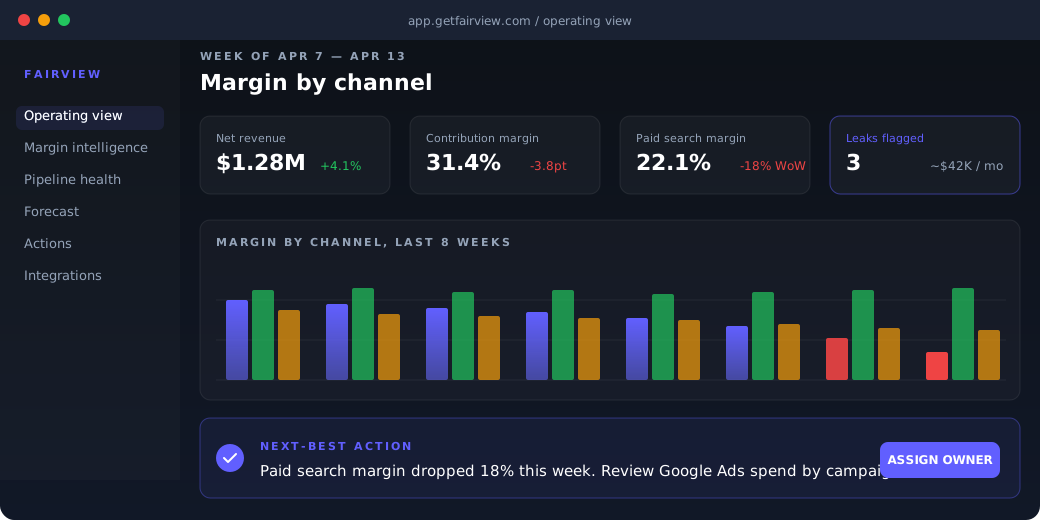
Fairview connects to HubSpot, Salesforce, Pipedrive, Stripe, QuickBooks, Xero, Shopify, Google Ads, Meta Ads, and HubSpot Marketing Hub via native OAuth. Connection takes about ten minutes. Once the sources are linked, the operating view returns pipeline health, forecast confidence, and the next-best actions for each GTM motion — without a warehouse project.
For a Sales Ops leader, that means pipeline coverage, stage conversion, and rep attainment live on day one. For a RevOps leader, the same view extends to marketing-sourced pipeline, CAC payback, and net revenue retention — so the forecast conversation uses one number per motion, not three.
See pricing and tiers for the plan that fits your stack.
One view
Pipeline, forecast, retention joined
10 min
To connect the source systems
10
Native integrations live today
Key takeaways
- Sales Ops supports sales. RevOps supports marketing, sales, and CS as one engine.
- Sales Ops owns CRM, quota, comp, pipeline. RevOps adds attribution, retention, forecast.
- Hire Sales Ops at ~5–10 reps. Move to RevOps at ~$10–25M ARR or when forecasts disagree across teams.
- RevOps absorbs Sales Ops; it does not replace it.
- The true constraint is joined data, not headcount.
Give your Sales Ops or RevOps team one source of truth.
Connect HubSpot or Salesforce, Stripe, and the ad platforms. Fairview returns one pipeline, one forecast, and one retention view on day one. 14-day trial, no card required.
Frequently asked questions
Sales Operations supports the sales team. It owns CRM configuration, quota setting, compensation, territory design, and pipeline reporting. Revenue Operations covers the full revenue engine end to end, which means marketing, sales, and customer success. RevOps typically reports to a CRO, COO, or CEO; Sales Ops reports to the VP Sales.
No. RevOps is a broader mandate that absorbs marketing ops and CS ops alongside sales ops under a single revenue leader. Sales Ops is a sub-function focused on the sales motion. Some companies rebrand a senior Sales Ops leader as Head of RevOps without expanding the scope, which tends to confuse the org rather than help it.
Hire Sales Ops when the sales team reaches roughly five to ten reps and pipeline hygiene is breaking down. Move to a RevOps model somewhere between $10M and $25M ARR, when marketing, sales, and customer success use disconnected systems and the forecast numbers stop agreeing across teams.
Sales Ops owns the CRM, sales engagement platforms, CPQ, and compensation tools. RevOps owns all of those plus marketing automation, customer success platforms, the data warehouse joins between them, attribution models, and the shared forecast. In a RevOps org, Sales Ops still owns its sales-specific tooling — it just reports into the broader function.
Not usually. In most growing companies, Sales Ops becomes a specialist function inside a broader RevOps team. Its focus narrows to sales-team productivity, quota and comp, CRM hygiene, and pipeline reporting. The attribution, retention, and forecast layers become RevOps responsibilities because they span functions Sales Ops never controlled.
Sales Ops tracks pipeline coverage, win rate, sales cycle time, rep attainment, and forecast accuracy for the sales motion. RevOps tracks all of those plus CAC, CAC payback, net revenue retention, marketing-sourced pipeline, end-to-end funnel conversion, and blended forecast across marketing, sales, and CS.