.svg)
TL;DR
- CAC payback period is the number of months it takes for contribution margin from a new customer to recover the cost to acquire them.
- Formula: CAC ÷ monthly contribution margin. Use contribution margin, not gross margin.
- D2C target: under 12 months (best-in-class < 6). SaaS target: under 18 months (best-in-class < 12).
- A long payback does not kill the business — high churn during payback does.
- Fairview calculates CAC payback per channel and per cohort once your ad spend, CRM, and Stripe data are connected.
CAC payback period is the number of months it takes for the contribution margin from a new customer to cover the cost of acquiring them. It is the most honest unit-economic metric a D2C or SaaS operator can track — because until the payback clock hits zero, growth is burning cash rather than compounding it.
Every growth-stage operator has watched a board deck where LTV:CAC looks beautiful and cash still leaks. The usual culprit: a 24-month payback window hiding inside the averages. Revenue eventually catches up; the problem is the 24 months of working capital the business has to float to get there.
This spoke gives you the formula D2C and SaaS operators actually use, benchmarks by model, a cohort-based payback curve, and the two questions you must ask before a long payback is acceptable. It is a companion to profit leak detection, contribution margin by channel, and true ROAS.
What is CAC payback period?
Definition
CAC payback period: the number of months it takes the contribution margin generated by a new customer to equal the cost of acquiring them. Lower is better. It tells you how long working capital is committed per acquisition before the business starts making money on that customer.
Payback is a cash metric, not a profit metric. It does not answer "is this customer profitable eventually?" — that is LTV:CAC. Payback answers "how long until we stop funding this customer?"
For D2C brands burning cash on Meta and Google, the difference matters enormously. A 14-month LTV at 3.5x LTV:CAC is still terrifying if payback is 11 months and monthly churn is 8% — half the cohort is gone before the business has recovered its acquisition spend.
The CAC payback formula
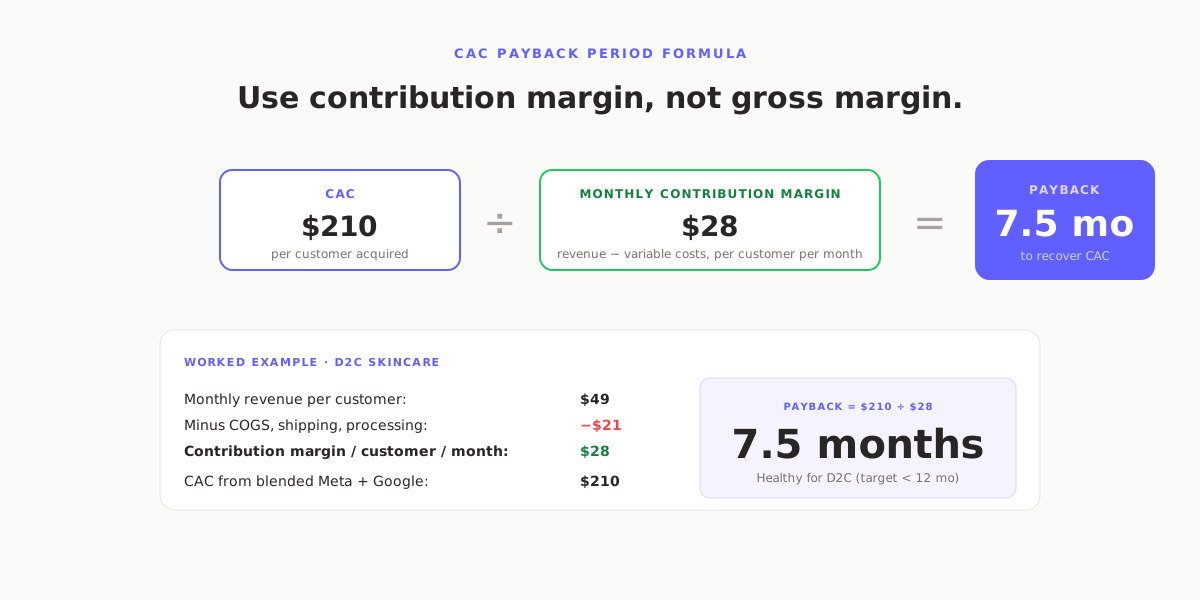
Formula:
Worked example from the diagram. A D2C skincare brand sells a $49/month subscription. COGS, shipping, and processing deduct $21, leaving $28 of monthly contribution per customer. Blended CAC from Meta + Google sits at $210. Payback = $210 ÷ $28 = 7.5 months. Healthy for D2C.
Key insight
Use contribution margin, not gross margin. Gross margin ignores ad spend, shipping, and processing — the exact costs that make a channel expensive to acquire from.
Contribution vs gross margin payback
Most SaaS benchmarks (Bessemer, OpenView) use a gross-margin version of the formula: CAC ÷ (ARR per customer × gross margin). That is fine when COGS dominates the cost stack — hosting, support, and third-party APIs. It is wrong for D2C, where fulfillment and ad spend attribution matter as much as COGS.
| Metric | Subtracts | Best for |
|---|---|---|
| Gross-margin payback | COGS only | Pure SaaS, enterprise |
| Contribution-margin payback | COGS + shipping + fees + variable support | D2C, hybrid, commerce |
| Cash payback | Everything including overhead allocation | CFO / board reporting |
Default to contribution-margin payback. It is the most operator-useful version because it drives weekly ad allocation decisions, not just board narratives.
The cohort payback curve
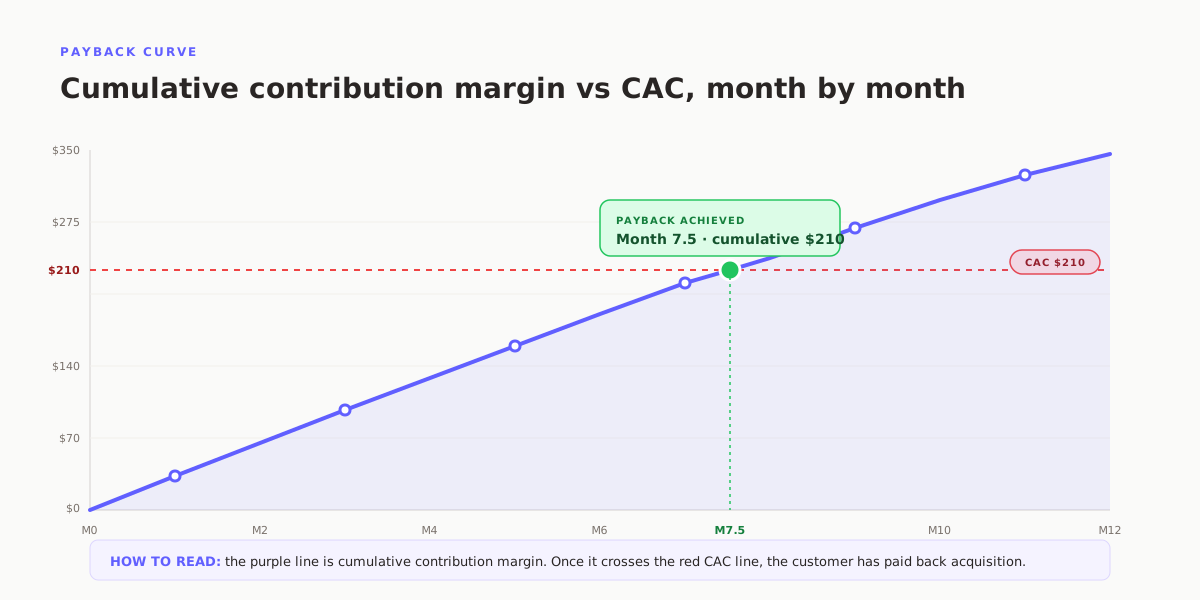
Averages lie. Measure payback per cohort. Group customers acquired in the same month, then track their cumulative contribution margin over time. Payback lands where the curve crosses the CAC threshold.
Cohort curves reveal what blended numbers hide:
- Channel mix drift. Paid social cohorts pay back slower than organic cohorts — if your paid mix grew, blended payback lengthened even though nothing else changed.
- Promo tax. Cohorts acquired during BFCM or big discount windows have lower first-order margin, so payback stretches even when CAC is flat.
- Churn timing. If 30% of a cohort churns before month 6, half of those acquisition dollars never get recovered.
- Product quality shifts. A change in the flagship SKU can silently drop contribution $2–3 per customer per month — enough to add 1–2 months of payback.
Benchmarks by business model
| Model | Healthy | Best-in-class | Review below |
|---|---|---|---|
| D2C subscription | 6–12 months | < 6 months | > 14 months |
| D2C one-time purchase | First-order payback | First-order profit > 0 | Losing on first order |
| SMB SaaS | 12–18 months | < 12 months | > 24 months |
| Mid-market SaaS | 18–24 months | < 18 months | > 30 months |
| B2B services | 3–6 months | < 3 months | > 9 months |
Benchmarks are directional, not prescriptive. A 14-month payback can be fine if gross retention is 95% and NRR is 120%. A 6-month payback can be dangerous if annual churn is 55%. Payback is a health indicator, not a goal.
Two questions before accepting a long payback
Long payback windows are only acceptable under two conditions. If neither is true, the payback is a leak disguised as a growth engine.
- Retention is high enough to outlive the payback window. If payback is 14 months, monthly churn must stay below roughly 5% to guarantee most of the cohort is still paying at month 14. Below that threshold, compute the expected payback on the fraction of customers who actually remain.
- The business has the cash to fund the window. A 12-month payback committing $500K/month in ad spend means $6M of working capital is tied up before any of it comes back. Confirm the runway supports the commitment at your target growth rate, with 3 months of buffer.
Quote-ready
A 12-month payback is not a problem. A 12-month payback at 8% monthly churn is a bonfire.
How Fairview tracks CAC payback automatically
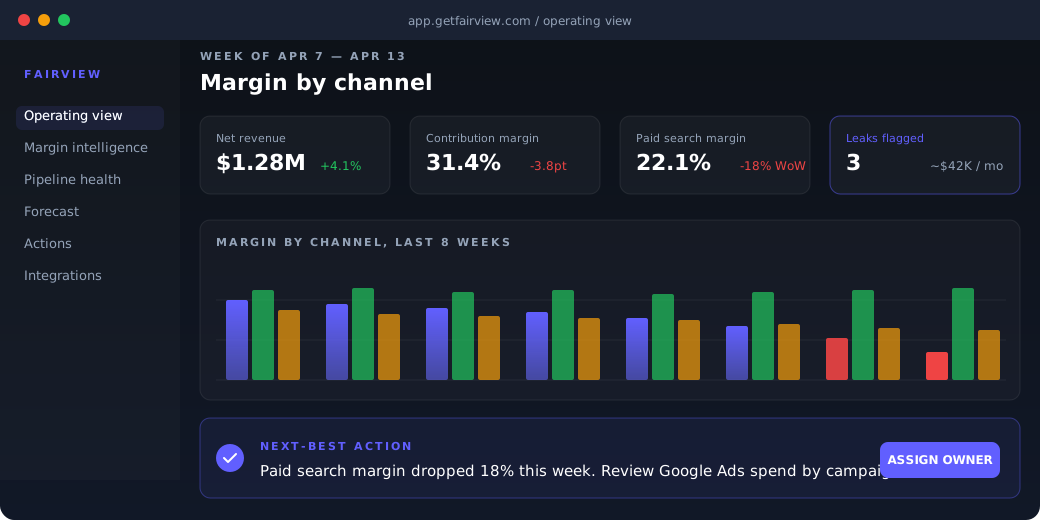
Fairview connects to HubSpot, Salesforce, Pipedrive, Stripe, Shopify, QuickBooks, Xero, Google Ads, and Meta Ads via native OAuth. Once connected, the operating view reconstructs acquisition cohorts, attributes CAC per channel, and tracks cumulative contribution margin against the CAC line week over week.
When a channel’s payback window stretches past your configured threshold, Fairview writes a named next-best action: "Meta Prospecting payback stretched from 8.2 to 11.4 months this cohort. Monthly contribution dropped from $34 to $27. Likely driver: AOV down from $58 to $49. Review landing-page mix."
See pricing and tiers for the plan that fits your stack.
Per cohort
Payback curve, not just averages
Daily
Refresh across channels
10
Native integrations live today
Key takeaways
- CAC payback = CAC ÷ monthly contribution margin.
- Contribution margin beats gross margin for D2C.
- Measure per cohort, not blended — averages hide mix drift.
- D2C healthy < 12 months. SaaS healthy < 18 months.
- Long payback is acceptable only when retention is high and runway is confirmed.
See your CAC payback per channel, per cohort.
Connect Stripe or Shopify, HubSpot, and the ad platforms. Fairview returns your first cohort payback curve on day one. 14-day trial, no card required.
Frequently asked questions
Divide customer acquisition cost by monthly contribution margin per customer. Contribution margin is revenue minus COGS, shipping, payment fees, and variable support for that customer. The result is the number of months it takes a new customer to repay what you spent to acquire them.
Under 12 months for D2C subscription brands, with best-in-class under 6. For one-time purchase D2C, the goal is first-order profitability — if the first order does not clear acquisition cost plus fulfillment, the business is funded by future orders that may or may not happen. Anything over 14 months deserves an immediate channel-by-channel review.
Contribution margin, especially for D2C. Gross margin subtracts only COGS and misses shipping, processing fees, and variable support — the costs that most distort D2C unit economics. Contribution margin subtracts all of them, so the payback number reflects the actual cash recovery per customer rather than a hypothetical one.
LTV:CAC asks whether the customer is worth acquiring in the long run. CAC payback asks how long the business has to fund that acquisition before the money comes back. A 3.0x LTV:CAC with an 18-month payback can still crush cash flow at scale; a 2.2x LTV:CAC with a 5-month payback compounds fast. Use both — they answer different questions.
Yes, but the number you care about is first-order profit. For a pure one-time purchase brand, payback has to happen on the first order or the business depends on reorders that may not come. Track contribution margin per first order versus CAC: if it is negative, either AOV needs to rise, CAC needs to fall, or the model needs a subscription layer to make the economics work.
Monthly at the blended level, weekly per channel, and quarterly per cohort. Blended payback moves slowly. Channel payback moves with CPM changes, creative fatigue, and seasonality. Cohort payback is the ground truth view — only a few months of cohort curves will reveal whether the trend is improving or drifting the wrong way.