.svg)

TL;DR
- Build quota bottom-up from rep capacity, not top-down from the revenue plan. Reconcile the two numbers before you commit.
- Capacity = selling days × meetings per day × opportunity rate × win rate × average deal size.
- Discount raw capacity 15–25% for lumpy or outbound pipelines. Predictable inbound motions can run at 5–10%.
- Segment quota by motion (enterprise, mid-market, SMB, expansion). One universal number hides real gaps.
- Fairview computes capacity-based quota from your CRM and stress-tests it against live pipeline coverage daily.
The worst quota is the one set top-down from a board plan and then pushed onto reps without a reality check. The best quota is built bottom-up from capacity, discounted for variance, and reconciled against the revenue target — in that order. This is how to do it when your pipeline is still lumpy, outbound-heavy, or coming off two uneven quarters.
Most early-stage quota-setting fails for the same reason. Someone picks a revenue number that makes the model work, divides it by headcount, calls it the quota, and spends the next two quarters wondering why attainment is 45%. The pipeline was never going to support the number. Nobody checked before the plan went out.
This spoke walks through the method a capable revenue leader actually uses: size rep capacity from your real win rate and deal size, discount for pipeline variance, segment the number, stress-test it against pipeline coverage, and revisit quarterly. It is a companion to sales forecasting methods, bottom-up vs top-down forecasting, and the sales quota glossary entry.
Why unpredictable pipelines break top-down quota
Definition
Capacity-based quota: the revenue a fully ramped rep can realistically close in a period, given average deal size, win rate, and sales-cycle length. It is the bottom-up floor that any top-down target should be reconciled against, not a replacement for the plan.
Top-down quota works when pipeline is stable. When a team has four quarters of similar booked ARR, low segment variance, and a reliable inbound engine, dividing the revenue plan by headcount is a defensible shortcut. That is not most early-stage or mid-market B2B SaaS teams.
Unpredictable pipelines have three features that break top-down math. Booked ARR swings 25% or more quarter-over-quarter. One large deal can move the number. And the win rate itself is still moving, so any multiplier applied to headcount is a guess stacked on a guess. Setting quota top-down in that environment is not ambition; it is wishful arithmetic.
The fix is not to abandon the revenue plan. It is to build a second number from the bottom up and force the two to meet. When they do not meet, the constraint is usually pipeline volume, not rep effort — and pushing a bigger quota onto the same pipeline is the clearest path to a missed quarter.
The five-step method
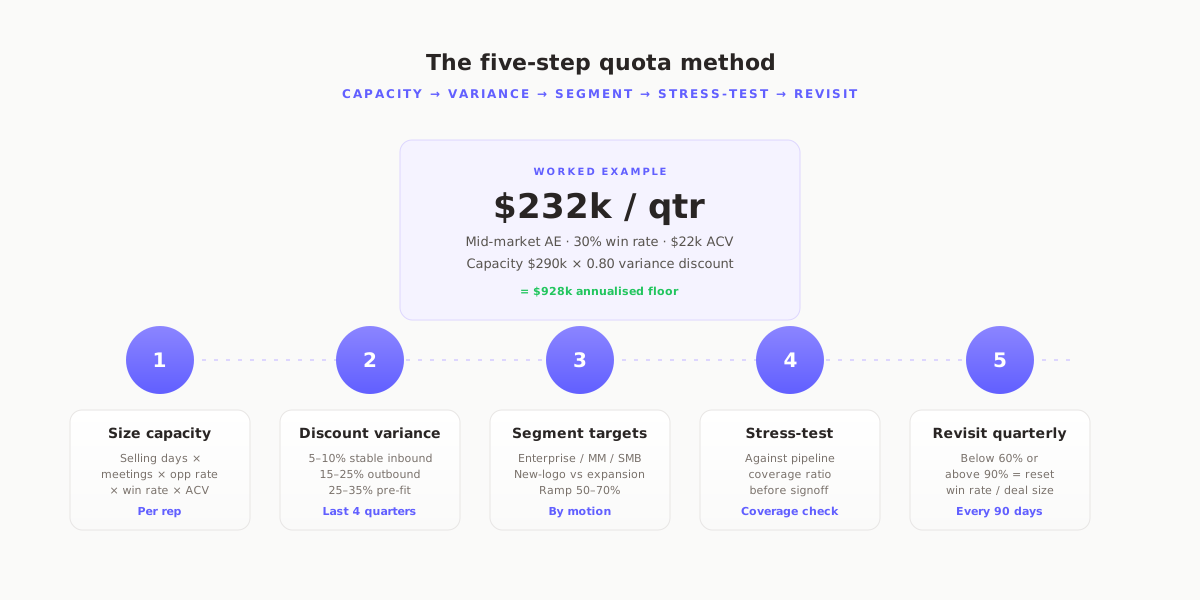
- Size capacity per rep from selling days, meetings, opportunity rate, win rate, and average deal size.
- Discount for variance based on how lumpy the last four quarters actually were.
- Segment the targets by motion (enterprise, mid-market, SMB, expansion) and by ramp stage.
- Stress-test against pipeline coverage before the number gets signed off.
- Revisit quarterly and re-baseline the inputs as win rate and deal size move.
Treat it as five sequential filters. A quota that survives all five is defensible on a board call. One that skips any of them is the reason attainment shows up in the 40s.
Step 1: Size capacity per rep
Formula:
Team capacity = Sum of ramped-rep capacity + (ramping reps × 0.5–0.7)
Worked example. A mid-market AE has 55 selling days in the quarter, runs 2 discovery calls per day, converts 40% of those to qualified opportunities, wins 30% of qualified opps, and averages $22k in ACV. Capacity = 55 × 2 × 0.40 × 0.30 × $22,000 = $290,400 per quarter, or roughly $1.16M annualised.
That number is the upper bound of what a fully ramped rep can deliver at today's win rate and deal size. It is not yet the quota. Any plan that sets individual quota above the capacity number is not a stretch target; it is a structural miss waiting to happen.
Key insight
Capacity is the ceiling, not the target. Quota sits below capacity by the size of your pipeline variance, not above it by the size of your ambition.
Step 2: Discount for pipeline variance
Capacity assumes every input holds. In lumpy pipelines, the inputs do not hold. Meetings slip, opportunities ghost, and deal size swings with the mix. The discount adjusts capacity for the real-world variance your team has actually experienced.
Calculate quarter-over-quarter variance in booked ARR over the last four periods. The simplest form is the standard deviation of quarterly bookings divided by the mean. Translate that coefficient into a capacity discount:
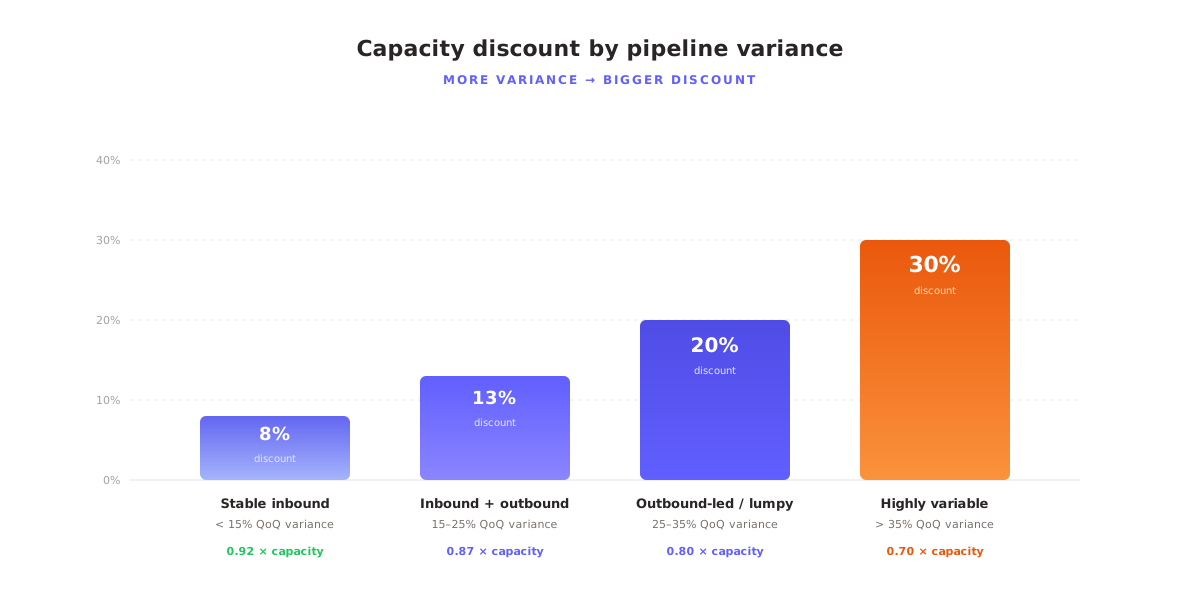
| Pipeline profile | QoQ variance | Capacity discount | Quota / capacity |
|---|---|---|---|
| Stable inbound | < 15% | 5–10% | 0.90–0.95 |
| Mixed inbound + outbound | 15–25% | 10–15% | 0.85–0.90 |
| Outbound-led / lumpy | 25–35% | 15–25% | 0.75–0.85 |
| Highly variable / pre-fit | > 35% | 25–35% | 0.65–0.75 |
In the worked example above, an outbound-led team running at 30% variance would discount $290k capacity by 20% to reach a quarterly quota of roughly $232k, or $928k annualised. That is the defensible starting number, not $1.16M.
Step 3: Segment the targets
A single quota across every rep and segment is the most common self-inflicted miss. Enterprise AEs working $150k deals over 9-month cycles have a completely different capacity profile from SMB reps closing $8k deals in 30 days. One number punishes both.
- Segment by motion. Enterprise field, mid-market, SMB inside sales, and expansion each get their own capacity calculation and their own quota.
- Tier by ramp. Ramping reps carry 50–70% of a full quota for their first two quarters. Forcing 100% on month-three AEs destroys retention and masks a bad onboarding program.
- Separate new-logo from expansion. Expansion closes at 50–65% and moves faster. Mixing it into the same quota makes the new-logo gap invisible until the quarter is already lost.
- Publish the segment math. Reps who can see how their quota was derived argue about the inputs, not the number — which is a better argument to have.
Quote-ready
Quota divided by headcount is not a plan. It is the absence of one.
Step 4: Stress-test against pipeline coverage
A capacity-based quota is internally consistent. It still has to clear one external check: does the current pipeline actually support it? This is where most quota plans quietly break.
Take the team quota for the period. Divide by the historical win rate on qualified opportunities. That is the pipeline coverage the quota implicitly assumes. If your current qualified, in-period pipeline is 40% below that number, the quota is not achievable no matter how the capacity math looks.
Stress-test it three ways. What happens if win rate drops 5 points? What happens if average deal size drops 15%? What happens if the top two opportunities slip a quarter? If the plan falls apart under any of those, the quota is too aggressive for the pipeline it sits on.
Step 5: Revisit quarterly
Win rate moves. Deal size moves. Ramp curves shorten and lengthen. A quota that was right in January is often 10% off by April. Most teams re-baseline annually and adjust segment targets every quarter.
Two signals force a revisit. Team attainment below 60% for two consecutive quarters means the number is disconnected from pipeline, and the fix is almost never "more effort." Attainment above 90% across the board means the quota is too soft and the company is underpaying against plan. Healthy attainment sits around 60–80% of reps hitting, with team attainment near 90–100%.
How Fairview sets capacity-based quota automatically
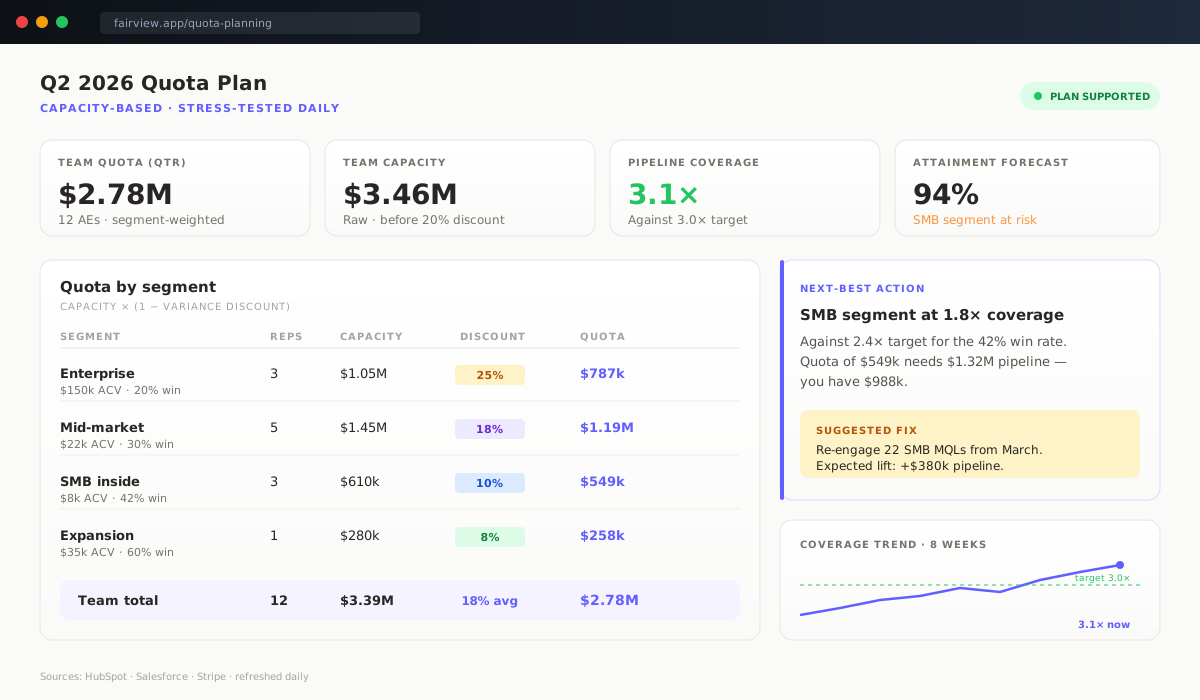
Fairview connects to HubSpot, Salesforce, and Pipedrive and pulls the inputs directly: selling days, meetings booked, opportunity rate, win rate, and average deal size — per rep, per segment. The Pipeline Health Monitor computes capacity-based quota and compares it against the top-down revenue plan, so the reconciliation happens before the plan goes out.
The Forecast Confidence Engine then stress-tests the quota against live pipeline coverage every day, flagging when attainment risk crosses a threshold. When a segment's quota is no longer supportable — because win rate has slipped or pipeline has compressed — you see it in week three, not week eleven.
See pricing and plans for the tier that fits your CRM and team size.
Per rep
Capacity calculated from live CRM inputs
Daily
Quota stress-tested against pipeline coverage
10
Native integrations live today
Key takeaways
- Build quota bottom-up from rep capacity, then reconcile against the revenue plan.
- Capacity = selling days × meetings × opportunity rate × win rate × deal size.
- Discount 15–25% for lumpy or outbound pipelines; 5–10% for stable inbound.
- Segment by motion and tier by ramp. One number across every rep is a planning miss.
- Stress-test against pipeline coverage before signoff, and revisit quarterly.
Build a capacity-based quota your pipeline can actually support.
Connect HubSpot, Salesforce, or Pipedrive. Fairview returns capacity per rep, segment quota, and a daily coverage stress-test on day one. 14-day trial, no card required.
Frequently asked questions
Build quota bottom-up from rep capacity rather than top-down from the revenue plan. Start with selling days, meetings per day, opportunity rate, win rate, and average deal size. Multiply those into a per-rep capacity number, discount by 15–25% for pipeline variance, segment by motion, then stress-test against live pipeline coverage. Reconcile the result with the top-down plan before signing anything off.
A capacity-based quota is derived from what a fully ramped rep can realistically close in a period, given average deal size, historical win rate, and sales-cycle length. It is the bottom-up floor any top-down revenue target should be reconciled against, not a replacement for the plan. When capacity and plan disagree, the constraint is almost always pipeline volume rather than rep effort.
Stable inbound motions can run with a 5–10% discount on raw capacity. Mixed inbound / outbound motions typically need 10–15%. Outbound-led or lumpy pipelines need 15–25%, and highly variable pre-fit motions need 25–35%. Calibrate off your last four quarters of booked-ARR variance, not next quarter's optimism.
No. Enterprise, mid-market, and SMB motions have different win rates, deal sizes, and cycle lengths, so they need their own capacity math and their own quota. Within a segment, ramping reps should carry 50–70% of a full quota in their first two quarters. A single universal number punishes every rep whose segment does not fit the average.
Quarterly. Most teams re-baseline annually and adjust segment targets every quarter as win rate, deal size, and ramp curves move. If attainment sits below 60% for two consecutive quarters the quota is disconnected from pipeline; above 90% across the board it is too soft. Both are signals to re-run the capacity math before the next period begins.
Somewhere between 60% and 80% of reps hitting quota each period, with team attainment around 90–100%. Higher than that signals a quota that is too soft and a company underpaying against plan. Lower signals a quota disconnected from pipeline reality, where the fix is reconciling capacity to plan rather than asking reps to work harder.